
Wobbly Antenna
Dear RV Doctor:
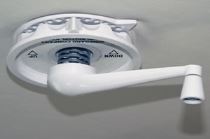
I have a Winegard crank-up “batwing” TV antenna, and when it’s in the up position, it rocks back and forth when the wind blows. Someone told me there’s a tool to adjust the antenna. Do you know what kind of tool this might be and what I have to do to adjust the antenna?
Larry Jackson, Wolcottville, Indiana
Larry, I’m personally not aware of such an adjusting tool. Winegard does have a cable installation tool, but it’s not applicable to your style antenna. Are you sure the gears are not just worn out? Winegard offers a gear replacement kit that probably will help the instability problem caused by worn, old-style gears. You can tell whether you have the older gears by inspecting the cranking rod from inside the RV. Remove the crank handle and spring by loosening the set-screw, and take a look at the shaft that extends down below the ceiling. If the rod is round, it’s the older style; if it’s a hexagon shape, it’s the newer style. But first make sure the antenna is mounted correctly. The base should be attached securely to the roof and sealed properly to prevent water intrusion. The antenna mount must be secured to a solid portion of the roof. If it’s sloppy when fully extended, it’s likely that worn gears are the problem, so have your local RV parts center order the new replacement gears with the hexagon shaft. The instructions for making the swap can be found at www.winegard.com.
Nonstop Refer Operation
Dear RV Doctor:
I have been told that it is better to let an RV refrigerator run all the time, even when the motorhome is not in use. The technician claimed that when the refrigerator is not running, the fumes from the ammonia will cause corrosion and thus will rot the aluminum to the point that it will leak. He said that if the unit is left running all the time, it will not have to be replaced. Any thoughts on this?
Bob Cartwright, Sebring, Florida
Bob, I can’t say I would put much stock in what this technician told you. There are no ammonia fumes associated with the absorption refrigerator. It’s a completely sealed system. Ammonia is corrosive, true, but 90 percent of all leaking cooling cores are the result of moisture intrusion on the outside of the cooling unit pipes, typically inside the foam pack area where it is most difficult for condensation and moisture to evaporate. All the tubing in a cooling unit, by the way, is made from steel, not aluminum. In addition, during the charging process, a chemical called sodium chromate is induced into the sealed system, which coats the inside of the cooling unit tubes, thereby protecting them from any corrosive action of the liquid ammonia.
In my opinion, running the refrigerator when not necessary is basically a waste of energy (120 volts electricity or LP) and puts more wear on the system controls than does starting it up as needed. The life of the heating element likely will be shortened if allowed to run continuously on the electric mode. Plus, when operating on LP, the burner and flue will need to be cleaned more often. If you have a fairly new RV and refrigerator, battery consumption would also be a concern, and the constant operation of the circuit board(s) will also take its toll eventually.
I honestly cannot see where there is anything to gain and there actually may be something to lose by letting the refrigerator operate nonstop. But that’s just my opinion. Basically it goes back to the definition of an RV as put forth by the Recreation Vehicle Industry Association; it’s a vehicle made for “temporary” living. A switch to a household-type compressor-driven refrigerator, however, would be a viable option for those RVers with full-time hookups and no need for LP operation.
Sender Sensibilities
Dear RV Doctor:
Where can I find a fuel sending unit for a 1976 Vogue Type C motorhome?
Chuck Green, San Francisco, California
Chuck, if the maker of your Vogue’s chassis is Dodge, which I suspect it is, I’m guessing the sending unit is a side-mounted model with what is called a 78-ohm wrap. It probably has a single draw tube and no vapor return tube. If the problem you are experiencing with the sender is that it reads empty all the time, the problem may not actually be the sender itself. Here’s how to tell. Use an ohmmeter and measure the resistance at the sending unit. It should measure between 8 and 78 ohms if it is working properly. If indeed it does measure a resistance within the above range, check that the wire running from the sender to the fuel gauge is intact. You can do this quickly and easily by turning the ignition key to the “on” position and touching the sender wire at the tank to a good frame ground. If the fuel gauge goes up past the full mark when that wire is grounded, it ensures the sender wire itself is in good condition.
If the sender does not measure within the above resistance range, it may simply need a good cleaning. After confirming that the fuel level in the tank is well below the side-mounted sender opening, remove the sender and inspect the wire windings (wraps). Use an electrical contact cleaner to remove any corrosion that may be on the windings. Work the float back and forth, making sure the contact cleaner reaches the full travel. This may be all that is necessary.
If the sender still does not register the fuel level properly, chances are a new or rebuilt sending unit is in your future. If you cannot locate a used one at a local automotive recycling yard, contact Transfer Flow Inc. at 800-442-0056, extension 11. They also repair older senders.
{loadpositionEndBlurbHouseCalls}