
Air Conditioner Woes “” Redux
 |
Dear House Calls Readers:
I’ve been known to create a little controversy occasionally within the “House Calls” column “” not often, but every now and then. Well, it seems one of my responses to a question caused several readers to contact me. I indeed appreciate your vigilance and awareness.
Back in the February 2009 issue of Family Motor Coaching, I replied to an inquiry from Autumn Rose, who asked whether it would be okay to plug her motorhome shore power line into her stationary home’s 240-volt clothes dryer outlet for the purpose of testing the rooftop air conditioner (“Air Conditioner Woes,” page 26). I may have misled some readers by providing an incomplete response to Ms. Rose’s request, plus I failed to fully explain my reasons for advising her NOT to plug her motorhome into her home’s dryer circuit. For that, I do apologize.
Because several people asked, I thought it was necessary to revisit the issue and to better explain the reasoning behind my advice that she NOT connect to the dryer circuit. This also provides an opportunity for me to address some of the confusion that apparently exists regarding the alternating current (AC) system found in today’s motorhome.
Before I begin, let me state emphatically that every response in every “House Calls” column is written with the safety of the RVer “” and their motorhome “” as my utmost priority. At no time would I ever endorse a practice or a procedure that would, in any way, compromise safety for either. In fact, I repeatedly teach this very principle to professional RV service technicians as well as RV owners in my seminars and college courses. Plus, you’ll see that caveat in each “House Calls” column. So, it was within the precincts of this safety maxim that I responded to Ms. Rose.
As a brief refresher, here is Ms. Rose’s inquiry:
“The last time my husband and I went camping, our RV air conditioner did not seem to work. The fan would turn on, but the air being blown out would never get cool. The motorhome is only a few years old, and the air conditioner has not seen a lot of use. My husband checked the connections on the A/C and found everything to be perfectly clean and in almost-new condition. We wanted to test it here at home to find out if maybe the outlet at the RV park was bad, or if there is another problem with the air conditioner. We want to know whether we can test the air conditioner by using the 240-volt outlet that our dryer is connected to. We don’t want to damage anything by trying it without some advice on whether that voltage would be sufficient.” “” Autumn Rose.
After reading through the half-dozen or so e-mails I received regarding the topic, I concluded there were some valid points made regarding my failure to fully explain my response. But what raised my interest most was the realization that many people likely do not fully grasp the differences between the AC system that’s used in a stationary residence and the one employed in a motorhome.
I noted some misconceptions in the e-mails I received. One person mentioned that if the dryer outlet in the house was identical to that found in a campground, it would be safe to plug into it. Another indicated that if you have a 50-amp plug on your RV, then your RV electrical distribution system will function the exact same way. Another comment was that 50-amp RV connections are the same as 240-volt connections, and that most RVs with 50-amp service indicate they are for 4-wire, 3-pole, 120/240-volt-AC service, which is exactly the same thing as is provided by a 4-wire dryer outlet. One e-mail noted that 50-amp RVs are 240-volt, just like your home, and the breaker box in these RVs is set up the same way as your home breaker box.
In addition, many readers made assumptions that I could not make in good conscience. For one thing, Ms. Rose did not indicate whether their motorhome is wired for 30-amp service or 50-amp service. One could assume that it is a 30-amp motorhome based on the fact that only one air conditioner was mentioned. Conversely, it could be assumed that it is a 50-amp coach since they looked at the house dryer circuit (typically 4-wire, 240-volt AC) and concluded it might work. But since that information was not included in the question, all I could do is guess. Guessing is a dangerous proposition when the subject system contains potentially lethal ramifications.
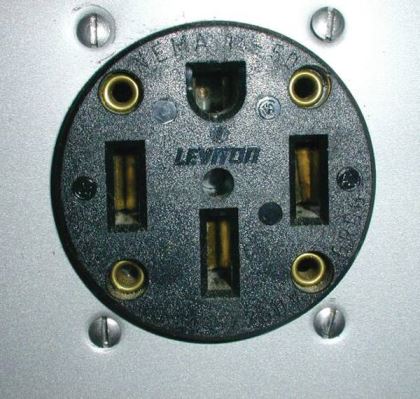
We also would be forced to assume that the dryer circuit in her house indeed included a modern 4-wire, 240-volt-AC receptacle. Prior to the mid-1980s (sorry, I can’t quote the exact date), dryer circuits were not required by the National Electrical Code (NEC) to contain a ground conductor. In other words, the dryer receptacle could very well have only three wires: two legs of 120 volts and a single neutral conductor. Perhaps this is what the Roses viewed at the dryer. Some might suggest simply connecting the ground wire and the neutral wires together in an adapter, but this, too, would be a code violation. The NEC states that the ground circuit in the RV cannot carry electrical current, and the neutral wire in a motorhome indeed carries current.
But the major conflict I have with plugging any motorhome into any house circuit is that typical house wiring and RV wiring differ in a crucial way. In a typical house, the ground conductor is interconnected with the neutral conductor. In an RV, the neutral conductors are ALWAYS isolated from any ground connection. The white and bare wires are never connected and must remain isolated from each other.
I quote from the RV Electrical Systems textbook published by the Recreation Vehicle Industry Association (RVIA), the same book I use to teach RV service technicians:
“In the distribution panelboard there are two terminal strips, or buss bars, for connecting wires. One buss bar (insulated from the box) is for the neutral and the other (screwed to the box) is for the grounds that are grounded to the vehicle chassis. In other words, the white and bare wires are isolated from each other. This ensures the neutral (white) remains ungrounded. If the neutral becomes grounded, while there is also reversed polarity in any circuit, the metal components or chassis of the RV can become energized or “hot.” This condition is extremely dangerous. In a house, the white and ground wire can be connected to the same buss bar since the house electrical system is grounded from the panelboard to a steel ground rod that is driven into the earth. The RV does not have the grounding rod to insure the needed grounding. It depends on the grounding of the land-based supply system that is connected to the RV through the grounding wire of the power supply assembly (shore cord and panelboard).”
Same textbook, different section:
“RVs are wired differently than houses and the differences are based on the grounding system. In an RV, the white or neutral conductor is isolated from the ground conductors. This means there is no electrical interconnection of the white wire and the bare ground wire in the RV. These two wires are not interconnected until connected at the power supply at the park pedestal or other suitable power source. Reverse polarity occurs when the white and black wires are crossed. In an RV, the power supply cord or power supply adaptor plug can provide reverse polarity. This is especially possible where someone cuts off the ground pin of the cord or uses an ungrounded (2-wire) extension cord. In a situation of reverse polarity where there is also a short, the power could be “fed” to the white wire, bypassing the overcurrent protection provided, energizing the exterior skin or other metal parts leading to severe burns or possibly death.”
Same textbook, yet another section:
“An important factor to remember is when working on distribution panelboards, the RV is unlike a house! The RV has the neutral circuit isolated from ground. As explained earlier this is so that reverse polarity could not cause energizing the skin of the RV. The neutral in the distribution panelboard of an RV must always remain isolated from ground. Never attach the bonding strap or bonding screw (comes with a panelboard). These would normally be used in a house panelboard to connect the neutral bar to the distribution panelboard, as grounds and neutrals can be interconnected. If a bonding strap or bonding screw is present in a distribution panelboard intended for use in the RV, it should be immediately discarded.
Note: If the neutral is not isolated from ground in an RV, a serious hazard could exist.”
I find it interesting that in three separate sections of the same textbook, the point is made concerning the importance of the isolated neutral wire in an RV. And keep in mind, the reversed condition mentioned above can occur within the motorhome itself, within the house wiring, within the pigtail adapter, or within any extension cord or motorhome power cord. The same thing can happen in any campground, too, although it’s more commonly found at older RV parks.
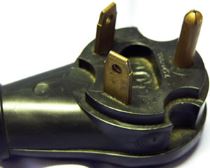
For the sake of education, let’s make a couple of assumptions. First, let’s say that Ms. Rose’s motorhome is indeed a 50-amp coach and she only has a problem with the air conditioner. To plug into the residential dryer circuit, an adapter connection would be required, since the 50-amp plug configuration is different from all dryer receptacles, regardless of amperage. It’s quite common to find miswired electrical adapters (typically they are imported and cheaply constructed) and often they are assembled with undersized conductors and/or internal connectors. Wires and/or connection points that are too small can cause severe overheating issues. Also, more than likely an extension cord will be necessary to reach from the motorhome to the dryer receptacle. In my house, I would need a 100-foot extension cord! Again, voltage drop and undersized conductors would be a safety concern. The voltage drop in any long electrical run using an undersized extension cord feeding a high-load appliance is hazardous. Low voltage is especially harmful to rooftop air conditioners. (Don’t forget, troubleshooting the air conditioner was the original intent of the question.)
But what if she has a 30-amp coach? This can present even more issues. First of all, the 30-amp plug at the end of the shore power cord is configured to a pattern found only on recreation vehicles. You’ll never see the RV 30-amp plug pattern used in any house circuit, unless it was specifically installed by a licensed electrician exclusively for an RV hookup. It will most certainly not be used for a dryer circuit. So, like the 50-amp cord, an adapter will have to be employed to connect the motorhome to the dryer circuit. The main issue here is that because the 30-amp RV plug is exclusive to the RV industry, all such adapters would have to be “homemade.” Again, safety concerns prohibit me from recommending that any do-it-yourselfer, no matter how electrically educated, simply “wire up” an adapter to connect a 120-volt RV to a 240-volt dryer circuit. That would be totally irresponsible on my part. If any miswiring exists in the motorhome, the adapter, or the dryer circuit, severe damage to the 120-volt components on the motorhome could result.
But I do have to concur with many of those who took the time to contact me that IF the conditions were right; IF the dryer circuit were wired correctly; IF the correct pigtail adapter were sized appropriately and wired correctly; and IF there were no reversed wiring conditions anywhere within the RV or any associated connections or extension cords, then, yes, it would be plausible to connect the RV to a home dryer circuit. But with so many “IFs” to consider and so many “unknowns” that would need to be made known, I could not have responded differently given the information provided.
So, I am not saying it is never okay to plug your motorhome into a residential outlet. It might be fine provided all the wiring is correct, the correct adapters are used, the voltage is within the proper range, and the polarity is correct. But you should never plug into any receptacle without first measuring the voltage and checking the polarity at the very least. If you own an older home (built prior to 1984 or so), I suggest having an electrician check the house wiring to be sure it is correct and that the receptacle is properly grounded prior to plugging in. Also, if you know you will be connecting to your house electric regularly, you probably should consider having a dedicated motorhome receptacle installed.
Returning to the safety aspect for just a moment, consider that by NOT plugging the motorhome into an undefined dryer circuit, no safety concern was compromised, no one was hurt, and no equipment was damaged. If I would have stated, “Sure, go ahead and plug it in “” RVs and homes are wired exactly the same,” a dangerous incident may have occurred, and I most certainly would have created a bigger problem for the Roses and possibly for anyone who may have read the column and tried to do the same thing. However, I do concede that I could have crafted a better response, although I still believe the problem is more than likely an internal air conditioner pressure issue rather than an electrical input issue. What I certainly did not want to see is a 30-amp motorhome plugged into a 240-volt circuit. To find out the consequences of that combination, read on.
240 Volts!
Dear RV Doctor:
I attempted to create a 30-amp plug off of my house for my grandmother’s National RV motorhome. I did not do a good job of explaining to my electrician what I needed, and he hooked up a 240-volt connection instead of a 120-volt connection. When I plugged the motorhome into the connection, we heard popping noises and then there was smoke. What should I expect to have burned up?
Steve Hulls, Jacksonville, North Carolina
Steve, I’m so sorry to hear about that miswiring. Unfortunately, many items onboard the motorhome could be affected. Virtually all the 120-volt-AC devices need to be carefully checked: refrigerator, microwave oven, GFCI, convertor, air conditioner, inverter, television, circuit breakers, receptacles, etc. Most assuredly, some devices will have been harmed, but it takes special troubleshooting procedures and special testing equipment to fully evaluate the situation.
In the meantime, do not plug the coach into any AC source until the unit can be thoroughly tested by a certified RV service technician. In addition to the individual components, the wiring itself should be hi-pot tested to reveal damage to the insulation on any circuit. Again, all of these tests should be performed by a competent, well-equipped RV shop employing RVIA/RVDA-certified RV technicians.
It’s unfortunate, but you’d be surprised how often this actually happens. The first and second rules before plugging into any park power pedestal or home receptacle are to measure the voltage and check for the proper polarity. I say this not to rub salt into your wound but as a reminder to the other readers. Extremely high or low incoming voltage and reversed polarity are indeed hazardous! If the smoke was noticed quickly and the coach disconnected soon enough, there is a good chance the damage will be minimal; however, the aforementioned tests should still be performed to be sure.
{loadpositionEndBlurbHouseCalls}