
Dear RV Doctor:
I’m wondering whether I’m better off using two 6-volt batteries wired in series or one 12-volt battery. I’ve heard a variety of reasons why it’s better and why it’s not. What is your opinion?
David Yue, North Andover, Massachusetts
You’ll find this topic both cussed and discussed often! My take? Replacing 12-volt batteries with 6-volt batteries usually will increase the capacity to store amperage, so I’m a fan of using true deep-cycle 6-volt batteries whenever possible. And the reason for my decision really boils down to simple math. As an example, two Group 24 (12-volt) batteries connected in parallel will yield approximately 170 combined amps of storage (about 65 amps each). Two Trojan 6-volt batteries wired in series will yield approximately 225 amps at 12 volts. The more batteries you add, obviously the more current you’ll be able to store. Four 6-volt batteries wired into a series-parallel configuration, as another example, will provide about 450 amp-hours of use. Even if you had two larger, Group 27 (12-volt) batteries in parallel, they total only about 210 amps, still less than two 6-volt golf cart batteries connected in series.
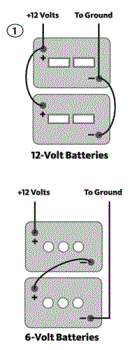
When connecting two 6-volt batteries in series, attach the hot lead (from the RV) to the positive post of one battery and the negative lead, or ground connection, to the negative post of the second battery, as depicted on the left in Illustration 1. A short section of battery cable will connect the negative post of the first 6-volt battery to the positive post of the other 6-volt battery, completing the 12-volt configuration.
Realize that at the basic level, all DC components found in today’s production motorhomes are powered by 12 volts. If 6-volt batteries are employed, a minimum of two must be connected together in order to provide the 12-volt output needed. Compare the illustration of two 12-volt batteries wired in parallel at the top of Illustration 1 with two 6-volt batteries connected in series at the bottom.
If you were to connect two 12-volt batteries in series, the output voltage would measure 24 volts. Likewise, two 6-volt batteries connected in parallel would yield only 6 volts. You can see the importance of knowing how your system is wired!
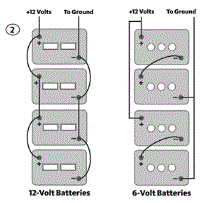 As more batteries are added to a bank of 12-volt batteries, each additional battery is simply wired in parallel. But when adding batteries to a 6-volt bank, they must be added in pairs and wired into a series-parallel configuration.
Check out Illustration 2. In effect, what exists on the right are two sets of 6-volt batteries. Each set contains two 6-volt batteries wired in series, and then the two sets are connected together in parallel. If additional storage capacity is desired, another set of 6-volt batteries can be added. In the series-parallel configuration for 6-volt batteries, remember that they must be added in pairs. You cannot have an odd number of 6-volt batteries in the battery bank. And like their 12-volt cousins, for optimum performance all batteries in any battery bank should be the same type, the same size, and the same age.
RV batteries are a substantial investment, so it makes perfect sense for you to want to get the most out of that investment. My motto has always been: Carry as much battery capacity as you have room for and as your wallet can endure.
Oven Flashback!
Dear RV Doctor:
My propane RV oven experiences regular flashbacks to the air shutter at the back of the oven. I have tried adjusting the shutters to no avail. Do you have any suggestions on how to fix this?
Waldo Warren, Palm Springs, California
As I teach students in my E-Learning RV Program, the first thing to check (or have verified) with any LP appliance issue is the delivery line pressure. LP pressure that is too low or too high can cause a plethora of operational issues with any and all LP-burning appliances. It’s quite possible that your pressure is set too high.
Setting the pressure to the correct level necessitates the use of a manometer, which any quality RV repair center or professional RV service tech will have. Once the LP pressure has been set to 11.0 inches of water column, the next item to check would be the cleanliness of the main oven burner. Most burners can be removed with relative ease. Inspect each of the holes in the burner, looking for ports plugged by cooking greases, an accumulation of oven cleaner, or other debris.
Next, though in the oven it’s rarely adjustable, check that the oven burner assembly is in alignment with the orifice fitting at the safety valve. Any misalignment may cause turbulence inside the mixing tube, similar to problems associated with water heaters. The incoming LP draws in air from inside the oven to be mixed prior to it being consumed by the burner. Another item to check is the orifice fitting itself. It can be removed, soaked in acetone or a like liquid, and then allowed to air dry. Much like the ports in the burner, it is possible that cooking oils may have partially blocked the oven orifice. In addition, oil distillates can accumulate in the manifold on older motorhomes, causing pressure variation as the gas bubbles past the oil. This is easily recognized by fluctuations on the manometer test. Finally, the air shutter should be adjusted so that the main burner flame is steady, with sharp blue points and not lazy or “floating” above the ports. One other cause of your symptom may be a damaged or bent burner assembly. But a close inspection of the burner will reveal if that’s the case.
{loadpositionEndBlurbHouseCalls}