
Up Or Down?
Dear RV Doctor:
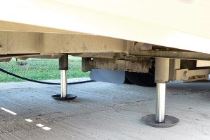
I moved my motorhome to the Oregon coast and will leave it there for two to six weeks between visits. Should the hydraulic levelers be left up or down? When I store it for the winter, six months at a time, I always retract them. Considering the saltwater air near the coast, I would assume they should be up even though it might be for only two weeks. In the park on the coast, I see that some people leave them extended while others have them retracted. Thanks for your help.
Gary Hester, F408872, Meridian, Idaho
To my knowledge, HWH is the only company that allows their levelers to be left extended during winter storage or periods of non-use. Still, your assumption is correct, as salt spray can wreak havoc on the exposed hydraulic cylinders. I’m betting any leveling system manufacturer would recommend the motorhome be stored with the levelers fully retracted to minimize corrosion and contamination when stored near the ocean.
When it comes time to activate the levelers, extend them fully and clean the hydraulic cylinders with a clean cloth dampened with automatic transmission fluid, and wipe them clean afterward. By keeping the cylinders clean, you reduce the chance that corrosion will damage the hydraulic seals or contaminate the system. Actually, the same goes for any type of leveling system, hydraulic or electric. Clean all the moving parts, lubricate according to the manufacturer’s instructions, and store the unit with the jacks/levelers retracted when near salt spray or in dirty, dusty climates.
Cook, Charge, And Drive
Dear RV Doctor:
I have two quick questions about battery use. The first deals with charging while traveling down the road. I have a diesel Gulf Stream mini motorhome with two 12-volt-DC batteries mounted in line. I want to be able to use a small slow-cooker while driving during the day, and then have fully charged batteries when I stop at night. Is this possible? I normally travel with everything turned off, including all propane and other house equipment. I just want to make sure I get there with fully charged house batteries.
Second, I’m planning on getting solar equipment and understand that I have a long road ahead to figure out what my needs and expenses are, and whether to choose a portable panel or a mounted panel. I am heading to Oregon later this year and have heard of a reputable business there that specializes in RV solar equipment. Do you know the name of the company and where it’s located? I would like to stop by and get their evaluation and an estimate of my needs. I sure would appreciate any information you can send my way.
Nancy Swickard, F418742, San Francisco, California
Not being a chef of any kind, I’m assuming your slow-cooker is powered by 120-volt-AC power. To operate the AC circuits in the motorhome as you drive, you’ll either need to run the generator or activate an inverter. I’m not sure whether your motorhome came equipped with an inverter from Gulf Stream, but they are readily available in the aftermarket. I happen to favor the Xantrex line of inverters, but there are certainly other brands from which to choose. For optimum use, you’ll probably need a larger battery bank than simply two paralleled 12-volt batteries.
An inverter draws 12-volt-DC current from a battery bank and “inverts” it to 120-volt AC output. Two benefits of using an inverter are that it’s silent and there are no moving parts other than perhaps a cooling fan. I do recommend using a true sine wave inverter, which, depending on your perspective, can be expensive. In addition, the final capacity of the battery bank along with output potential of the inverter will depend on the amount of the load you’ll need to power. Look for a wattage rating or amperage rating on your slow-cooker or within its documentation.
Some motorhomes are equipped with a small, modified square wave inverter with a dedicated output receptacle, but typically these units are limited in scope and can even cause operational problems with the electronics in some appliances. I always suggest purchasing a true sine wave inverter from a reputable, state-of-the-art manufacturer.
While using the inverter, the battery bank will likely be drawn down, so it also may be necessary to upgrade the automotive alternator to a higher output device. This will ensure you’ll have battery charging capability from the engine alternator while driving. Even so, it is possible that you will run the battery bank down by virtue of the nature of inverter technology. On the upside, with a state-of-the-art charging inverter, the battery bank can be replenished quickly once you connect to shore power. So, depending on the energy load(s) of the appliances in use, you may not arrive with fully charged batteries when using an inverter, but it shouldn’t take long to recharge them once you plug in. It all boils down to the math according to the “sizing” of the devices I mentioned. Proper planning is paramount. If your motorhome has no inverter but is equipped with an onboard generator, using the generator may be your best option.
As to your other question, I, too, am a big fan of photovoltaic (solar) charging. It’s one of the most popular seminars I present at RV shows. Permanently installed panels are my recommendation. But once again, proper planning and sizing of the battery bank, the number of panels, the type of charge controller, the electrical harnesses, etc. will all depend on your needs.
One company I am familiar with is AM Solar in Springfield, Oregon. For more information call (541) 726-1091 or visit www.amsolar.com. I’ve been to their new facility and was quite impressed. As for all the devices I’ve mentioned “” inverters, batteries, charge controllers, solar panels, etc. “” AM Solar will be able to evaluate your system requirements and advise you as to your best recourse once they see your motorhome.
{loadpositionEndBlurbHouseCalls}