
The Law Of Gravity
Dear RV Doctor:
I have an Itasca motorhome and have run into a problem filling my fresh water tank when dry camping. There is no gravity feed inlet to fill the fresh water tank. The last time I was out dry camping, I ran out of fresh water. I took a short piece of hose and a funnel and thought I would just fill the tank with fresh water from a few containers I had. That didn’t work. It seems that because of a valve in the fresh water inlet, the water must be under pressure before it will flow into the tank. (I presume it’s the backflow preventer.) I rigged a piece of wire to keep this valve open while pouring the water in, but it was not a very satisfactory solution. Got any ideas?
Gerald Bunting-Blake, M.D., F417543, Tempe, Arizona
 Some motorhomes, such as yours, are equipped with a manual valve that allows filling the fresh water tank only by using the city water connection and a pressurized water source. This supposedly was done as a convenience, since most motorhome owners typically stay in campgrounds plumbed with a city water spigot. A few years ago it was possible to fill the fresh water tank only by using a gravity-fill inlet. In between those times, some coaches were outfitted with both filling methods.
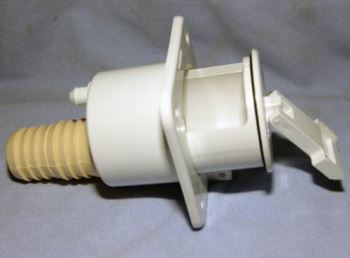
For motorhomes equipped with the city water option only, it is possible to add an aftermarket gravity-fill inlet, in most cases. The only prerequisite is that there must be enough room to add the fill entry on the exterior sidewall and route the hose to a new fitting installed on the top or on the side of the tank near its uppermost point. The optimal location — because the system relies on gravity — is to install the fill entry above the tank and have the new fitting attached directly to the top. This, of course, will depend on where the tank is located and how difficult it is to access. A certified RV technician can plastic-weld or spin-weld the appropriate tank inlet and fill vent fitting to the tank once it’s accessed or exposed. Then a gravity-fed fresh water fill entry port (drawer or door style) can be installed through the sidewall, providing you the option of filling the tank through the gravity inlet or through the city water pressure method you now have. Nothing needs to be modified on the city water pressure fill assembly, since you’re only adding a new gravity-fill entry port to the non-pressurized portion of the fresh water system.
However, if you do not dry camp enough to justify the expense of adding a gravity fill, another option is to carry a spare 12-volt water pump (a good idea anyway), two short sections of approved fresh water hose, and some hose clamps. One of the hoses should have the male hose fitting on one end to attach to the motorhome’s city water inlet. Attach the two hoses to the auxiliary water pump using hose clamps and insert the open end of the inlet hose into your spare water containers. The pump can be fitted with a 12-volt-DC plug and connected to a conveniently mounted 12-volt-DC receptacle in the plumbing bay. Or, simply use temporary jumper wires to power the pump from any 12-volt battery. Be sure the receptacle or the jumper wires are fused appropriately. Since the auxiliary pump will provide enough pressure to open the backflow preventer in the city inlet, you’ll be able to fill your on-board tank from any off-board water container in this manner.
The Law Of Expansion
Dear RV Doctor:
I travel alone in my 2003 Rialta. It has a small ASME propane tank, with a capacity of only about 5 gallons. My problem is that I would like to boondock for longer periods of time than the small capacity of my propane tank will last, even while conserving fuel. Is there any way that my ASME tank could be fitted with an adapter that would allow me to add a DOT (cylinder) tank for extra propane capacity when needed?
Beth, Salt Lake City, Utah
You’re not the first one to have such a request, and there is a solution. Several years ago Marshall Gas Controls/Marshall Brass introduced an aftermarket kit called the Extend-A-Stay that makes it possible to connect an off-board propane cylinder to the motorhome’s ASME system. The kit is available from many online RV retailers or through your local RV parts and accessories store.
The Extend-A-Stay consists of a tee fitting that is installed between the main shutoff valve on the ASME tank and the POL fitting/regulator assembly that leads to the rest of the appliances in the motorhome. It is positioned before the coach pressure regulator, on the high-pressure side of the system. The connections do not require any type of sealant, so it can be installed by any RV handyperson. But be sure to perform a leak test using bubbles whenever the gas system is opened! Once the Extend-a-Stay is in place, with the system pressurized, daub or spray all the connections on both propane containers with a soapy solution. I always recommend children’s blowing bubbles, the kind you get from the dollar store. They are inexpensive and at just about the perfect viscosity to indicate a leaky propane connection. Avoid using dishwashing detergent that contains ammonia or chlorine.
Be sure the tee assembly kit is produced by Marshall. There are many knockoff propane products flooding the market now; some are not so good, in my opinion. Marshall is a well-respected, reliable company with a long history in the RV industry. Safety being the most important aspect when modifying the propane system in any way, it’s best to use only reliable, time-tested products. It’s also important to know how to properly carry the spare DOT cylinder when you travel. Let me know if you need directions concerning the transportation of cylinders. Remember, never compromise on safety!
The Law Of Pressure
Dear RV Doctor:
I have a Monaco diesel motorhome with a Cummins engine. Can I hook up an air hose to the air brake reservoir tank to top off my tires? I know it is best to check the tire pressures when they are cold, but when I get to where I can top off the tires, they are already hot.
Charles Thompson, Palmyra, New Jersey
If your motorhome is equipped with a quick-disconnect fitting teed into the air system, by all means it is perfectly fine to fill your tires when you have enough pressure in the tank. Many motorhomes have this feature conveniently located under the front access panels. It does require that you carry an air hose and fill nozzle that can reach all the tires. A tee, valve, and quick-disconnect fitting also can be installed by a qualified shop in the aftermarket, too.
But until then, you can simply measure the inflation pressures cold; note how much air you need to add; and when you get to the nearest air pump, simply inject that amount. For instance, if you measure the tires when they are cold and you find that they are 5 psi low, drive to where you’re headed and add the 5 psi at that time. As long as the tires are not significantly underinflated, you should be fine.
{loadpositionEndBlurbHouseCalls}