
Motorhome Heater Problem
Dear RV Doctor:
I own a 2008 Suncruiser, and the coach furnace suddenly stopped working. There is power leaving the circuit breaker, but there is no power at the toggle switch. I have no idea where to look next. Any suggestions?
Morley Kenway, F417820, Winterland, Newfoundland and Labrador
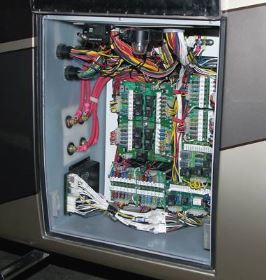
I’m assuming you are referring to the low-voltage, 12-volt-DC power coming into your furnace, correct? If you have voltage leaving the power source, with intact circuit protection, but it’s not reaching the furnace, chances are there is an opening in the circuit somewhere between points A and B. In the shop, we teach professional RV technicians to spend about 30 minutes when attempting to locate such an open condition. It is the same as though they were checking a circuit that kept tripping breakers or blowing fuses. Spend a little time diagnosing, taking measurements, etc., and then if the problem is not located quickly, simply run a new wire from point A to point B.
In a motorhome, conductors sometimes make a circuitous route from the power source to the device. Oftentimes the wires are routed in ceiling voids, behind paneling, under floors, inside harnesses or looms, etc. It’s much easier, takes less time, and is more cost-effective to simply disconnect that wire at the furnace and the circuit breaker/fuse panel (both ends) and then tape them off and run a new wire, securing and concealing it as best you can. Shorts and opens, especially if intermittent, can be costly to physically locate and rectify. Knowing there indeed is a problem within that circuit, your best solution may be to simply run a new conductor. A good technician should have you in and out of the shop in about an hour.
Water Heater Inner Tank Leaking
Dear RV Doctor:
A quick question: what should I do about a cracked water heater in my Type C motorhome? I have been told numerous things, such as it can be welded; it should be replaced, because anything else will be temporary; it can be repaired using roofing compound, etc. I am totally confused. Please help! By the way, it is an Atwood water heater.
Jasper Willis, Southfield, Michigan
Much depends on the age of your current water heater. All water heater inner tanks can be replaced, since both Suburban and Atwood have made them available in the aftermarket. Any respectable RV service technician can perform that replacement easily enough. However, the labor charge may outweigh the cost of simply replacing the complete water heater.
If you’re handy, you may be able to perform the replacement yourself, but some specialty tools may be required. If the unit is 5 years or older, I’d opt for a complete replacement. If it’s relatively new, obtain an estimate from your local professional technician to see what it would cost to remove, disassemble, and replace the inner tank only. Every component on the heater literally will need to be removed and reinstalled. In addition, a few propane tests will need to be performed at the conclusion of the repair.
I recently worked on a 5-year-old water heater, and the circuit board for that particular model was no longer available. So, the older the water heater, the more sense it makes to replace the complete unit. You’ll gain by having the latest technology as well as a new warranty in your favor.
Replacing certain components on an older water heater will not guarantee the health of the remaining original components. You may replace the tank today; tomorrow it could be the circuit board; and the next week the gas valve may go bad, if you get what I mean. By the way, I would never attempt to weld or repair a crack in any water heater inner tank. With the temperatures and pressures the tank is subjected to, I don’t know of any service facility that would guarantee such a repair. There’s just too much liability with the risk of it rupturing again and the potential for injury.
Feasibility Of Adding An Inverter
 Dear RV Doctor:
I have a new 2012 Type A motorhome with a side-by-side refrigerator/freezer. Would it be possible to hook up a 12-volt-to-120-volt inverter to operate the refrigerator while traveling on the road instead of using costly propane? If so, what size inverter would I need to handle the wattage? I know some of the newer motorhomes have this option.
Frederick Iuliucci, F359248, Cherry Hill, New Jersey
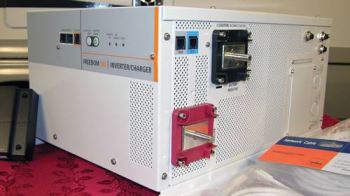
It is absolutely possible to make this work IF the battery bank AND the inverter are sized correctly. You will have to evaluate the size and condition of the existing battery bank, ensuring it has adequate storage capacity and consists of the right type of batteries. Then, the inverter must be sized correctly to handle the load it will be expected to carry. On top of that, the battery charging system will have to be optimized and compatible with the batteries in the bank. Solar battery charging is another option to consider.
Many of the newer motorhomes offer such an all-electric system, bypassing any need for propane. In fact, at FMCA’s 87th Family Reunion, held in Indianapolis earlier this year, I reviewed a Type B motorhome that offered a propane-free model.
To start, you will need to put some thought into your electrical needs inside the motorhome and make a few simple calculations. Many worksheets are available online to help you through the process. The first step would be to determine what size inverter your system would require. Many of today’s new motorhomes come equipped with two inverters — one for the various 120-volt-AC loads and one dedicated to the refrigerator/freezer. If you can determine the wattage requirements of your refrigerator (that info should be on the data plate or in the owners manual), and will not be placing any other loads on the inverter, simply add approximately 25 to 30 percent more and you’ll know what size to shop for. I always recommend a pure sine wave inverter, although a less costly modified square wave inverter may suffice. Carefully read the 120-volt-AC requirements for the refrigerator. The inverter requirements will spell out what size battery bank is needed for optimum operation. Again, you should always slightly exceed the requirements so the battery bank is able to carry more current than will be necessary for optimum operation. If the same battery bank supplies the rest of the motorhome and feeds the inverter, all of the load draws must be factored in.
The bottom line is that sizing the components boils down to simple electrical mathematics, coupled with the amount of space you have for batteries and the inverter. Oh, and how thick your wallet is will be a major factor as well.
{loadpositionEndBlurbHouseCalls}