
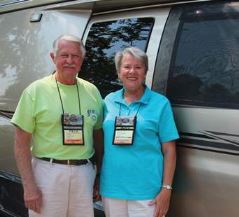
There’s a motorhome size and type for everyone, and Mike and Jennifer Wendland have discovered that for them, a 22-foot Type B is just the right fit.
By Mike Wendland, F426141
November 2012
I have to admit, I had my doubts about a life of RVing in a Type B motorhome.
I was sure it would be fine for weekend getaways, but as the Open Mike tour and my Roadtreking.com blog took off and it became apparent that we were going to be traveling a lot more than I first planned, we secretly wondered whether the 22-foot Roadtrek RS-Adventurous we bought would be big enough.
Now, with more than 12,000 miles under our tires and having enjoyed trips that lasted up to three weeks, we’re delighted with our choice.
But more than that, we’ve realized we apparently are living out a trend in RVing: a boom in Type B sales that seems to be helping to turn around an industry hard hit by the economic doldrums that had put many a dealer on the edge of bankruptcy.
Monthly sales figures for Type B motorhomes confirm what we’ve concluded from our own experience, interviews with dealers we have met at various RV rallies around the country, and the many other Type B owners we’ve met in our travels this past year.
At this writing, Type B sales for 2012 were up nearly 28 percent over 2011. Sales of all motorhome types increased more than 4 percent during the same period. This is according to Statistical Surveys of Grand Rapids, Michigan, which keeps track of RV registrations for the industry.
When it comes to Type B motorhome manufacturers, there’s what I call the Big Six. Four are in Canada — Roadtrek, in Kitchener, Ontario; Pleasure-Way, in Saskatoon, Saskatchewan; Leisure Travel Vans in Winkler, Manitoba; and Great West Vans in St. Andrews, Manitoba. Two are in the United States — Winnebago Industries, marketing its Type B under the Era brand in Forest City, Iowa; and Thor Industries’ Avenue and Interstate models, in Jackson Center, Ohio, which the company says are inspired by its Airstream brand. Another Type B manufacturer, Sportsmobile, is based in Austin, Texas.
In my view, the boom in Type B sales can be attributed to two trends — baby boomer retirees and downsizers.
Baby boomer retirees. Each day in America, 10,000 baby boomers reach Social Security age. Sociologists tell us this generation of retirees is the most healthy, active, affluent, and adventurous of any other group that came before. Many, retiring early because of buyouts or being forced out of jobs during the economic downturn, have made calculated decisions to seize the opportunity to see the country. Others have planned for this moment for years. But many new retirees are choosing Type Bs because of their easy mobility and the convenience of also being able to use them as second vehicles.
Downsizers. Another sizable contingent of new Type B owners have downsized from a Type A or C. These are typically veteran RVers who have been on the road for several years. Some are full-timers who have found an area of the country in which to purchase a home and settle but who still want to be able to travel in comfort. Others want more flexibility and simplicity when traveling.
Jennifer and I are in the first category. Granted, we don’t know anything different. We’ve never tried a Type A motorhome. And sometimes our Roadtrek does feel cramped, especially when our 70-pound Norwegian elkhound, Tai, is traveling with us. But we’ve adjusted to the tight spaces and absolutely love the mobility our Type B provides, from pulling into regular parking spaces to being able to boondock and stay deep in state and national forests, totally self-contained in true wilderness.
Darlene, a reader of my Roadtreking.com blog, has owned a Type B 2004 Roadtrek 190 Popular since 2010 and has taken trips as long as five weeks in it.
“We have purposely bought small RVs to force ourselves to be outdoors,” she said. “You can never feel closed in being outdoors. The whole idea of taking a trip is to be enjoying and appreciating the great outdoors.”
John and Sally Hearne from Pittsboro, North Carolina, are typical of many downsizers. I met them at FMCA’s 87th Family Reunion in Indianapolis, Indiana, this past summer and shared a seminar stage with them to discuss downsizing from a Type A motorhome to a Type B.
The Hearnes started motorhoming in 2005 with a 32-foot, gas-powered Type A and traveled across the country. They did all the bucket-list spots — including the Grand Canyon, Bryce Canyon, and Zion National Park — and fell in love with the RV lifestyle. In 2010 they traded for a 40-foot, four-slideout diesel pusher, complete with a washer and dryer, residential refrigerator, and central vacuum system. For five months, they traveled the country with gusto in their big rig, towing a car behind them. But then, some discontent entered the picture.
“We found that traveling in a large coach requires that you do most of your traveling on major highways and interstates,” Sally said. “Therefore, we didn’t get to travel on the backcountry roads that we love to tour.
“We could only use fueling stations that could accommodate our size and length. There was no impromptu stopping along the way. I would see a roadside stand with fresh produce that I would love to buy. But, there was nowhere to put our big rig. We couldn’t just pull off the road anywhere. I saw shops in small towns that begged to be explored. Nope, we couldn’t do that. There was nowhere nearby to park. By the time we could find a campground that could accommodate our coach, unhook the tow car, and drive back to the produce stand or small town shop, we would be miles away from the place of interest. So, I just had to forget about it.”
In July 2011 the Hearnes sold the 40-footer and bought a Roadtrek 210 Popular.
“The space is a miniature of the Class A, but it has all we need,” Sally explained. “There is inside storage for clothes, food, etc., and outside storage for some essentials. Since it is so easy to stop anywhere we want, we do not have to stock a large amount of food. We love being able to drive anywhere we want to go in town or out of town.”
Ron Woodward, a retired engineer from Minnesota, told me about the same thing. He previously owned a Type A and downsized last year to a Type B from Pleasure-Way. “We didn’t like the big campgrounds and our dependency on hookups,” he said. “Now, we can go anywhere. We love boondocking in the state forests. Just us and nature.”
Granted, a number of other RVers remain just as convinced that a Type A or Type C motorhome is the right fit for them. Just look around at a rally, campground, or elsewhere, and you’ll see all sizes, styles, and types of motorhomes. Perhaps the bottom line is that we all must find our own personal motorhome bliss.
With the onset of November and colder temperatures in the north, the great snowbird migration to warmer regions begins. We’re hoping to become a part of it this year, taking long trips to Florida, the Gulf states, and the Southwest, including Texas Hill Country. We won’t be gone the entire season but will plan three- and four-week forays on each leg, returning to our Michigan home for grandkid fixes.
But we’ll do so confident in our Type B and excited about the adventure that awaits as we go Roadtreking across America.
Hope to see you out there . . . on the open road.
{loadpositionEndBlurbOpenMike}