
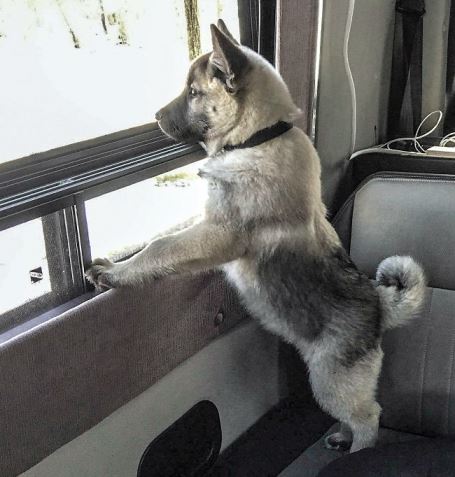
Mike and Jennifer Wendland have a new furry travel companion who already has stolen their hearts.
May 2016

Bo is our brand-new Norwegian elkhound puppy, soon to be our loyal travel companion.
We didn’t ask for Bo. And when our three grown children surprised us with a 10-week-old puppy as we celebrated Jennifer’s birthday and my birthday in February, let’s just say the tears Jennifer shed were not tears of joy.
A puppy? Arggggh! We’re too old for this, we thought, doing our best to look cheerful as our kids beamed. After they left for the night, it was Jennifer, me, and Bo.
Gulp.
But then … Well, if you’re a dog person, you know precisely what happened. How those bright eyes and that sappy, ears-down joy that a puppy shows when it first sees you every morning turn you into a gushing doofus.
It happened to us. Like I said, we didn’t ask for it. Our kids knew, however, that ever since Tai, our 12-year-old Norwegian elkhound, died after a short illness this past summer, our hearts have had a hole in them. Tai loved our Roadtreking life. It is hard to find a photo or a blog post from our four-plus years of traveling in which he wasn’t part of the action.
He was recognized so frequently during our travels that he became a celebrity in his own right. And when he died, we received literally hundreds of condolences from readers of this column and from our podcast listeners.
We always knew we would get another dog. We just weren’t ready yet. Our kids apparently thought we were. So, here we are now trying to train a puppy who is nonstop energy.
Housebreaking was the first hurdle, and pretty much a 24/7 undertaking for the better part of a month. We bought books and guides and crates and toys and did our best for several weeks to not let him out of our sight.
We’re extremely pleased to report that we’ve rounded the housebreaking corner, but the training challenge is far from over. The chewing stage is what we’re in now, as I write this. Pretty much anything he can fit in his mouth or wrap his razor-sharp puppy teeth around is fair game. So, we’re working hard on redirecting all that energy as we teach the “Leave it!” command.
We’ve named him Bo, in honor of Tai, whose full name was Taibo. Bo is the fourth Norwegian elkhound we have had over the years. Always one at a time, thank you. How motorhome folks with two or more dogs manage them is beyond me.
We have had to change our travel plans for a few weeks. All the experts say young pups need two to three months of a calm, regular schedule and pretty much constant time with their humans for proper bonding. We left him with our daughter and her family — the chief instigators of this unexpected gift — as we did a quick trip down to Perry, Georgia, for FMCA’s Family Reunion in March. But other than that, we’ve all been together.
We also have been working at introducing Bo to our motorhome, where he will spend a lot of time once we start moving out across North America in mid-May. He seems to like that same spot between the two front seats that Tai used to claim. We’re now outfitting the Roadtrek with a doggy seat belt and some other things to make traveling with a puppy a bit easier.
One of the things we have added to the motorhome is the Canary home security system. It’s marketed as a home security device, but it works just as well in an RV. All it needs is AC power and a connection to the Internet, the latter of which is provided to us by the Verizon Jet Pack MiFi Mobile Hotspot.
The Canary device works via a mobile app, and it provides live, wide-angle streaming video and audio. We set it up before we leave the RV, and we can use our smartphones to check what’s happening and how Bo is doing from anywhere.
Setup could not be easier. You first download the Canary app — free from Google Play or the Apple App store — and then plug in a black power cord. This automatically turns on the unit; you don’t have to push any switches or anything. Then, following the instructions on the app, you plug in a yellow cord between the Canary and the audio jack on your smartphone. You then are prompted to enter the password for the Wi-Fi. That does it in terms of pairing the Canary to your Internet Wi-Fi network. You then unplug the yellow cord and shouldn’t have to use that again. The Canary is activated.
Now, in a home situation, you’d leave the Canary plugged in and on all the time. Your Wi-Fi data at home is unlimited. In an RV, though, most of us do our best to control data usage. So, we turn the unit on only when we need it, such as when we go out to dinner, or when we leave the dog alone while we take a short hike. That way, we will not rack up excessively high data fees.
Something else we really like about the Canary: It provides real-time readouts of the temperature, humidity, and air quality, so we can be sure the A/C is working.
The Canary’s camera, sensors, and memory adjust to normal conditions, such as when Bo moves from the front to the back of the motorhome. But when something unusual happens — if he gets too rambunctious or if an intruder enters — it will send an instant alert to our smartphone. You help the system “learn” by entering tags or short descriptions of the video that are saved when an alarm is triggered.
If a real emergency occurs — say, a break-in — you can use your smartphone to activate an ear-piercing siren. You can even program the app to call authorities wherever you happen to be.
Canary records the video, too, which you can then download. And it keeps a running list of when it was activated and when you come and go from the vehicle. You can turn off the audio and video for complete privacy.
The cost is a one-time $200 fee. Premium upgrade features, which involve additional fees, include the ability to archive the video, a feature more suited to full-time use in a fixed residence. Since we are in an RV and use the Canary only occasionally while traveling, I’ll stick with the free service for a while. You can view a video I did about the Canary at https://youtu.be/Y1u1UF6C3jA.
Bo, meanwhile, seems to find the coach very comfortable. We’ve taken him for a series of short rides and let him spend extended periods of time in the Roadtrek. He shows no stress or anxiety. You can see from the photo that he has spent time looking out all the windows and finding the best spots.
And the training has been going well. A basic puppy obedience course that Bo, Jennifer, and I are taking will be complete in late April. We’re not sure who’s training who, but the three of us seem to be getting along well and progressing just fine.
It’s almost time for Bo to hit the road.
He has both of us thoroughly wrapped around those gangly puppy paws. I’m planning some of our hikes and walks and vowing to stick to my 330 Rule — no more than 330 miles in a day and/or stop by 3:30 p.m. — so Bo can ease into life on the road. We are still debating whether we will take a trip to Alaska late this summer, but we certainly will be heading out for a couple months on the road, and Bo will be right there with us — wherever we go.
But, man, this puppy training is a lot of work. Our lives have been turned upside-down, and I think we’re both still a little shell-shocked.
Wish us well!
Veteran journalist Mike Wendland, F426141, FMCA’s official on-the-road reporter, travels the country with his wife, Jennifer, aboard the couple’s Roadtrek Type B motorhome.