
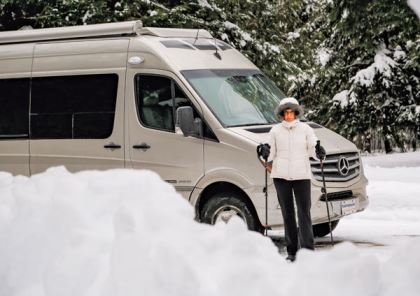
The Wendlands and a group of RV adventurers embrace the snow and the freezing-cold temperatures while enjoying what has become a traditional winter camping outing in the Upper Peninsula of Michigan.
By Mike Wendland, F426141
January 2017
Who says you can’t go camping in the wintertime up North? For the fourth year in a row, we’re planning a winter outing at snowy Tahquamenon Falls State Park in Michigan’s remote Upper Peninsula.
And when I say snowy, I mean very snowy. We’ve had from two to three feet of snow on the level ground each year we’ve gone up there. The drifts are as high as six feet. And, yet, with our heaters going, we’re as warm and toasty as can be inside our motorhome.
Winter camping is just the same as summer camping — except you wear a lot more clothes outside. In the motorhome, only minimal changes are involved. Because it’s cold — we’ve camped in temperatures as low as 13 degrees below zero Fahrenheit — the coach must be winterized. We have no running water; so, we bring bottled water for cooking and drinking. For the toilet water, we pour equal amounts of RV antifreeze in for whatever, ah, amount we deposit.
Jennifer and I also bring a small ceramic electric heater if the temperatures are zero or below, to supplement our Roadtrek CS Adventurous XL’s Alde heating system. The hydronic Alde system produces a warm, even, radiant heat, like baseboard heating from boilers in high-end homes. Ours also heats the floor, which is a real luxury.
Some of the other winter campers we have met showed us a secret they’ve used to keep heat inside their motorhomes. It involves a product called Reflectix. You can find it at home-supply stores such as Lowe’s and Home Depot. It looks a bit like bubble wrap between two layers of aluminum foil. It comes in rolls and can be cut easily with scissors. Our friends cut squares of Reflectix to fit inside all their windows to add some heavy insulation.
Probably the hardest thing about winter camping in northern climes is finding campgrounds that stay open. That’s one reason we pick Tahquamenon Falls every January. Not only is it open year-round, but the Michigan Department of Natural Resources rangers plow out our campsites for us, and we have electric hookups.
The rangers also let our group use the park’s snowshoes for the weekend we visit, and that has proved to be so much fun that over the years, many in our group have ended up buying their own equipment. Snowshoeing is very easy to learn, and walking across and atop the snow on long hikes is one of the most pleasurable activities you can imagine.
We spend a surprising amount of time outdoors in the snow during our campouts. We order up a big supply of firewood and have huge bonfires going pretty much from Friday afternoon through Sunday at noon. At night, we bring out the lawn chairs and gather round the fire, just like in the summer, but, again, bundled up pretty well.
This year, a couple of our regulars have been studying the art of igloo making and are planning to put their book learning to use. They’re even vowing to spend the night in an igloo. Notice I said “they.” Not me.
Besides the snowshoe hikes, my favorite outdoor activity in the wintertime is photography. The snow makes the woods stunningly beautiful. The Upper Falls, one of the largest waterfalls east of the Mississippi, has a drop of nearly 50 feet. It measures more than 200 feet across and has a water flow of more than 50,000 gallons per second. It roars all year round, but during the winter, the spray the water kicks up drifts to the river shoreline and coats the trees in icicles. We love night photography in the wintertime as well. With no light or air pollution, the stars are breathtaking.
I shot a video during one of our visits a few years ago that shows the falls and the campground, as well as conversations with other winter campers — including some who camped in the snow in tents! You can watch it on YouTube at https://youtu.be/5A4VtXUCStA.
Winter camping is not for everyone, but it seems to be particularly well suited for Type B motorhomes. We’ve never needed chains or snow tires, and I’ve driven during whiteouts and on roads covered with several inches of unplowed snow. The heavy weight of a Type B provides lots of traction. I haven’t tried this in a Type A or C motorhome, so I can’t really speak to that experience, but I suspect it may be a bit more challenging, depending on travel conditions.
If you’ve never tried winter camping, you need to do so. Trust me, you’ll have a ball.
Who says you can’t go camping in the wintertime up North? For the fourth year in a row, we’re planning a winter outing at snowy Tahquamenon Falls State Park in Michigan’s remote Upper Peninsula.
Vetern journalist Mike Wendland, FMCA’s official on-the-road reporter, travels the country with his wife, Jennifer, aboard the couple’s Roadtrek Type B motorhome.