
Electrical Pedestal At Home
Dear RV Doctor:
I have a question about installing an electric hookup at home for our Winnebago motorhome. Our coach is wired for 30 amps. How difficult is it to install a plug-in at our house for the motorhome? There’s no way we would draw more than 30 amps, but I don’t want to do any damage to the motorhome or to our house.
Jim Goodspeth
Via email
It’s vital that the electrician you hire truly understands RV wiring, which differs from the typical residential electrical system. This is explained in a three-part series I wrote for this magazine in 2010; “Wired For Safety” appeared in the May (page 40), June (page 42), and July (page 48) issues.
Your motorhome is wired with an isolated, nonbonded neutral conductor inside the coach. That said, it is very doable, and many members have indeed installed a typical campground-type pedestal box at their residence. It’s quite convenient for keeping the battery bank charged and for loading/unloading the rig or using the coach as a guest suite for visitors. Still, it is imperative that your electrician verify you have a spare 30-amp or 50-amp slot in your existing breaker box. It also may be necessary to include a new subpanel. Do not exceed the limits of your existing service or panelboard.
I would recommend a three-circuit box, even though you have only a 30-amp motorhome. That way, you’d be all set should you decide to trade in your Winnebago for a 50-amp coach. Plus, you’ll have an extra receptacle for a visiting motorhome or for other ancillary use. This is assuming you have those spare slots in your existing breaker box.
A great place to purchase a three-circuit box is www.rvpoweroutlet.com, a leading provider of RV circuit boxes for homeowners and commercial campgrounds. The box is fully assembled, complete with 20-, 30-, and 50-amp receptacles and their associated circuit breakers. Your local electrician can connect it to your home’s wiring system and you’ll be good to go.
Antifreeze On Tires
Dear RV Doctor:
During the “Ask the Experts” panel discussion at the FMCA convention in West Springfield, Massachusetts, this past summer, I mentioned what I do to check for propane leaks and mounted tire leaks. In a spray bottle, I keep a mixture that is half water, and half antifreeze and dish soap. When checking a tire on a warm, sunny day, the antifreeze prevents the spray from drying quickly as I apply it, so I can spray the entire tire. I’ve been doing this since 1978. Back then, before the Alaska Highway was paved, the spray proved invaluable on two occasions for finding leaks in two mounted tires, which I then plugged. A tire engineer in attendance in West Springfield said he would let you know if the antifreeze is harmful to the tires. Please let me know his response.
John Calvo, F25500
Syosset, New York
That was one of this magazine’s Technical Advisory Committee gurus, tire engineer Roger Marble. When I reminded him of your question, here’s what he had to say:
“I did some checking and found nothing indicating a bad reaction to antifreeze on tires, but that doesn’t mean I would wash my tires with the stuff. I basically say, don’t use anything on tires that you would not want to use on a nice paint job. This includes scrub brushes, SOS pads, or any chemical I would not want to put on my paint. Petroleum distillates are bad. This also includes brake fluid, which I know has been used by some, as it makes tires really shiny. I can’t tell you the number of Type A units I have seen in convention displays with some gunk on the tires that I can scrape off with my fingernail. I, for one, use only a water/soap mix. I’m not sure how necessary it is to keep the tire wet, as leaks will normally show up with bubbles.”
So, there you go. The only thing I use on tires, other than soapy water to remove dirt and grime, is 303 Protectant. The 303 blocks harmful UV and ozone and helps extend the life of the tire a bit.
For checking propane leaks, it’s okay to use dish soap as long as it doesn’t contain ammonia or chlorine, which can corrode some gas fittings. Plenty of aftermarket solutions — even children’s blowing bubbles — have a perfect viscosity for use in testing both propane and air leaks. Apparently the antifreeze won’t hurt, either.
Fittings On Propane Device
Dear RV Doctor:
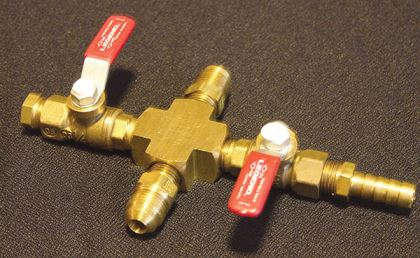
In your very good video about testing the propane system on a motorhome, you use a device that is constructed using what appear to be simple brass plumbing parts. Can I purchase that device somewhere, or do I have to make one? If I have to make it, what are the fittings I would need?
Mike Browning, F300893
Epping, New Hampshire
That propane test device is indeed constructed of common brass fittings. I’ve never seen anything like it commercially offered. Here’s a list of the individual fittings.
- one1/4-inch brass cross (probably the most difficult fitting to find)
- two 1/4-inch MPT (male pipe thread) x 3/8-inch male flare adapters
- two 1/4-inch MPT x 1/4-inch FPT (female pipe thread) gas valves
- one 1/4-inch MPT x 3/8-inch hose barb adapterX-one1/4-inch MPT plug
- one 3/8-inch female flare swivel
In my test kit, I also have an assortment of various adapters and hoses, depending on how each coach is outfitted. For those who have not watched that video, it can be found here: https://goo.gl/wbsM9O.