
Dear RV Doctor:
My motorhome is equipped with two gel batteries. I plan to replace them. What type do you suggest?
Tom Fry, F459849
Bethel Island, California
During my seminar presentations, I try to survey attendees about their battery choice, and over the years, the number of motorhome owners with gel batteries has dwindled to maybe one or two — if that — in any given seminar. Gel batteries once had their place in RVs, but their popularity has waned with the advance of other battery technologies.
Lead-acid/wet-cell technology is still viable and popular, as are AGM (absorbed glass mat) batteries. Lithium ion/iron technology, in my opinion, is still a few years away from widespread use, because of the initial cost and the requirement for a special type of battery charger. The potential is awesome, however. Some motorhome manufacturers, at least, are beginning to offer lithium, if just as an option.
Deciding on the type of replacement battery depends on a few things: Are you planning to keep that motorhome a while longer? Do you have room to add more batteries? Is the total battery bank weight going to be a factor? Do you use the coach regularly, full-time, or just a few weekends?
 Assuming the two gel batteries occupy approximately a 12.5-inch-by-7.0-inch footprint, you’d be able to install two Group 27 batteries, either 12-volt AGM or lead-acid. If you have more room, then consider adding four batteries for double the capacity. You certainly cannot have too much amp-hour capacity, especially if you do a lot of dry camping.
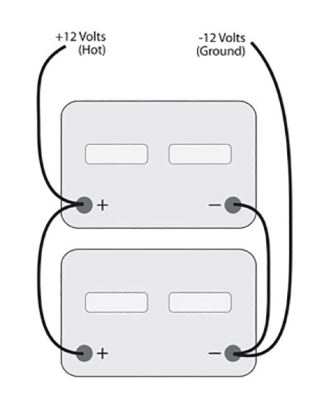
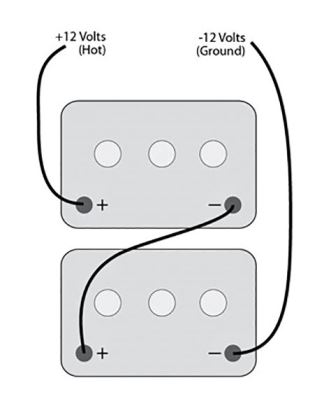
Two 6-volt batteries wired in series is an alternativeto having two 12-volt batteries connected in parallel. Mathematically, you’ll gain a few more amp-hours per square inch. Since I’m fond of tinkering and being able to measure the electrolyte specific gravity and battery temperature, etc., I would opt for two (or four) commercial-grade, deep-cycle, lead-acid batteries. If you tend to shy away from performing hands-on battery maintenance and monitoring, sealed AGM batteries are probably a better option. You really can’t go wrong either way.
Both AGM and lead-acid have their pros and cons; too many to list here. Brand-wise, Trojan, Interstate, and Lifeline are all reputable choices. If your motorhome is equipped with solar battery charging capability, Lifeline is likely a better choice. So, consider how much room you have, both in the coach and in your wallet. Once you determine that, shop around for the best deal.
Dear RV Doctor:
A rather perplexing issue with our 2014 Pleasure Way Type B motorhome has stumped my local dealer and me. On a three-week trip my wife and I took this past spring, the carbon monoxide (CO)/propane leak alarm frequently went off about 3:00 or 4:00 a.m. The only way we could prevent that was to turn off the propane valve on the tank. The alarm sounded when all the propane appliances were turned off but the propane tank valve was open. Since there was no combustion, there was no source for carbon monoxide, so I don’t think CO was entering the detector.
My suspicion was a propane leak within the furnace. I took the motorhome in for a propane leak-down test that showed no evidence of a leak. They also tested the alarm, found that it worked properly, and noted that it is still within its expected lifespan. I seem to recall it was manufactured in either 2012 or 2013. When I got the coach home, I tested the alarm myself with both the test button and a butane lighter and found it worked properly.
Our coach has a fold-down sofa that uses cushions between ottomans just forward of the couch to make a king-size bed. The CO/propane alarm is thus under the middle of the bed. When it goes off in the middle of the night, we can’t easily get to the alarm to silence it. It ultimately silences when we open the sliding side door to ventilate the coach and we fan air into the area below the bed. Also, since it was cool at night during our trip, we usually had no windows open for ventilation. The dealer offered to replace the propane alarm as a way of trying something. Do you have additional insights or recommendations?
John Vandergrift, F271762
Poulsbo, Washington
Wow! You’ve done about all you can to ensure you have no propane leaks anywhere on the motorhome. That said, I’d suggest having another shop perform the same pressure-drop test and an internal check of the furnace, just to be sure. (To see how the pros perform leak tests on a propane system, watch this video: https://youtu.be/dK46tDIOzUA)
I’m not a big fan of combination monitors/alarms. For optimum benefit, the CO monitor should be installed about head high, since CO mixes with the ambient atmosphere. The propane monitor should be mounted low to the floor, since propane is heavier than air. It might be a good idea to obtain one of each and mount them in their proper locations.
Try to avoid placing the propane monitor under the bed. That location could be contributing to the malfunction. Perhaps it’s detecting the off-gassing of the fabrics and cushions trapped in the area under the bed. However, that doesn’t explain why the alarm does not go off with the service valve closed on the container. Until you’ve had a second shop verify it, I wouldn’t rule out a slight propane leak emanating from the furnace. Also, remember that the effective life of most alarms that sniff the air is five to seven years. Yours is very close to that. If your dealer will provide two separate detectors, I’d take him up on that deal.
Dear RV Doctor:
Can Pure Power Blue be used to clean household carpets to remove years of heavy pet odors? Will it hurt or stain the carpet? Will it harm pets or people? And what combination of mixture to water should be used in a rug shampooer?
Kevin Rendos
Via email
To provide the best response possible, I contacted Kelley Stark, president of OP Products, the company that created Pure Power Blue. Here’s what he said:
“Pure Power Blue will work for carpet, but I would caution against using it on white carpeting, even though the blue dye is water soluble. I have had people tell me they do use it for cleaning their carpets, but I consider it a bit anecdotal. We make a product called Pet Force that is a similar formula to PPB but designed specifically for removing pet stains and odors. We sell a lot to janitorial professionals and carpet cleaners. The product can be bought on our website (www.opproducts.com) or through Amazon.com.”
So, there you go. As far as how much to use, since odors have built up for years, I’d start with a 50/50 solution of water and Pet Force and try it on a scrap piece of carpet first. Then adjust accordingly. A lot will depend on how deeply the odors are entrenched. After the first treatment, follow the directions on the container.