
Dear RV Doctor:
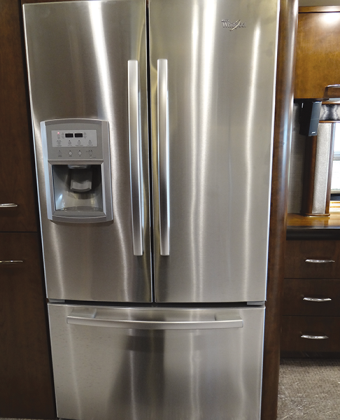
I’m looking for info about switching out our RV refrigerator for a home refrigerator. What extra power equipment will be needed for the motorhome?
Julie Howell
Queen Creek, Arizona
The trend of enjoying residential refrigerators in motorhomes is widespread, with many coach manufacturers now offering them, at least as an option. Some are forgoing propane altogether and creating all-electric motorhomes. Replacing the RV absorption refrigerator with a standard house-type refrigerator does require some extra equipment and some mathematics.
To operate the unit when not connected to shore power, you’ll need an inverter (either your existing inverter, or a new dedicated inverter) as well as possibly a larger battery bank. I recommend using a pure sine wave inverter; not all residential refrigerators will work with a modified sine wave inverter. The addition of a solar charging system also is quite beneficial, especially if you do a lot of dry camping away from normal electrical hookups.
The math I mentioned involves determining how much wattage (or AC current) is required by the refrigerator you choose. Also, the installer must verify that the existing inverter (or perhaps a new one) will exceed the demand of the refrigerator, as well as keep up with other AC loads it may have to power.
Then it will be necessary to assess the size of the battery bank. Are there enough batteries in the bank to power the refrigerator inverter as well as the remaining DC loads connected to that battery bank?
Finally, if you add battery capacity, determine whether the battery charging system is properly sized to adequately charge the now-enlarged battery bank. This is the point where many owners install a solar array to help keep the larger battery bank charged.
The numbers will determine how sophisticated the installation of a residential refrigerator needs to be. So, the answer is yes, it is possible to replace an absorption refrigerator with a residential unit, as long as:
- The inverter is sized accordingly for the extra load (or a new, dedicated inverter is installed just for the refrigerator).
- The battery bank is sized properly to deliver enough DC amp-hours to power the inverter and other resistive loads.
- Battery charging capability — the engine alternator, converter/charger, or inverter/charger, etc. — is large enough to keep the battery bank charged.
- Solar power is considered, if necessary.
Dear RV Doctor:
We are about to start our first eight-week camp host activity. Our campsite is shaded by trees, with hardly any sunlight making it to the ground. My concern is that our air conditioners always will be wet/moist, causing mold and mildew to form. One of our A/C units has ductwork throughout the roof. I can just imagine having mold spores flying through the ductwork, and then ending up inside for us to breathe. Also, will our roof and awnings end up getting very nasty? Am I overly concerned?
Gene Bennington
Via email
I don’t think you’ll have anything to worry about. The important thing to know about RV air conditioners is that they really don’t “make” cold air. They are designed solely to remove moisture from the air inside the coach while moving heat from one location to another. Heat always moves from a hot area to a cold area.
In an air conditioner, this process of thermodynamics functions by the use of a compressor and an active refrigerant, through a condenser and evaporator, inside the sealed system. When a refrigerant is compressed and heat is removed (as in the air-conditioning condenser), the gas loses heat as it liquefies. As the pressure on the liquid is reduced (entering the evaporator), it returns to a vapor state, minus the heat that was lost in the condenser. The absence of heat makes the evaporator cold. And since the laws of physics make heat travel to cold, heat from the interior of the RV is absorbed by the refrigerant in the cold evaporator and carried to the compressor. The compressor forces it into the condenser, where it gives up the heat to the outside environment. The air is sucked from the living area by the spinning evaporator blower wheel that also passes the cooled air back into the RV. That’s a complete cycle: the refrigerant picked the heat out of the interior air through heat absorption and released it using the properties of evaporation and condensation.
That’s a lot of information, but the bottom line is there should be no undue moisture forming regardless of the lack of sunshine. As the removed heat condenses and is released to the roof of the coach, water will either evaporate or simply roll off the sides of the roof. In a sunny location, this happens more quickly, of course, but the formation of mold is rare in a normally operating A/C system. If drainage from the roof and A/C isn’t good, standing water can lead to mold, mildew, and mosquitoes.
The key is to keep the air-conditioner evaporator and condenser coils clean. A clean return air filter is also vital for proper operation. Once a year, take the cover off the roof unit to inspect the condenser coils, and remove the ceiling shroud or plenum inside the coach to inspect the evaporator. You may need a flashlight for the evaporator to be seen clearly. In rare instances, the coils will require cleaning. The unit filter is always located within the path of the return air to the air conditioner inside the coach. Keeping it clean will keep the evaporator clean in most cases.
Also, consider adding a renewable dehumidifier, such as H2Out (www.h2out.com), just for peace of mind. For the awnings, the operative words are clean and dry.
Dear RV Doctor:
I have a 2010 Tiffin motorhome. My question concerns how to wire a 50-amp shore power receptacle at our house. I am quite familiar with electrical wiring and house-service breaker panels. I fully understand the dangers of bonding the bare grounding with the neutral wire in the RV distribution box (which I learned at your seminar at the FMCA convention in West Springfield, Massachusetts). I was told I should use a double-pole, 50-amp breaker like most 240-volt applications, where each side of the double-pole breaker comes from alternate sides of the buss bar. Is this correct? I assume that since the two hot legs are out of phase with one another, each leg is providing 120 volts to the two hot legs in the receptacle, and the motorhome panel will be operating on 120 volts. I had one motorhome technician tell me that the two hot legs should come from the same side of the buss bar in the house panel. Can you clear this up for me?
Thomas Tazza
Via email
The two legs of 120 volts each must be fed from opposing phases of the 240 volts coming into the service entrance at the house weatherhead. If both hot legs of 120 volts are from the same phase, the neutral conductor will become overloaded (above its 50-amp rating) and become a fire hazard. The neutral/bond connection is found only at the service entrance. The 50-amp receptacle will contain two legs of 120 volts each when measured to the single neutral conductor or the safety ground wire. The coach loads are then distributed to each leg accordingly.
A quick check at any 50-amp receptacle is easily accomplished by measuring the AC voltage from one hot leg to the other. The correct measurement should be 240 volts AC (nominally speaking). If the measurement is at or near 0 volts AC, do not plug in. As I often mention, there are a few other tests to be performed, but this quick measurement will determine if those hot legs are on separate phases of incoming electricity.