
Water Heater Drain Plug
Dear RV Doctor:
Our water heater is equipped with a 1/2-inch nylon drain plug. The plug cracked inside, causing a leak. The nylon plug failed on our previous RV, too. After the first failure, we began to carry a spare. I know I am not over tightening it. I use plumber’s putty or Teflon tape on the threads, whichever I have handy. What am I doing wrong to cause the failure? What sealant should I use on the threads? Also, you have mentioned a brass plug, but I can’t find it.
Wyndy Broome
Via email
The plastic plug used for the water heater drain is designed with tapered threads, according to National Pipe Thread (NPT) standards. Such threads are narrower at the end, widening slightly as the threads approach the hex nut. That is why it seems to get tighter as you keep turning the wrench or socket. Because of this taper (compared to straight parallel threads), it’s often unnecessary to apply any type of sealant. That is especially true when the plug threads are plastic and somewhat pliable, and the female fitting on the water heater is aluminum. It’s best to tighten the plug only enough to keep it from leaking.
Chances are, the sealant you’ve been using is acting as a lubricant of sorts, allowing the plug to thread easier and deeper than necessary. And although it doesn’t seem like it, you probably are overtightening the plug and eventually cracking it. The heat of the water within the tank also affects the viability of the plug threads.
Solution
I suggest trying a new plug, but without any sealant. Also, because the plastic threads easily can become distorted or cross-threaded, and the plug can obtain a permanent warp, I recommend replacing the plug every time the tank is drained. It is relatively inexpensive.
Never install a brass plug into the water heater; use only a plastic plug. Mating two different metals (brass and aluminum) can cause a galvanic corrosion reaction that eventually will make it impossible to remove the plug. You may have heard me recommend using brass fittings and adapters instead of plastic within the distribution piping system when feasible, so I apologize if I led you astray. That certainly does not apply to the water heater drain plug.
A Debate
Dear RV Doctor:
I’m having a debate with some fellow campers. The question: Is the propane regulator affected by changes in atmospheric pressure? I say the propane pressure remains the same and that only the air-to-fuel ratio will change. And that’s why the appliances are affected. Am I right?
David Maeland
Via email
According to the Propane Education & Research Council, which mirrors what we teach professional RV service technicians for certification, propane is indeed affected by heat and pressure, very similar to water boiling in a closed pot. But the reaction takes place only inside the propane container on the RV.
At atmospheric pressure, the boiling point of propane is minus 44 degrees Fahrenheit. Any temperature colder than that, the propane remains in a liquid state, because its vapor pressure is less than atmospheric. At temperatures above this boiling point, the vapor pressure of propane is greater than atmospheric pressure, which causes the liquid to vaporize. This happens inside the tank (or cylinder) in the space that exists above the level of the liquid. This is also why a propane container can be filled only to 80 percent of its capacity. A minimum of 20 percent of capacity is necessary for vaporization to occur.
When an appliance burner inside the RV is lit, propane vapor will flow through the regulator to the burner, mix with air somewhere along the way, and combust. When any appliance is in use, the demand will immediately cause a slight drop in pressure inside the container. This upsets the heat/pressure balance and causes the liquid propane to begin boiling into a gas to replace the fuel being delivered by the regulator to the appliances. As long as the demand for propane remains, the propane will continue to boil, supplying fuel to the burner.
Solution
When all the appliances eventually are turned off, the propane will stop flowing out of the container and return to its balance point, but vapor will still be present above the liquid in the container, ready for when you ignite another appliance. But until then, the boiling will stop as this balance is reached. Because one of the jobs of the pressure regulator is to always deliver an even flow of propane vapor into the RV’s distribution piping system, and ultimately to the appliances, the regulator goes into a lock-up condition, whereby pressure exists but no fuel is flowing through it.
All appliances must mix primary air with the delivered propane vapor in order to burn completely and efficiently. So, regardless of what happens inside the container, a properly adjusted regulator always provides the right amount of propane vapor pressure. The size of the orifices within each appliance controls the volume of propane vapor. What we typically cannot control these days — the RV water heater is an exception — is the amount of air that is mixed with the gas at each burner.
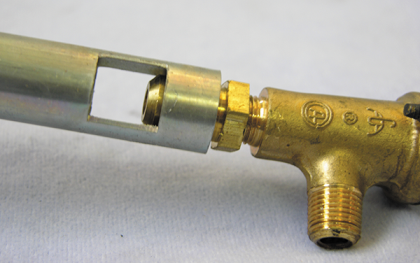
In the accompanying photo, notice the square opening cut into the cooktop burner tube. As propane vapor passes through the orifice in the burner valve, it draws in the primary air through this opening. Notice also that the opening is nonadjustable. Therefore, you are correct in your assertion that the only thing that really changes as the RV goes higher into the mountains is the fuel/air mixture at each appliance. The regulator maintains the same delivery line pressure.
Another Debate
Dear RV Doctor:
About four years ago, I bought a used 2000 Newmar Mountain Aire motorhome. I read an article about battery charging that indicated most coaches have 12-volt systems. This begs the question: Why are 6-volt batteries supplying a coach’s 12-volt system? To me, 6-volt batteries are expensive. And in my area, at least, they are hard to come by.
Gene Obdob
Via email
Six-volt batteries wired in series are viable in RV applications for a number of reasons. First, most commercial-grade, deep-cycle 6-volt batteries are truly commercially constructed. Their heavy-duty design, thicker plates and separators (as much as 60 percent more in some cases), and ability to be repeatedly used (and somewhat abused) make them attractive for RV use.
Another plus is that they can store slightly more usable amp-hours (mathematically) per size of footprint compared to two like-sized 12-volt batteries connected in parallel. With two 6-volt batteries, half as many cells need inspection and hydration. With proper use and maintenance, 6-volt batteries typically have a longer life span. And although I have no scientific data to verify it, I feel a 6-volt battery has a tendency to shed less of the active plate material than its 12-volt cousin through normal use.
But as I tell my seminar attendees, I can be on either side of a 6-volt/12-volt debate and win! I’ve just provided a portion of one side of that debate for you here.