
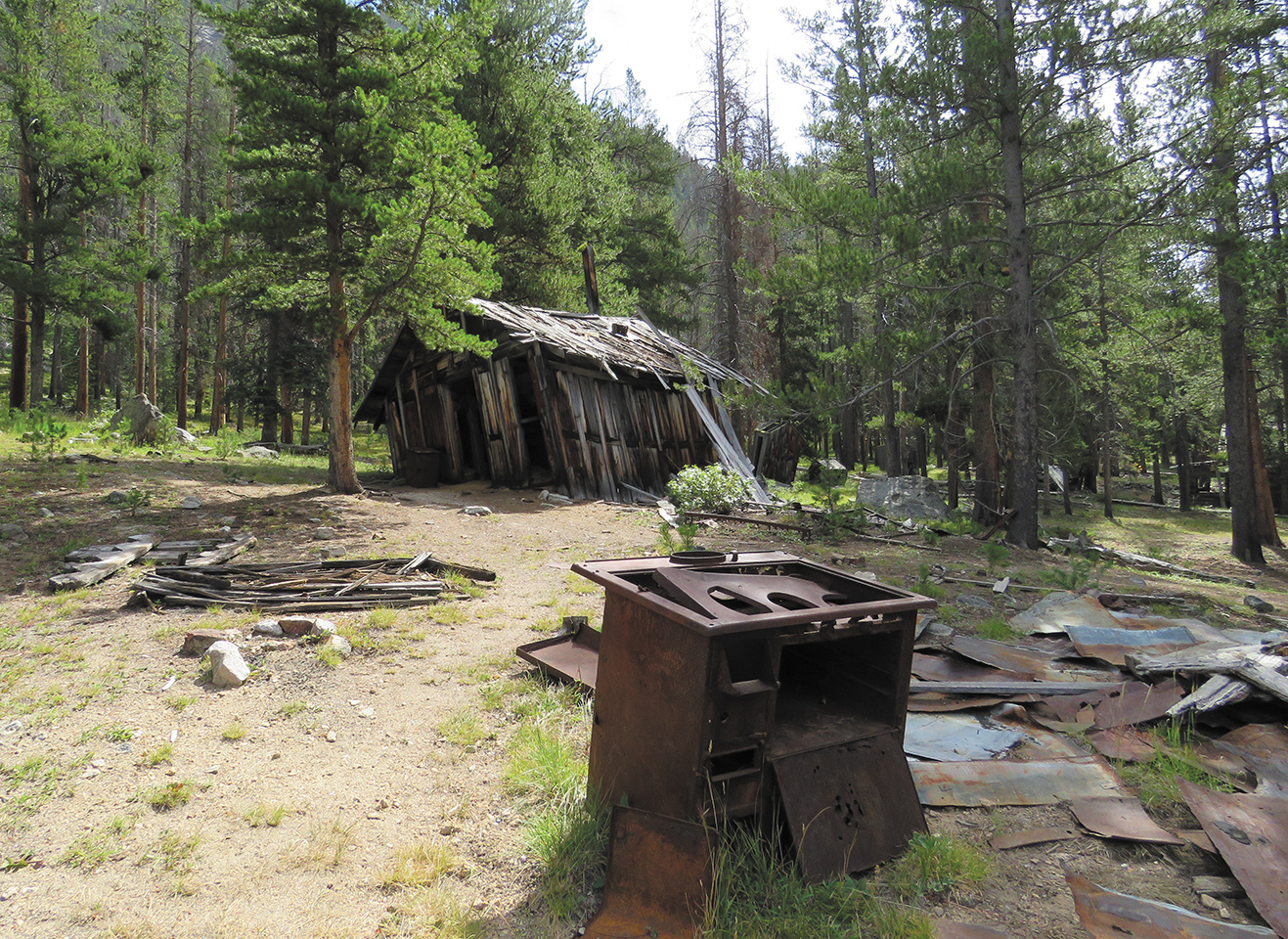
The ruins of a remote mining operation in Montana reveal great ambitions.
By Mary Taylor
Coolidge, a mining town in southwestern Montana, once had electricity, telephone service, a school district, and a post office, all very unusual for such a remote location built in the 1910s. It sat in a long, narrow canyon, and as it grew, the homes and shops spread out along the single road and into the pines on the sloping land that formed the canyon.
The town was named for the 30th U.S. president, Calvin Coolidge, who was said to have been a friend of its main developer. Just like “Silent Cal,” it is very quiet now.
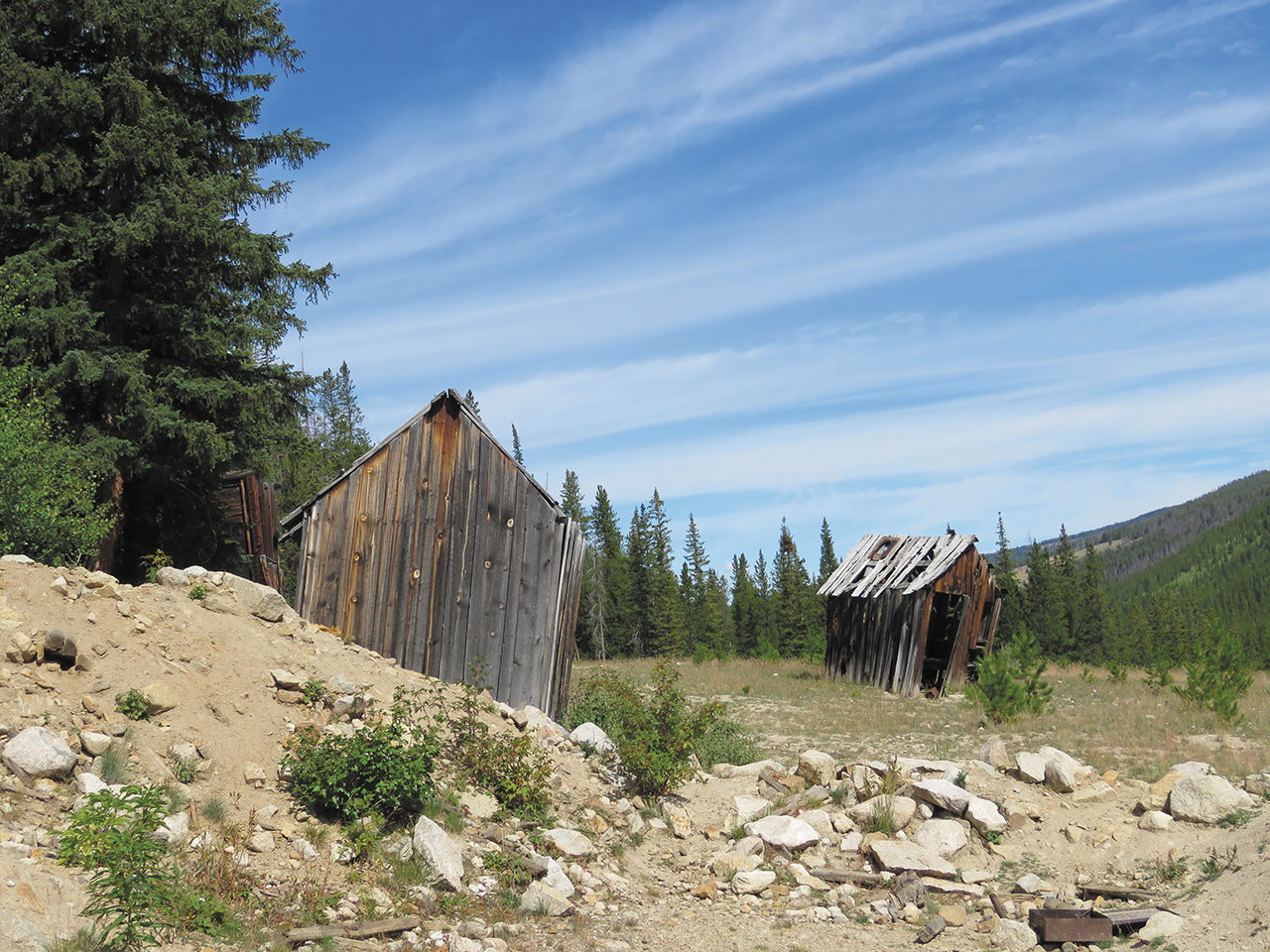
When residents abandoned Coolidge, Montana, they left behind a fascinating time capsule of buildings such as this one.
A drive up a 5-mile gravel and dirt road is required to get to this ghost town. A parking lot big enough for smaller RVs and cars awaits at the end. The town, which existed from 1914 to 1932, is about a half-mile walk from the parking lot. It’s a well-graded and easy stroll.
One by one, the crumbled, tilted, wooden structures appear through the trees. Initially there is no evidence of the large silver mill that was completed in 1922 — just the dilapidated remnants of the town. Farther on is a gated bridge that leads to one of the mine openings. Finally, you see what remains of the $900,000 silver mill.
When completed, the mill covered 2 acres. All that is visible now is the surprisingly modern-looking concrete support structure, large gears, and jumbles of wooden supports.
The mine entrance is guarded by a locked gate and a warning sign. There is no evidence of activity, but a trickle of water the color of rusted iron slowly flows under the gate and stains a path downward toward the bridge approach.
A trestle-supported water trough originally ran between the mine entrance and the mill. All that is left now is a narrow graded path littered with weeds and the remnants of the collapsed trough. If you are cautious, you can walk along this rough track to reach the mill supports.
Wandering through the debris of the town can awaken one’s imagination. Iron stoves sit abandoned in open areas among the tilted buildings, along with pieces of metal roofing or siding. A company store, boarding houses, a pool hall, a cookhouse, and a dining hall once were in the lower part of the canyon. Stables as well as blacksmith and carpenter shops sat at the upper end of town, where another mine shaft existed. One or two complete structures remain upright, but it seems there is no end to the heaps of wood spread along the canyon road.
How did this town develop, and what happened to cause it to become a cluster of jumbled relics?
Mining Is Risky Business
The Elkhorn mine, which was the basis for this town, opened in 1872 and operated off and on for a number of years. For some time, it was profitable to ship the mine’s silver ore all the way to Wales for processing. But eventually the high cost of transportation and low silver prices made mining uneconomical.
A pattern of recurring national financial downturns and recoveries, plus bad luck, dogged the mine the entire span of its existence. Silver prices capriciously dropped and recovered. World War I delayed financing for the mine, and the Great Depression doomed it. What’s more, the enterprise that built Coolidge suffered from an apparent case of the cart before the horse. A lot of money was spent to prepare to process ore before enough of it was mined.
The town of Coolidge got its start because of William Allen. Allen grew up in Montana when it was still a frontier, and he became a political and business force in the state. With a background in banking and insurance, he eventually moved into financial promotion and formed the Boston-Montana Development Corporation to reopen Montana’s Elkhorn silver mine.
Allen served in the Montana House of Representatives and as lieutenant governor, and it was probably the friendship between Allen and Calvin Coolidge from Allen’s political days that led to the town’s name.
By 1913, the mining interests took precedent with Allen, so he quit his job with the state. Coolidge began to grow from a few tents to a town, with electricity, phones, and schools. The mill was constructed and the population exceeded 350. The area had two producing mine shafts. In all, an estimated $5 million was spent to construct the Elkhorn mine project. In 1919 a rail line was completed, called the narrow-gauge Montana Southern Railroad. It ran approximately 40 miles from Coolidge to a town called Divide.
By 1922 everything was built and ready for production. But the economy had suffered a recession in 1920-21, and there was not enough ore to supply the mill to run at full capacity. Within one year the company was in receivership. It managed to liquidate its debts and continue production through 1927, when more bad luck hit. An upriver dam burst and washed out 12 miles of railroad track and several bridges across the Big Hole River. The tracks were repaired by 1930, but the Great Depression prevented the mine from reopening. The Coolidge post office and schools were shuttered by the early 1930s because of a decline in population.
Allen had left his job to promote and develop a project that would dwarf anything ever attempted in the area. He spent more than 40 years, and his fortune, first developing the mine and then trying to revive the operation. Eventually, Beaverhead County acquired the deeds to the property in lieu of taxes. The mines never became the bonanza that Allen envisioned.
Further Details
Coolidge is on the National Register of Historic Places. It is managed by and located in the Beaverhead-Deerlodge National Forest (406-832-3178), southwest of Butte, Montana.
To reach Coolidge, travel 3 miles south of Dillon on Interstate 15 to State Route 278, then head west for 22 miles. Turn north on Forest Service Highway 73 (Pioneer Mountains Scenic Byway/Wise River Polaris Road) and travel for approximately 16 miles to the marked dirt road (Forest Service Road 2465) to Coolidge.
The gravel/dirt road can handle smaller RVs, but the rough ride may cause owners of even these vehicles to avoid it. The best bet is to take a towing/towed passenger vehicle. For details and weather conditions, contact the Dillon Ranger District (406-683-3900) before you visit.
Nearby camping is available at Beaverhead-Deerlodge National Forest campgrounds and at commercial RV parks in Dillon.
Coolidge is one of several fascinating, abandoned ghost towns in southwestern Montana. For a PDF of a printable map of all the area’s major mining towns, visit http://southwestmt.com/maps/gw_ghosttownsmap.pdf. For more information, call (800) 879-1159.