

Checking RV antifreeze and battery state of charge is simple with this handy device.
By Mark Quasius, F333630
September 2018
A refractometer is a compact, inexpensive device that measures the freeze point of antifreeze as well as a flooded battery’s charge level. It’s a great addition to an RV tool kit.
Refractometers are utilized in many industries, so RVers should choose one designed for automotive use. Typically they’re sold with a protective carrying case. A check of online retailers shows that a suitable refractometer can be purchased for less than $70.
How It Works
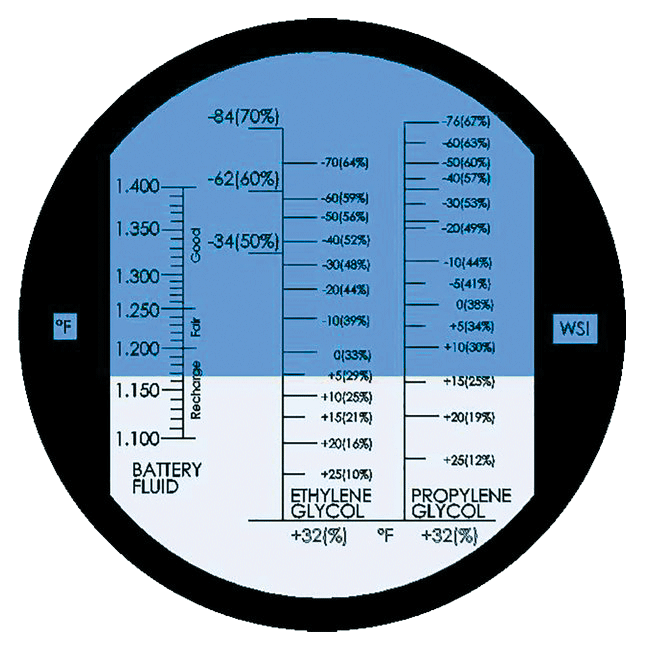
The device’s scales show readings for ethylene glycol, propylene glycol, and battery fluid.
Light slows down and changes direction when it moves from air into a liquid; that’s called refraction. A simple example: If you see a fish in a pond and dip a net into the water to scoop it out, you may not catch the fish, even if you have quick reflexes. That’s because the light rays reflected from the fish bend at the surface of the water, so the fish is lower than it appears.
The amount of refraction depends on the density of the material the light passes through, as well as the angle and wavelength at which light enters a substance. A refractometer measures the angle of refraction — the degree to which light is bent as it moves from air into a liquid sample — and correlates such angles to a refractive index, which can be used to evaluate a given liquid.
Operation
Most refractometers suitable for RV use have three scales — one for propylene glycol (PG) antifreeze; one for ethylene glycol (EG) antifreeze; and one for the battery electrolyte’s specific gravity. Thus, this one tool can replace multiple wet-bulb hydrometers that once were the mainstay of mechanics. Those old hydrometers were delicate and easy to break, but refractometers travel well without breaking.
To operate a refractometer, lift the hinged cover plate on the meter. Use the included eyedropper to place a drop or two of antifreeze or battery acid on the glass plate. Then close the lid, hold the device up to the light, and look through it as though it were a small telescope.
Light passes through the solution, and the results appear on a screen or plate with a labeled overlay grid. You’ll see three scales engraved into the viewer, one for each fluid type. Be sure to read the correct scale for the sample you are testing. A blue level on the scale indicates the exact measurement.
When one is testing automotive EG antifreeze, a scale displays the freeze point; in some refractometers, the ratio of antifreeze to water is shown as well. If the antifreeze is weak, the reading will be excessively high and you’ll know it’s time to service the cooling system before winter sets in.
A refractometer also measures the freeze point and mix ratio of the PG antifreeze in a hydronic heating system’s boiler. The freeze point is displayed on the refractometer’s PG scale.
More Info
The battery scale in a refractometer displays the electrolyte’s specific gravity so you can determine a battery’s state of charge. When a battery is discharged, the electrolyte is mostly water and reads a low specific gravity. As the battery charges, the sulfates recombine with the electrolyte and raise the specific gravity. Electrolyte from a fully charged battery has a specific gravity of approximately 1.255 to 1.280.
Often, a voltmeter will show 12.6 volts on a battery under a no-load condition, but a dead or low cell won’t allow the battery to deliver its rated power when placed under a load. With a refractometer, you can test each cell. If you find one with a lower specific gravity reading than the others, the battery may need service, such as an equalization procedure, or it may have to be replaced. Specific gravity readings from any two cells should not differ by more than 0.050, or a variation of about 4 percent.
After testing samples, rinse the plastic eyedropper with fresh water so that it is clean for the next use. Also rinse and wipe the refractometer’s glass plate before placing the tool in its storage case.
This multipurpose tool will help RVers with maintenance tasks and won’t take up much room, making it a great addition to an on-the-go tool kit.