

Everything you need to know to get started, including installation options, connections, and product suppliers.
By Mark Quasius, F333630
September 2018
To be legal, as well as safe, a vehicle towed behind a motorhome must have operating taillights, brake lights, and turn signals. That’s why a motorhome has a trailer lighting socket. Here, we’ll describe the options for installing auxiliary lighting, explain the connections needed in wired systems, and provide an overview of lighting products.
Installation Options
Several alternatives exist for equipping a towed vehicle with auxiliary lighting.
When there’s plenty of room inside a large taillight housing, a second set of bulbs can be installed, and those bulbs can be controlled by the motorhome’s lighting connection. This avoids interference with the towed vehicle’s existing lighting circuits.
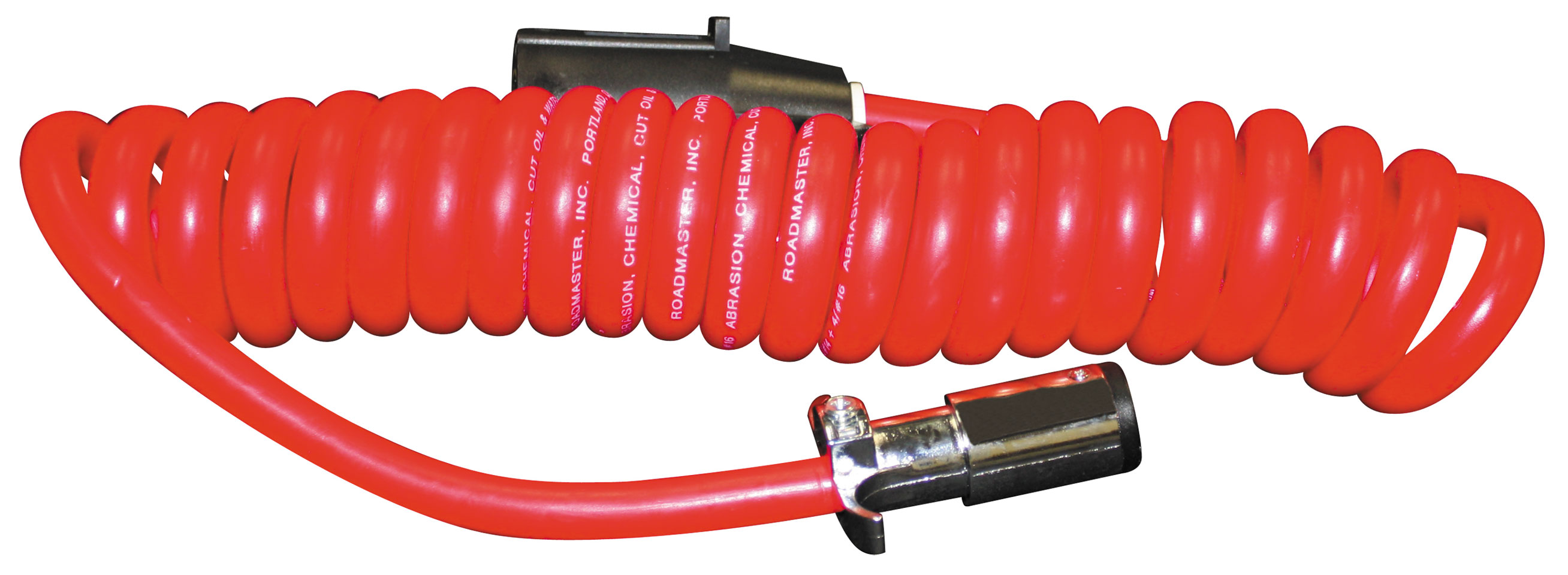
The Roadmaster 7-wire-to-4-wire Flexo-Coil cord stretches as necessary so it won’t drag on the pavement.
Unfortunately, the taillight housing in most vehicles is not large enough to accommodate a second set of bulbs. In that case, it may be best to utilize a lighting kit that taps into the existing taillight wiring. Such kits use diodes to connect the lighting systems of the motorhome
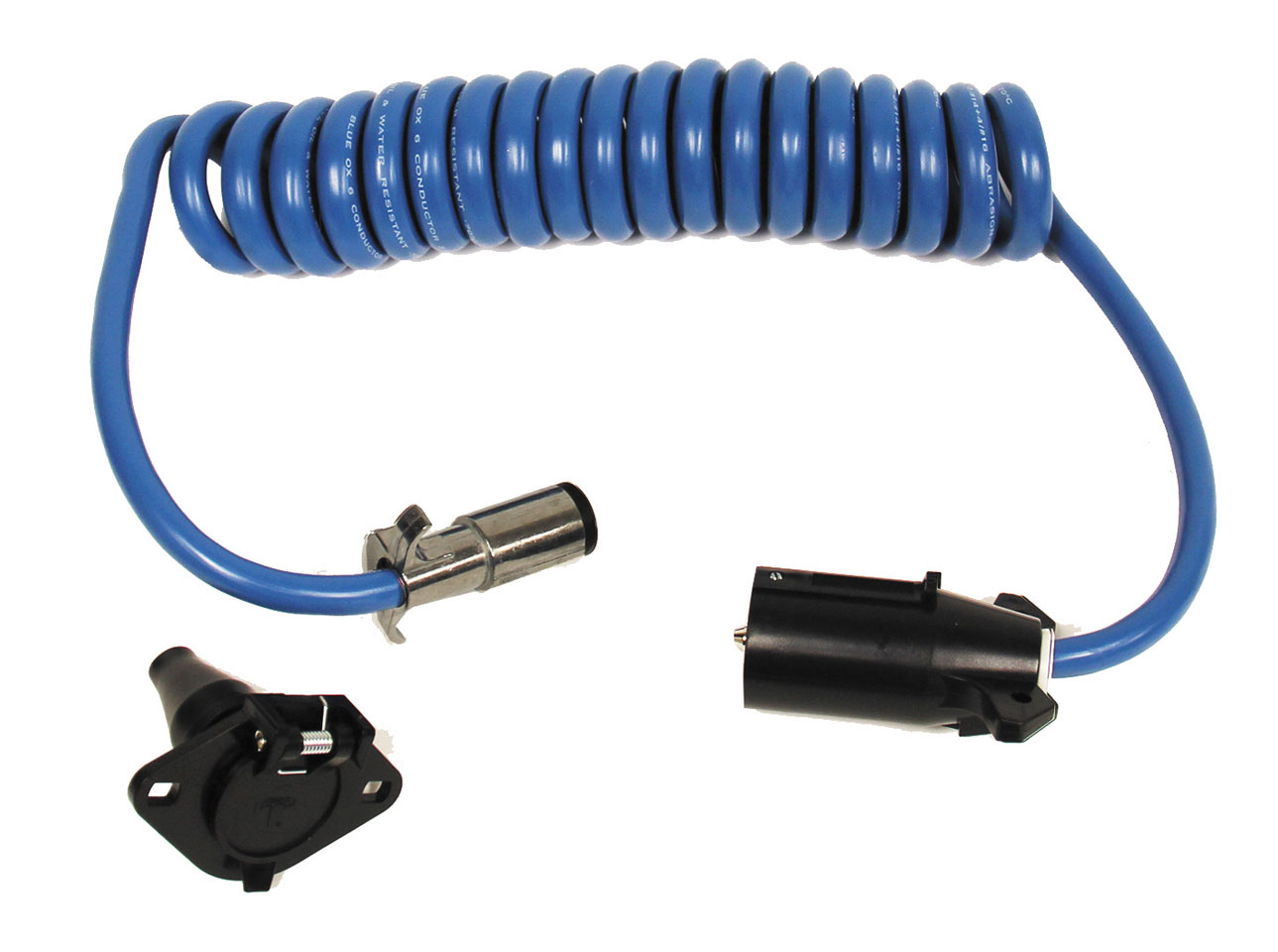
The Blue Ox 7-4 Coiled Electrical Cable has a seven-way round connector on one end, a four-way connector on the other.
and towed vehicle. Diodes prevent electrical feedback and other electrical anomalies from occurring when the motorhome utilizes the existing taillights. Simple plug-and-play wiring kits use the existing taillight harness connectors. Then, all that remains is running the wiring pigtail to the front of the vehicle and installing a socket in a location where it is easily accessible when towing.
Another option is to add portable lights to the vehicle. This may make sense if you’ll be towing a vehicle only for a short time and you don’t want to modify the existing lighting. Some portable lights attach with clamps and straps, but the vast majority are magnetic. Obviously, this won’t work on a vehicle with a fiberglass or aluminum rear body, but it works great on steel.
Some portable systems have a long cord that plugs into the motorhome; this requires finding a way to secure the cord to prevent it from being damaged while towing. However, the latest magnetic lighting bars use wireless technology to eliminate the umbilical cord. A small wireless transmitter plugs directly into the motorhome’s trailer lighting receptacle and communicates with the wireless receiver in the towed vehicle’s light bar.
Magnetic light bars may be self-powered by an internal rechargeable battery pack, or they may be equipped with a 12-volt cord that plugs into a 12-volt power socket inside the towed vehicle. Each system has its pros and cons. The self-contained system is handy, but it must be kept charged. A trip may be delayed if you are ready and the battery is depleted. Also, as the battery ages, its charge life will shorten. Those concerns disappear when using a light bar powered by the vehicle’s 12-volt power source, but you must run a power cable from the light bar into the vehicle. In that case, a charge line from the motorhome to the towed vehicle may be needed to prevent the towed vehicle’s battery from draining.
Connections
A wired system requires running an umbilical cord between the motorhome and the towed vehicle. Umbilical cords come in various configurations, depending on the connectors needed and the number of conductors in the cord. For motorhomes, the seven-conductor, RV-style flat-pin connector is the most popular, although six-conductor and four-conductor round-pin connectors also are used. The most popular umbilical cords are the six-conductor or four-conductor coiled cables that stretch as needed without dragging on the pavement.
A motorhome with a seven-conductor RV-style receptacle most likely won’t use all seven of those circuits. Basic trailer lighting requires only four conductors — taillights; left turn and brake light; right turn and brake light; and a ground wire. If you use a six-conductor cable, you will have two additional conductors. If you tow a trailer (equipped with electric trailer brakes) instead of a towed vehicle, one of the conductors provides the connection between the trailer brakes and the brake controller in the motorhome. It’s also a good idea to install a charge line from the motorhome to the towed vehicle’s battery to prevent the battery from being drained by an auxiliary braking system, lube pump, or other 12-volt device. The seventh conductor on a seven-pin RV receptacle is an auxiliary connection, which generally is used for backup lights on a trailer that is so equipped.
Choosing a six-conductor cable over a four-conductor cable is always a good idea, because someday you might want a 12-volt charge line. Or, you may decide to utilize one of the other conductors for another purpose, such as a return signal from a supplemental braking system to a dash indicator in the coach.
Following is a summary of products from several manufacturers.
Blue Ox
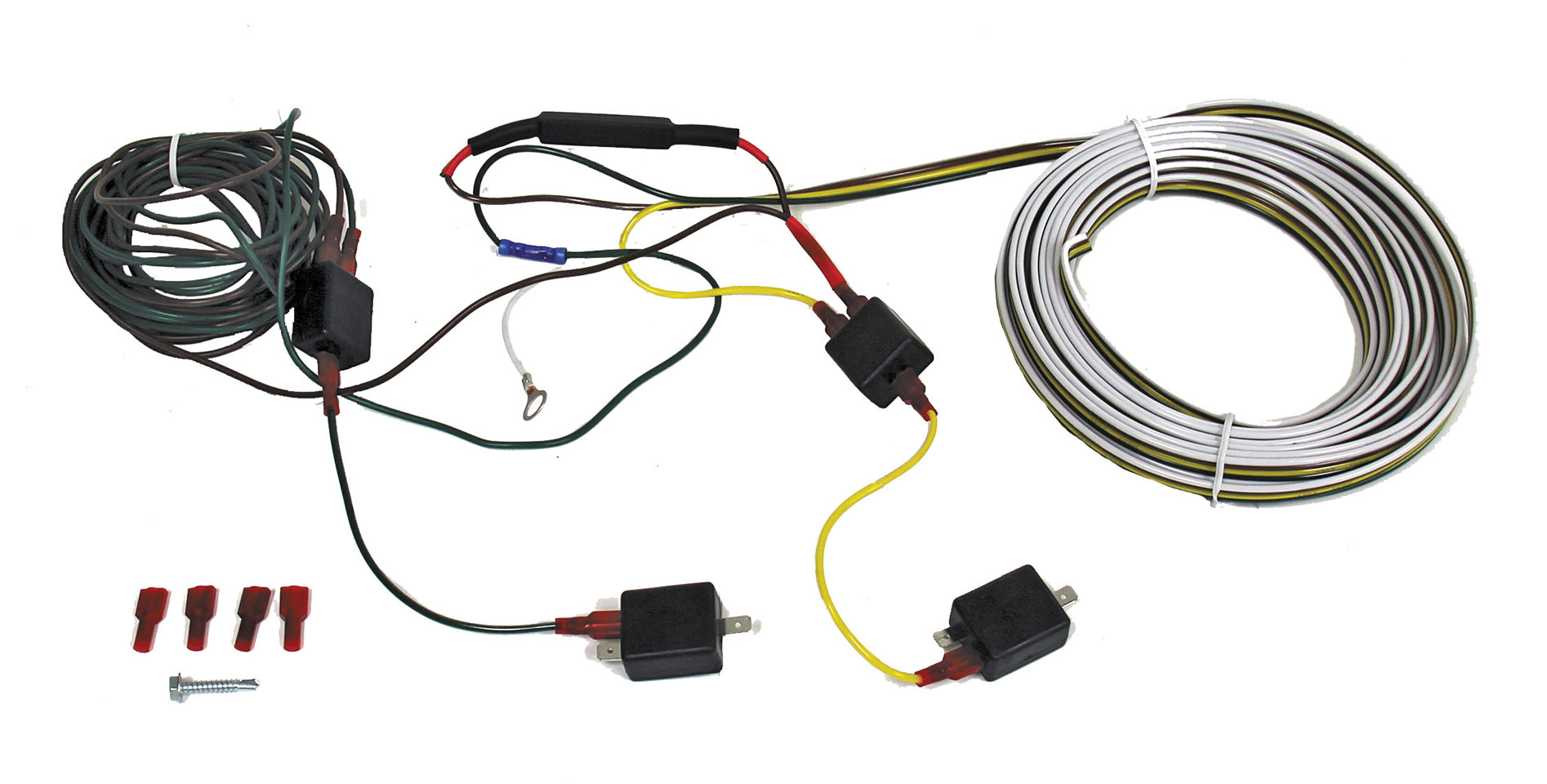
The Blue Ox EZ Light Wiring Harness with plug-in connectors.
In addition to manufacturing tow bars, baseplates, and related towing equipment, Blue Ox offers a selection of coiled lighting cables, dedicated bulb sockets for inserting into existing taillights, and diode kits to tap into existing taillight wiring. The EZ Light Wiring Harness is available in a number of configurations for a wide selection of vehicles; it utilizes existing vehicle lighting connectors for a plug-and-play installation without cutting into an existing vehicle wiring
harness. (800) 228-9289; www.blueox.com.
Demco Manufacturing Co.

) A complete towing accessory kit from Demco.
Demco, a supplier of tow bars, tow dollies, and auxiliary lighting, has a selection of diode packs and preconfigured wiring harnesses that feature a no-splice plug-in connection to an existing vehicle light
harness. (800) 543-3626; www.demco-products.com.
Hopkins Towing Solutions

A Hopkins Quick-Lock Diode.
Hopkins manufactures brake controllers and wiring adapters and harnesses. The company’s large selection of Plug-In-Simple! wiring harnesses are vehicle-specific with needed diodes. Installation requires no cutting or splicing. (800) 835-0129;
www.hopkinstowingsolutions.com.
Roadmaster
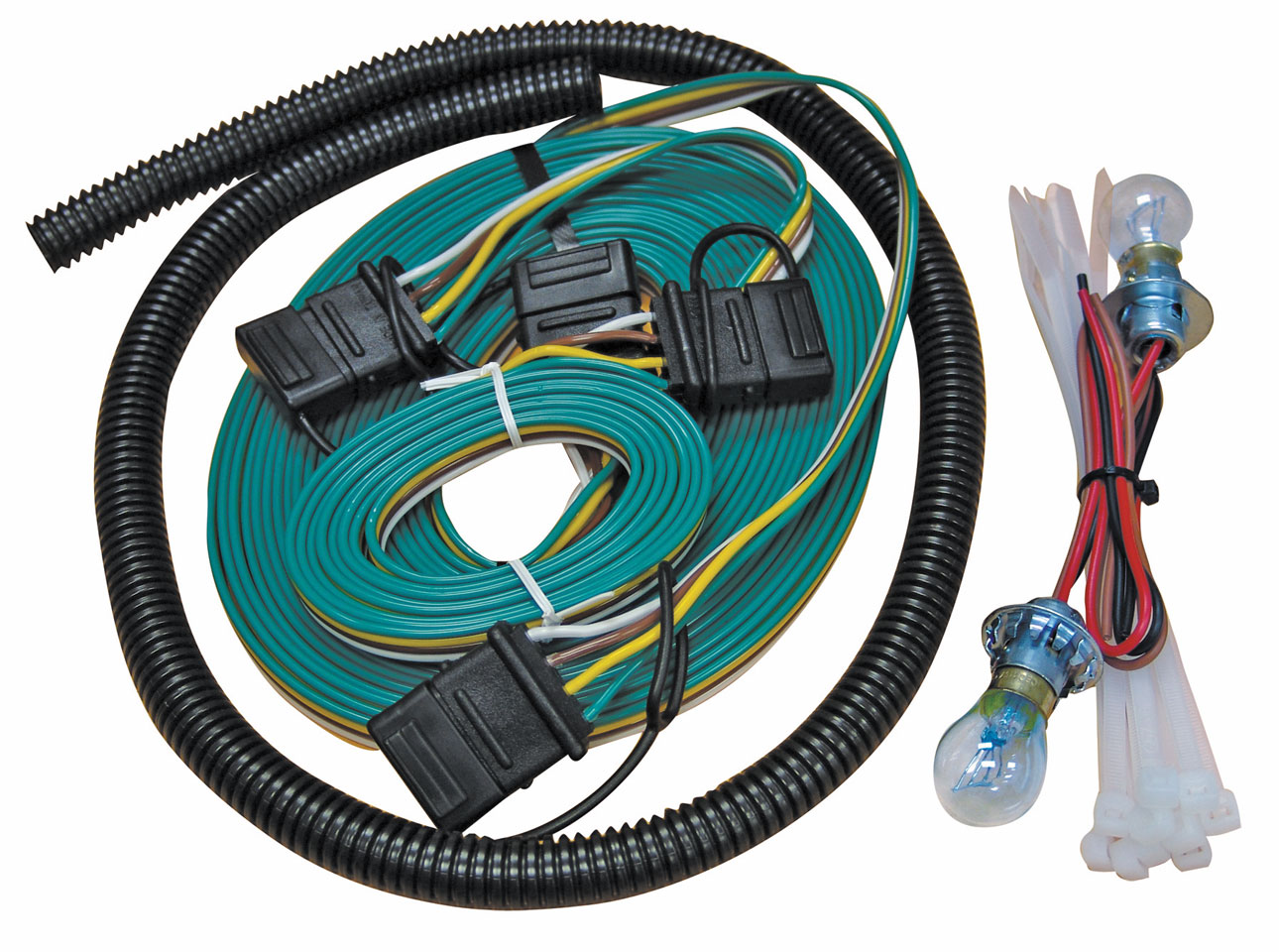
The Roadmaster Universal Wiring Kit with dedicated light sockets.
This manufacturer of RV towing equipment offers an extensive selection of lighting hardware. A variety of umbilical cords, adapters, and connectors are available, as well as lighting converters and diode kits. Wiring gear ranges from economy kits to custom plug-and-play installations. A set of magnetic tow lights is available for vehicles where a permanent installation is not desired. (800) 669-9690; www.roadmasterinc.com.
Towmate LLC

The Towmate RVHW32 Wireless RV Tow Light.
TowMate products range from inexpensive wired kits to high-end wireless light bars. The RVHW32 is a wireless 32-inch light bar. A transmitter sends a signal to a receiver in the light bar, activating the lights in conjunction with the motorhome’s lights. The RVHW32 receives power from the towed vehicle’s battery via a 12-volt power socket in the vehicle. The Helios 38-inch wireless light bar has an internal rechargeable lithium battery and does not require a connection to the towed vehicle’s battery. The Helios has a stated run time of more than 22 hours between charges. It also has functioning backup lights and sequential strobing turn signals. Both the RVHW32 and Helios feature magnetic mounting. (800) 680-4455; www.towmate.com.