

By Gary Bunzer, Technical Editor
November 2018
Saturated Storage
We have a Thor Motor Coach Tuscany, a 40-foot diesel pusher. While traveling through Georgia en route to Florida, we experienced a torrential downpour for about 15 minutes and a lot of water on the roadway. Then while unloading in Florida, we found that the basement was soaked, not with standing water, but with a lot of fine, wet dirt. My thought is that water somehow got into the basement during the trek through the standing water. We have looked high and low for openings in the big open area of the basement but can’t find any. How can we find where the water entered? Also, could the water on the freeway contain so much fine dirt, or did that come from elsewhere? This really has me stumped!
— Tom LaTour, F465326, New Port Richey, Florida
It’s likely that the fine dirt particles came from the roadway when you passed through that water. And it’s evident the compartment is not sealed tightly on the exterior of the motorhome. It’s a matter of seeking out the cracks or voids in the sealants surrounding the box’s exterior. Also look closely around any component passing through the walls of the box — wiring, harnesses, structural members, piping, or tubing of any kind. I used to manage a shop where we used a machine to induce fake fog into storage compartments while looking for it to seep past the joints. In a heavy downpour, even the tiniest opening will permit a spray of water that can soak the compartment’s contents.
Probably the easiest solution is to apply a wide section of EternaBond tape to all the joints on the exterior of the box. EternaBond tape will stick to anything except silicone. Shops use it abundantly on the RV roof, but it can be installed anywhere to seal gaps and seams. Clean and then cover every joint on the outside of the box with the EternaBond tape, overlapping the corners and edges. That likely will take care of any faulty or missing sealants.
Another cause of leakage into the storage bay might be a maladjusted door latch. Check that the bay door is closing completely along the entire perimeter of the opening.
Water got in there somehow, but it may be just a one-time happenstance of a heavy downpour coupled with forward movement that forced road water past the sealants. Still, I’d search carefully and eliminate the leaks if at all possible.
Misdirected Air
While we were traveling this past summer in our Type A motorhome on Interstate 10 from New Mexico to Florida, the dash blower fan for the air-conditioning was running but air was coming out of only one or two of the vents and not blowing as strongly as it has in the past. The hoses to the vents were attached. What could be the problem? Also, I saw your video in which you answered a question about whether it’s okay to run the onboard generator to cool an RV while driving. You said you can do that if it’s properly installed. We have a factory-installed gas-fired generator. Does this qualify as properly installed in order to run it while traveling?
— Patty Baylor, Via email
Usually you can assume that any factory-installed RV generator was put in correctly, so, yes, it is quite okay to run the generator and the air conditioner while traveling down the road. Keep in mind that the generator likely will not run when the fuel gets below 1/4 tank. The fuel line usually is plumbed that way to avoid having the generator run the tank empty, leaving you unable to operate the motorhome engine.
As for the dash air vents, chances are the baffles that direct the flow of air in the heater/defrost/air conditioning vents are stuck shut due to the summer heat and moisture you encountered along your southern route. Those baffles, located under the front cowling or under the dash, are operated by a vacuum motor that opens and closes each one. Each has some type of seal that prevents air from leaking around the baffles while they are closed. With high ambient temperatures plus the engine heat, those seals can become soft and molten, just enough to cause the baffle to stick. That prohibits the baffle from opening when the air direction is switched from defrost to the panel vents, for example. The stickiness is such that the small vacuum motors are not strong enough to break the baffle free.
I’d also have a mechanic check the engine vacuum. It may be beyond the scope of a do-it-yourselfer to locate those baffles, as some disassembly likely is required. But any good tech should be able to locate and manually open and clean those baffles and seals. They can be “conditioned” with a lubricant that will stop them from sticking, but first verify there are no other vacuum leaks in any of the hoses on the engine. This procedure could become an annual maintenance item if you travel that route every year.
Wiring Conundrum
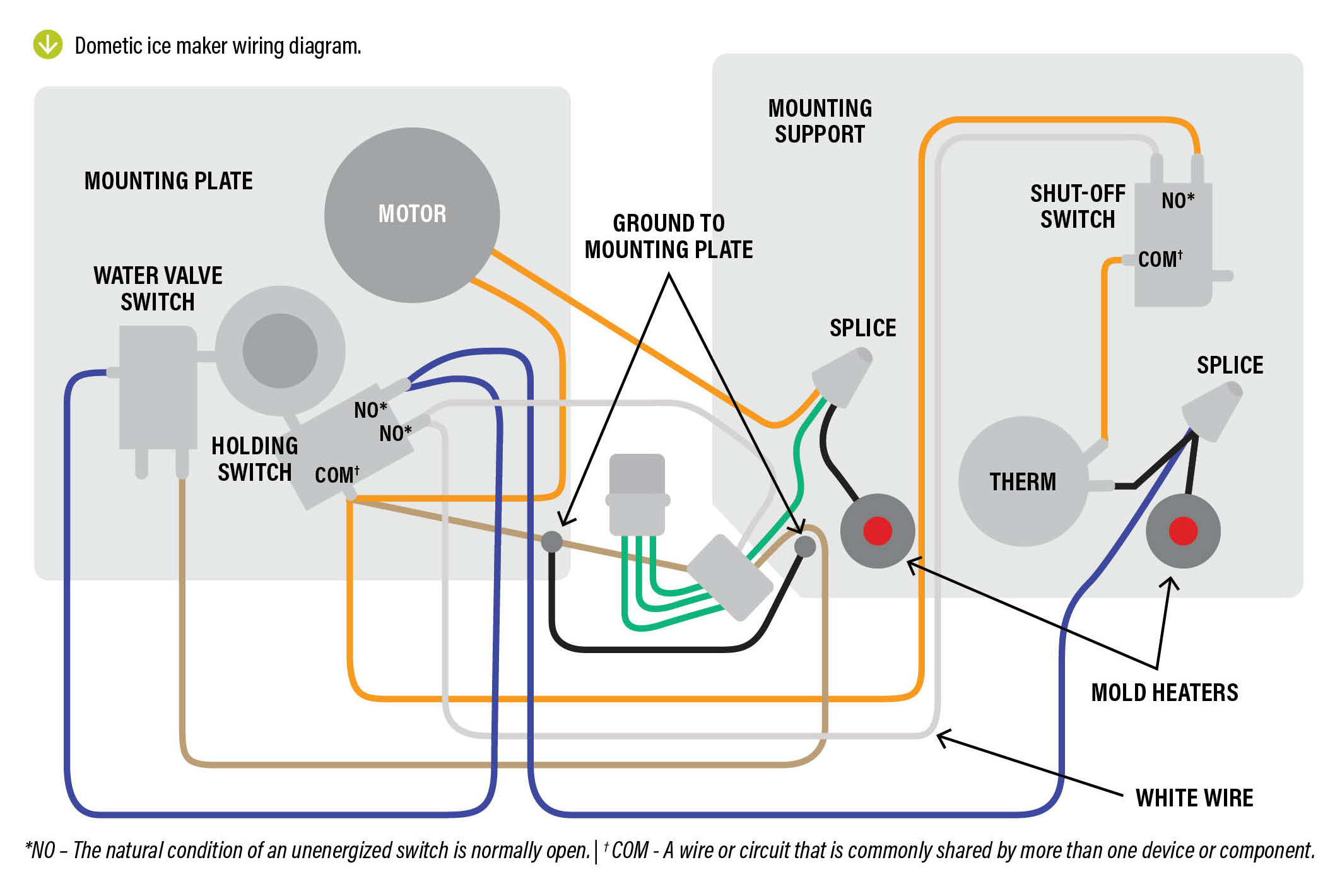 I have an older Executive Industries Diplomat motorhome. It has a Dometic RM1303 Automatic Energy Selection refrigerator that works great except for the ice maker. Somebody chopped all of the wires that were connected to it, and I have not been able to locate a wiring diagram to help me reconnect everything. I was able to reconnect most of the wires correctly, and at this point I can get the ice maker to cycle around to fill the tray and then shut the valve off before overfilling the tray, but that is about as far as I can get. After the ice tray is filled with water, the icebox does not get cold enough to freeze the water. So, I either need the wiring diagram for this ice maker or someone who knows how to wire it.
— Jeremiah Evans, Via email
I hope the accompanying diagram helps. Let me know if you need any other assistance.
Ballistic Battery
I recently had a motorhome battery blow up! My coach, parked in my yard, was connected to 120-volts-AC, 30-amp service. All the connections were good and clean; no corrosion. What was most likely the cause? The battery was 8 years old, but the monitor had been indicating a full charge.
— Gordon Bunker ● Via email
Yikes! It’s difficult to ascertain the exact cause of your battery explosion without seeing the evidence and checking the charging device. An unsophisticated or faulty battery charger, delivering too much voltage and current in a rapid manner, can lead to over-gassing the individual cells.
Once the battery begins accepting a charge (from any source), the voltage rises. If that voltage exceeds 14.4 volts or so, it expels hydrogen gas from the electrolyte; normally that gas is vented to the atmosphere. In a battery box or other quasi-sealed compartment, the hydrogen gas can accumulate to the point that all is required is an ignition source of some kind, such as a spark, an appliance flame, a loose cable, etc. An internally shorted cell on the battery itself also can trigger it.
Without examining the evidence, I’m guessing your battery, at that age, probably had shed some active plate materials that collected at the bottom of the battery. At some point, at least two cells shorted out, and with a charger pumping in unregulated voltage, it was enough to cause the explosion. It’s fortunate no one was injured. But at 8 years old, you certainly got your money’s worth out of that battery. If you opt for anything other than a sealed replacement battery, be sure to check the electrolyte level weekly.
I’d check the charging device to make sure an overcharge condition doesn’t happen in the future. It’s possible the converter/charger in the coach has a faulty component, which would require more troubleshooting.