
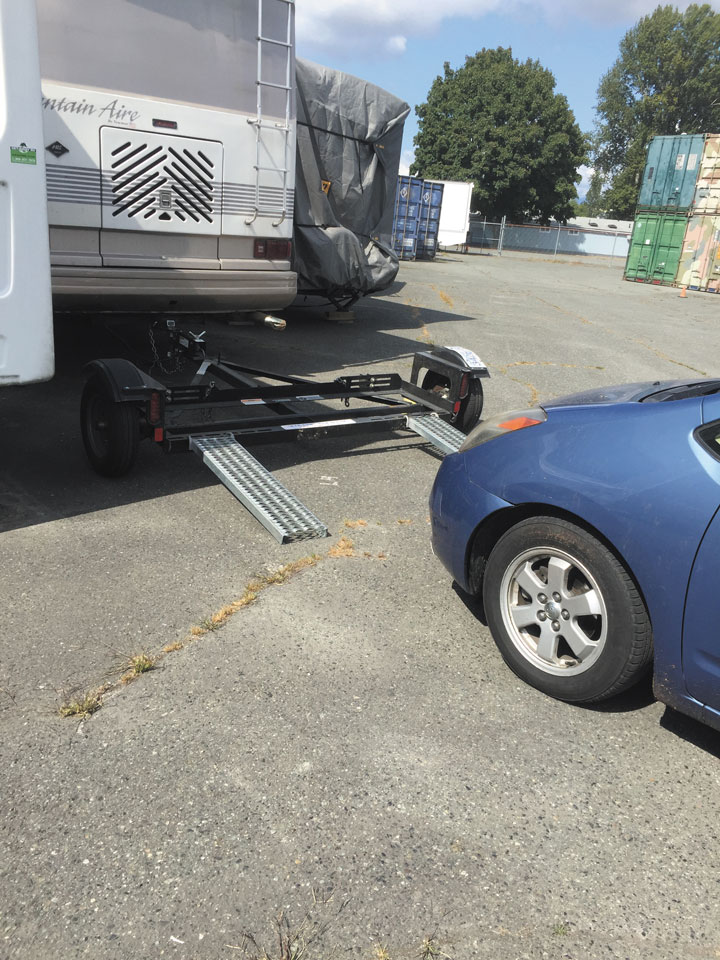
Acme Tow Dolly Company’s lightweight product features surge-type disc brakes.
By Steve Froese, F276276
December 2018
My family’s RV of choice is a large Type A motorhome. So, for us, and others traveling this way, the question becomes how to get around once a destination is reached. Transportation options include bicycles, taxis, trains, and ride sharing, but depending on the circumstances, these modes may not be viable, available, convenient, economical, or recommended. And ultimately, it’s nice to have our own car while traveling.
While searching for tow dollies, I ran across Acme Tow Dolly Company. Some years ago, this commercial trailer manufacturer decided that the tow dolly concept needed a major makeover. President Richard Brown and his team took up the challenge to rethink the tow dolly from the ground up.
The two primary concerns regarding conventional dolly design were brake implementation and weight. Some dollies weigh more than 600 pounds, but Acme’s dolly is less than 400. Although this may not seem like much difference, the Acme tow dolly is fairly easy for most people to move by hand.
For its Hydraulic Disc Brake Car Dolly ($2,499.99, at press time), Acme opted for a straight tube rather than a drop axle, and

Galvanized steel ramps are stored right on Acme’s tow dollies.
the company implemented a surge-type disc brake system to provide more effective braking. Since the brakes are disc rather than drum, adjustment is automatic, just as with disc brakes on a motor vehicle. The brakes are mounted near the top of the disc and are readily accessible on the dolly, allowing for quick and easy replacement of the pads.
Acme also sells the Idler Car Dolly ($1,799.99, at press time), an option with no brake. Both the brake and no-brake models feature LED lights as an option (or provided free for online orders) and removable galvanized steel ramps that store right on the dolly.
Acme opted for a completely welded frame, with no bolted components other than the hitch assembly. This means nothing can rattle loose while you are driving down the road. Acme also utilizes top-of-the-line components in the hydraulic surge brakes, as well as self-lubricating sealed hubs. The brake-equipped model features a slotted hitch tongue with the hydraulic line routed into it, providing extra protection for the brake line. The brake components are sourced from a common automobile manufacturer, so they are available at auto parts stores.
The 22-inch tires provide a nice, low ride for the dolly as well as the towed vehicle. The 3,300-pound axle weight capacity allows for almost any vehicle to be loaded. Also, the front of the pan is cut in the center, which allows low-profile vehicles to be loaded.

The author has experienced a smooth ride when using the Acme Hydraulic Disc Brake Car Dolly to tow his Toyota Prius.
I purchased the Acme Hydraulic Disc Brake Car Dolly and have found it to be easy to use and smooth-riding when towing my Toyota Prius. Since this particular dolly has its own brakes, no supplemental braking system is required on the towed vehicle. Another nice benefit of a tow dolly is that any front-wheel-drive vehicle can be loaded on it if the vehicle is within the weight rating of the towing vehicle. This is a benefit for anyone who has a choice of vehicles they want to take on a trip.
Several factors should be considered before you purchase a tow dolly. The weight of the tow dolly must be subtracted from the gross combination weight rating (GCWR) of the towing vehicle. Also, in many states and provinces, a dolly may be subject to registration/license fees, so check local regulations. Finally, tow dollies can be cumbersome to move and store, especially when staying at an RV park, but because of the small size and relatively low weight of the Acme dolly, stowing it is fairly painless. Since the dolly is so low to the ground, it often can be stored under the RV. An advantage of the Acme tow dolly is that it can be stored upright. This results in a very small footprint.
Also, don’t forget to rig the car in tow with lights. Since we tow only our Prius, I have wired the car lights directly to a trailer connector using an isolator, but you may choose to purchase magnetic tow lights.

Acme’s dollies come with safety chains, tie-downs, ratchets, and ramps.
The Acme dolly comes with safety chains, tie-downs, ratchets, and ramps, as well as full instructions for loading and securing the vehicle to the dolly. It also includes directions for maintaining the brakes, hub lubrication system, and surge system, as well as ordering parts.
The hub lubrication system needs service only every five years. The system uses a special positive pressure seal to keep the hubs lubricated and free from contaminants. Special grease must be purchased for this system, but that is a small price to pay every five years.
Acme offers a five-year warranty on all of the main brake components of the Hydraulic Disc Brake Car Dolly; an additional five years can be purchased for a nominal fee. Warranty coverage does not require returning to the factory; customers are directed to the brake manufacturer, which ships you the required parts once the warranty claim is approved. You then arrange to have the dolly repaired locally. The warranty does not cover labor.
I highly recommend using a tire pressure monitoring system (TPMS) with a sensor on each motorhome tire and on the dolly tires and the car’s rear tires. You will have to change the dolly’s valve stems in order to support a TPMS. If a blowout occurs on either the dolly or towed vehicle without a TPMS, it is highly likely that the driver would not notice. The result could be disastrous, ranging from a simple flat tire to vehicle or wheel damage or a serious accident or fire.
As a final note, remember that backing up a tow dolly is not advisable. However, it may be necessary in certain circumstances. Acme Tow Dolly officials say that if you must back up your tow dolly, be sure to insert the brake lockout key to avoid locking up the brakes. Then slowly and carefully back up, and try to limit the distance.
More Info
Acme Tow Dolly Company LLC
1031 E. Mountain St., Building 311
Kernersville, NC 27284
(336) 996-4396
www.cartowdolly.com