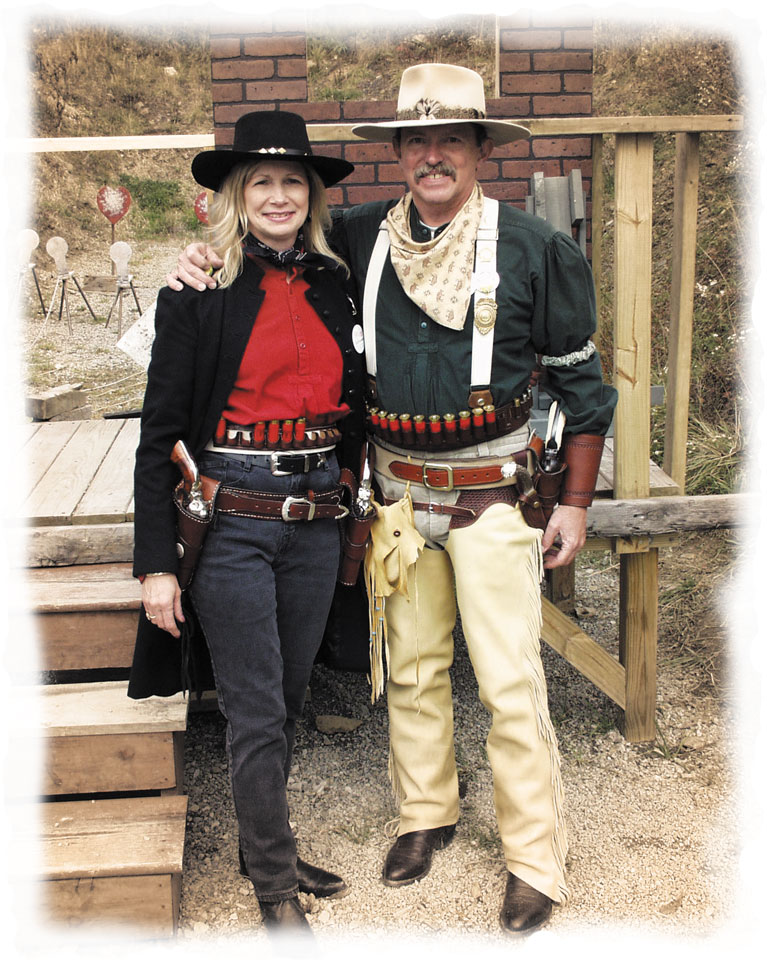
This competitive sport combines safe marksmanship with a nod to Western history and lore.
By Bruce Murray, F361709
January 2019
My wife, Deborah, and I started our camping adventures 30 years ago. We graduated from a tent to a pop-up camper and then purchased a Type C motorhome, a travel trailer, and our current RV, a diesel pusher. We plan many trips around one of our favorite pastimes: Cowboy Action Shooting.

Bruce Murphy engages shotgun targets at the Susquehanna Roundup Cowboy Action Shooting match in Pennsylvania.
RVing enables us to transport the paraphernalia needed for this fun, competitive shooting sport — firearms, ammunition, clothing, etc. Many of the matches have RV accommodations, which range from dry-camping areas to full-hookup sites.
Cowboy Action Shooting is governed by the Single Action Shooting Society (SASS), which is dedicated to preserving and promoting competitive Western-style shooting. SASS sets forth rules and procedures to ensure the safety and consistency of the sport. Through affiliated clubs, SASS sanctions local, regional, national, and international matches. To compete, participants must belong to the organization.
SASS-affiliated clubs are located in all U.S. states, as well as in Canada, Australia, South Africa, New Zealand, and Europe. Deborah and I could attend a match every weekend within an hour’s drive of our Pennsylvania home. Local matches typically last one day; regional matches, several days; national and international matches, almost a week.
Competition rules require participants to wear period attire appropriate to the late-19th century. Many enthusiastically embrace the costume aspect of the sport. Costumes range from trail-hand duds to elaborate period dress, military uniforms, and even gowns resembling those from Gone With The Wind.
Participants also are required to adopt an alias: one representative of a character or profession from the Old West; a Hollywood Western star; or an appropriate fictional character. The alias is a key part of the cowboy shooting experience, and it influences one’s choice of costume. An alias must be printable for a wide audience (no profanity, please), and it can be used by only one shooter. My paternal grandmother’s maiden name was Henry; she was related to B. Tyler Henry, inventor of the Henry rifle, precursor to the Winchester line of lever-action rifles. So, I adopted B. Tyler Henry as my alias. Deborah goes by La Coquette. To help in the selection process, SASS maintains an online database of aliases along with guidelines for members to follow when creating one.
Match Action

Bruce Murphy competes in the long-range rifle match during a Cowboy Action Shooting event at Winter Range in Phoenix, Arizona.
During a match, contestants compete with firearms typical of the Old West: single-action revolvers, lever-action rifles in a pistol caliber, and period shotguns. Each participant needs two revolvers, a rifle, and a shotgun. All firearms must be weapons that were manufactured before 1899, or reproductions thereof. Strict rules govern which firearms can be used in a match, and how they may or may not be modified. Rules also dictate the calibers of the rifles and pistols, the shotgun gauges, and the power factor of cartridges.
Various categories, or classes, of shooters exist; they are broken down by age, shooting style, and shooting era. For example, there is a Buckaroo class for shooters under age 14, and several age-related categories for those over 14. It is rewarding to see entire families participate in matches. Shooting styles include Traditional, which permits a two-handed hold on a revolver; Duelist, which requires a contestant to shoot a revolver with one hand, unsupported; and Gunfighter, which requires a contestant to shoot with a gun in each hand, unsupported.

A mounted shooter runs the pistol course during a Cowboy Action Shooting event at Winter Range in Phoenix, Arizona.
During a match, shooting contests take place in several different venues, which are known as stages. A typical one-day match usually includes five or six stages. Each stage features a different situation, with varied target arrangements and props. Think of a stage as a re-creation of a Western movie set, where competitors re-enact a scene from the film.
Match participants are divided into groups called posses. Each posse is led by a range officer, an individual responsible for making sure the group competes efficiently and safely. The range officer also manages the order of shooters.
Once a posse is assembled at a stage, ready to compete, the range officer reads the stage directions to the group; this includes any lines they may have to recite, which targets to shoot, which firearms to use, and in what order to use them. Once all posse members understand the stage and the shooting sequence, the initial shooter approaches the loading table.
SASS is extremely safety-conscious. For most matches, contestants use live ammunition to shoot at steel targets in relatively close proximity — usually 15 to 25 feet from the firing line. Shooters and spectators are required to wear eye and ear protection. Only the designated shooter is permitted to have his or her firearms loaded. A posse member acts as loading table supervisor and ensures that shooters load the firearms properly.
A shooter is called to the firing line by the range officer and positions his or her rifle and shotgun according to the stage directions. Once the range officer activates a handheld timer and a beep sounds, the shooter engages the targets. This is a timed sport; for each miss, 5 seconds are added to a shooter’s score. The shooter with the lowest overall time wins the stage. The competitor with the lowest cumulative time for all stages wins the match.
A typical stage may run like this: The shooter sits in a stagecoach, his or her rifle positioned on a hay bale adjacent to the coach and a shotgun placed on an adjacent bale. The shooter may have lines to recite. At the beep of the timer, they draw one revolver and shoot five pistol targets in the correct order; exit the stagecoach after holstering the pistol; run to the staged rifle and engage the rifle targets; replace the rifle, action open, on the bale; run to the staged shotgun and engage the shotgun targets; replace the shotgun, action open; draw the second revolver and engage the final pistol targets.
After the shooter completes the course of fire, the unloading table supervisor ensures that guns and pistols are emptied properly. Once this is completed, the shooter returns the firearms to a holster or gun cart.

Bruce and Deborah Murphy tote weapons, ammunition, and assorted supplies in their gun cart, which resembles a miniature Winchester delivery buckboard.
Think of Cowboy Action Shooting as golf with guns. Each shooter has, at a minimum, two pistols, a rifle, and a shotgun, plus more than 100 rounds of ammunition for a typical one-day match. Carrying that load around in a satchel or pack is unwieldly, not to mention exhausting, so shooters resort to using carts equipped with racks for their long guns, as well as places to store ammunition, folding chairs, umbrellas, coolers, etc. At many multiday matches, gun carts are judged for creativity and uniqueness. I built our cart to mimic a miniature Winchester delivery buckboard.
Spectators are encouraged at shooting matches. More than a few SASS members attended their first match as a spectator. Some spectators arrive in Western costume, though this is not a requirement.
At multiday regional and championship matches, the schedule includes side matches as well. These contests can involve long-range rifles; derringers; long-range pistols; and shotgun events such as strap, skeet, and sporting clays.
Another competition category is Mounted Cowboy Shooting. As its name implies, contestants fire rifles and revolvers from horseback. For these contests, blank ammunition wadded with chalk dust is used, and the targets are balloons on 4-foot-tall poles. The chalk dust will break a balloon as the shooter fires while galloping past.
Lastly are Wild Bunch matches, named for the 1969 Western The Wild Bunch. Model 1911 .45 Colt automatic pistols, lever-action rifles, and 1897 or model 12 Winchester shotguns — the guns used by characters in the film— are required for this shooting category.
Setting Up Camp

RV parking is available at many Cowboy Action Shooting events, which enables Deborah and Bruce Murphy to bring along their corgis.
When competing in one-day matches, we usually dry camp at the shooting venue. For multiday matches, we’ll stay on-site if hookups are provided or at a nearby commercial campground if they are not. During a Wyoming state championship match, “Hell on Wheels,” in Cheyenne, we opted for a commercial campground. After seeing us come and go while dressed like Roy Rogers and Dale Evans, curious campground neighbors asked us what we were up to. After we explained what Cowboy Action Shooting was all about, several of these new friends came to the range to view the match.
We have found that Cowboy Action shooters, like RVers, are friendly and helpful. It’s not unusual for a shooter to lend a fellow competitor a firearm if one of theirs malfunctions during a match.
I would encourage anyone interested in the sport to check out the SASS website and to attend a local match. But be warned: It’s addictive!
Further Info
Single Action Shooting Society
www.sassnet.com