
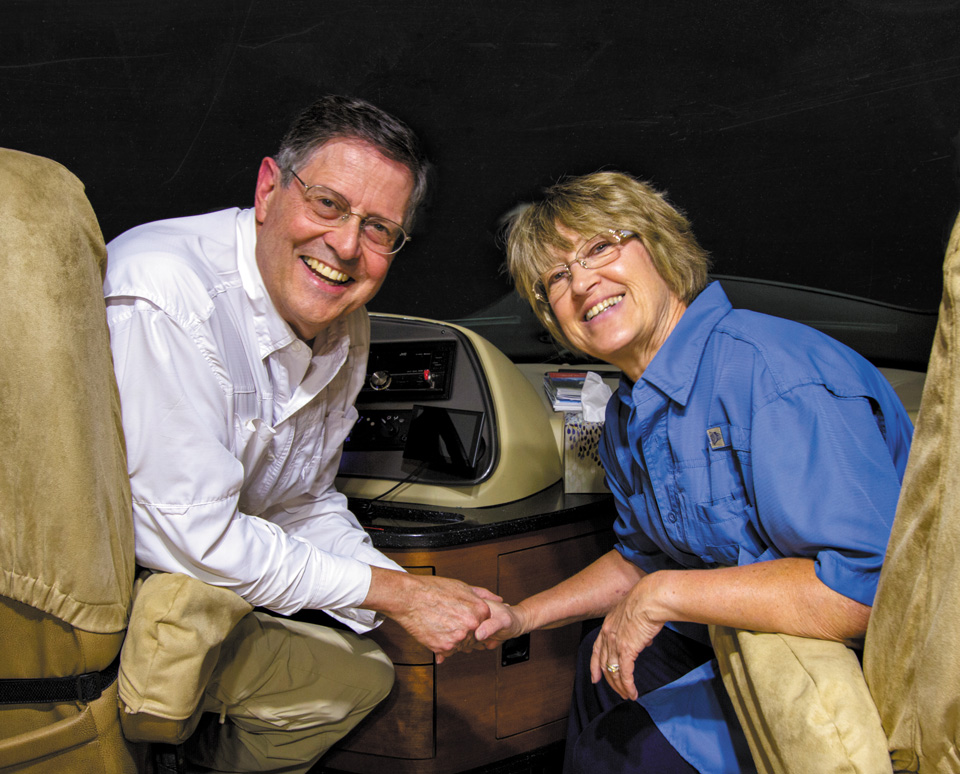
Impressions and experiences logged during a couple’s first year of travel in a 35-foot motorhome.
By Steven M. Jenkins, F466222
January 2019
My wife and I read about “glamping,” a term for glamour camping. We decided we liked that idea, since we were retiring baby boomers and well past the time when we used to sleep under the stars. So, we bought a 35-foot diesel pusher. Despite our careful research and planning, we were surprised a few times, as experience still proved to be the best teacher. There still is a lot of camping left in RVing, even though modern motorhomes strive to make life clean and easy.
We’d like to share some impressions and advice gleaned from our inaugural RV travels.
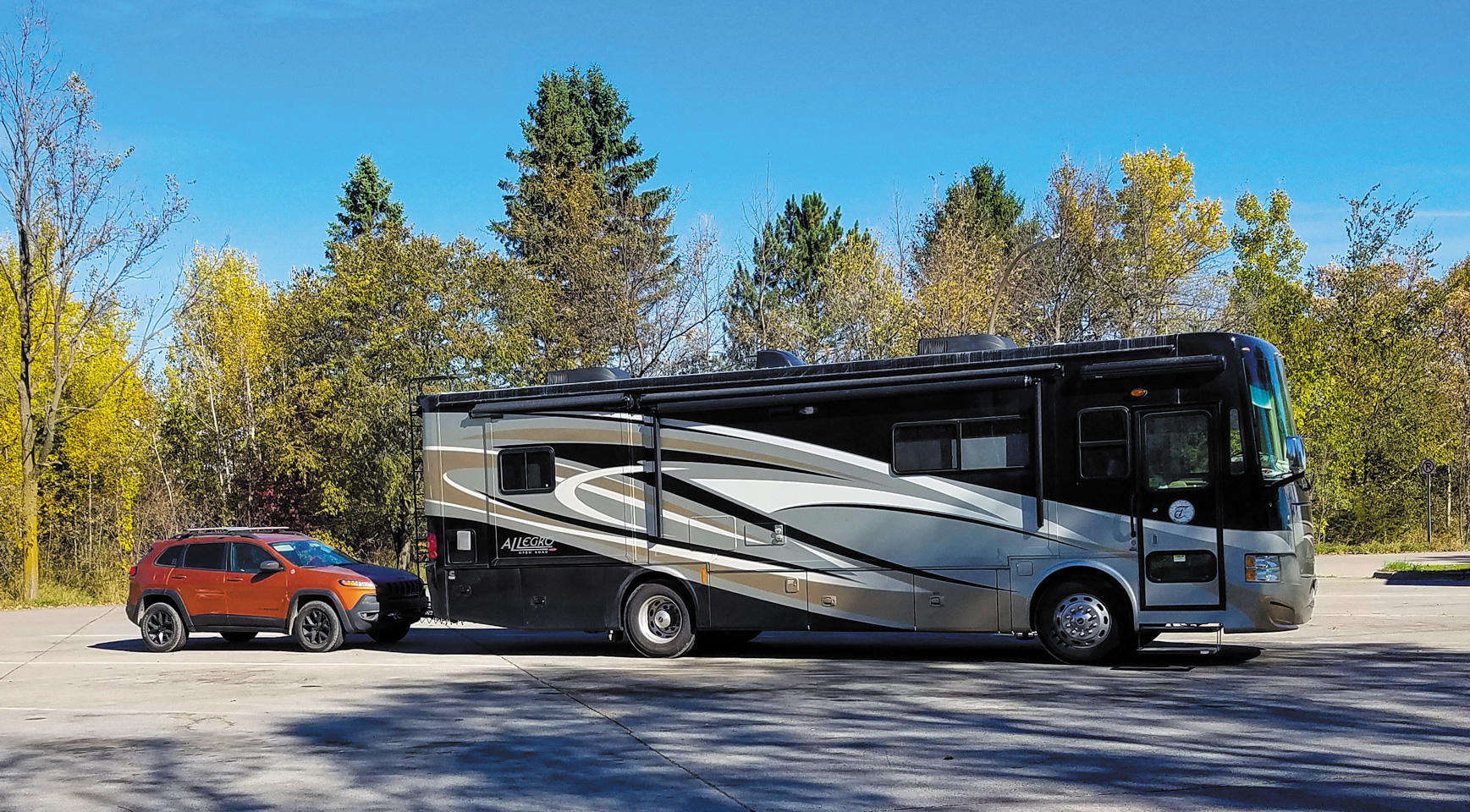
After purchasing their first motorhome, Steve and Betty Jenkins set out on their inaugural road trip, which yielded wonderful experiences as well as some revelations about RVing.
Everything outdoors is still camping. Clothes end up with black smudges out of nowhere as you work on hookups, hitch and unhitch the towed vehicle, etc. Stowing the electrical cable and water hose means handling items that have been lying on the ground, so you need to have a paper towel or something suitable to wipe them off as you roll them up. Wear old clothes and gloves for these tasks.
Bring along bug spray. Have insect repellent handy, even if you are not planning many outdoor adventures. During warm weather, flying pests will try to devour you as you hitch and unhitch the RV, especially if you are near the water.
Purchase a good doormat. Tracking dirt into an RV is unavoidable, so buy a sturdy doormat to keep at the top of the entry stairs. It is far easier to shake out the mat outdoors than to continually sweep out the entire interior.
Get a 13-gallon kitchen trash can. Our motorhome, like many others, has a small area in the cabinet under the kitchen sink. We bought a trash can for that spot at an RV supply store; however, the items that one typically disposes of in the kitchen trash are often large and bulky and can quickly fill up a small can.
Get an “island” for the kitchen. If your RV does not have a built-in kitchen island, buy a folding table that can be set up when extra counter space is needed. This makes a huge difference, especially in a smaller galley. We found a good folding table at a local home-improvement store that is the same height as the counter and stows easily.
Invest in plastic storage bins. Organize the overhead cabinets and basement storage areas with an assortment of lightweight containers. Buying them at a home-improvement store or other big-box store is easier than purchasing online, as you can see exactly what dimensions the containers come in.
Use a drying rack inside your shower. There always seems to be bathing suits and other items that need to be washed and hung up to dry, but most RV parks prohibit drying clothes outside. So, an indoor clothes rack is important to have. We also use plastic clothespins that have hooks on one end to hang items in the shower.
Traveling out West can be dusty. Parts of the western United States can be dry and windy, causing red clay to become dust and take flight, covering the RV, towed/towing vehicle, and you. It even makes its way into the basement bays and the interior. And RV parks don’t typically allow guests to wash their vehicles. So, prepare for a dirt-covered experience. We left Florida expecting less respiratory congestion away from the pollens, but we discovered that dust-related issues caused similar concerns.
Cleaning a motorhome windshield is time-consuming. One of the attractions of a large motorhome is its expansive, picture-window windshield. But it also attracts bugs (or their remains) in large quantity every day that you drive. Because of an RV’s height, you generally must use a ladder to reach the large area of bug-laden goo, scraping it off with a razor blade, then spraying it with glass cleaner and rubbing it clear with a paper towel. That only covers one arm’s length of the windshield, requiring you to repeatedly move the ladder about a yard at a time across the width of the windshield — every day you drive.
Western mountain road driving is very different from traveling in the East. Our diesel pusher slowed down to less than 20 mph by the time we reached the top of a miles-long, 12 percent climb. That can be pretty scary when towing a vehicle, with no place to pull over. And this is magnified when the cars and trucks behind you angrily sound their horns and pass on the double-yellow lines.
Then there are equally dramatic declines, where exhaust brakes and downshifting may not slow the RV down enough to be comfortable. Additional pedal braking is needed, which can lead to overheating brakes. And don’t forget the altitude, which changes continually as you rise and fall a thousand feet or so on steep grades. Just as passengers do when riding in an airplane, you may need to chew gum to relieve the pressure in your ears as you simulate air flight in your RV.
Wind turbulence was our biggest problem on the road. I was shocked to sense the motorhome being shoved to the next lane by what seemed like an invisible hand, thanks to the wind. Sometimes it felt as though the RV would tip over. This was especially noticeable out West, but we found it almost everywhere to some degree. I even had a steering control unit installed, which helped to diminish weaker winds, but it did not end the problem in areas with pronounced wind turbulence.
We were surprised by the ease of emptying the holding tanks. All of my reading and planning paid off, as I had the necessary items for this chore: disposable gloves, high-grade sewer hoses, etc. I rarely found a damaged or defective sewer opening where we stayed. The process went smoothly, and I was able to get the hoses out and back in without incident. The one exception was when fastening and unfastening the sewer hoses. The plastic hook-over-knob design fit so tightly that I had to use channel lock pliers to fasten and unfasten the hoses. After I used a 3/8-inch drill bit to widen the hook slots, the hoses hooked and unhooked easily.
The motorhome roof, outer walls, and floor needed more insulation. Because our RV roof lacked sound-deadening insulation, hard rains tended to create a roar inside. And when outdoor temperatures soared or plummeted, items stored in the cabinets and pantry also became too hot or cold. In August, as we drove on the highway, operating both air conditioners with help from the generator, the rear bedroom near the diesel engine registered a temperature of 99 degrees. I had stored photography equipment under the bed and found, to my horror, that the waterproof coating in my best camera bag had melted and stuck to a couple of expensive lenses.
Get bubble-pack insulation sheets. In the Southwest, air conditioning alone was not enough. We also had two electric fans to help cool the coach interior, but nothing is as nice as having something to put against the windows. Reflectix-brand polyethylene bubble-pack sheets are great for shutting out the heat while parked in warm areas. Plus, it comes in 4-foot-by-10-foot rolls that easily can be cut to fit windows.
Slow way down when driving on uneven pavement. Pulling off the road into a fuel station, we encountered a shoulder drop-off, then small dips and rises in the road surface that were greatly magnified by the height of our motorhome. In addition, speed bumps must be crossed at about 5 mph to avoid a loud rise and crash down, jarring the RV’s contents dramatically. You need to ignore the fuming drivers behind you, and just slo-o-o-w down.
Secure all interior doors for travel. Based upon the above experiences, as well as testimony from other RVers, it is wise to use bungee cords to keep all cabinet doors shut during transit. We added one to the refrigerator door as well after it swung open during a sharp turn. No matter how careful a driver you think you are, unforeseen things will cause you to make a quick, hard swerve or turn that can yank the doors open and send the contents flying.
Campground reservations are important. We stayed in full RV parks nearly everywhere and were happy that we had made reservations. Even some truly run-down facilities were packed with campers desperate to find a place to park. Conversely, reservations can limit impulse side trips and some travel flexibility.
Store bottled water in your RV’s basement. We had read about this before our trip and bought a large plastic bin to house about a dozen gallon jugs of spring water for drinking and cooking. We ran into someone who claimed her first few days on the road were spoiled by “intestinal flu” — her digestive system’s reaction to the local water. Even though we have a water filter in our city water hookup, we do not drink the local water.
Do not overpack food items. Rather than fill your freezer with meat and frozen vegetables, you may be better off preparing some meals, such as casseroles, in advance. Divide them into serving sizes, wrap the servings in plastic wrap, and freeze them at home. Then transfer them to the RV freezer for easy preparation on the road. When those meals run out, go shopping. The only exception is for those unusual and/or hard-to-find items; pack what you will need.
The biggest storage challenge is the refrigerator. I had read about placing extension rods in front of the refrigerator door to keep jostled items from falling out when the door opens, so I got one for each shelf. What I didn’t receive warning about was the continual need to rearrange the refrigerator contents before taking to the road so as to prevent shifting. Items in the fridge fell over and slid around if they were not snugly up against something solid and immovable. Small organizing bins can help with this issue also.
Do not pack too many clothes. Even in the hottest weather, we wore long-sleeve nylon shirts and long nylon pants with high ultraviolet protection factor (UPF) ratings to protect us from the sun. These are thin, stay cool to the touch, and take up very little room in the closet. Toss in a light hooded jacket and warm coat for colder weather, two or three pairs of shoes or boots, and a couple drawers of underwear and socks, and you are set for almost any trip.
Standard fuel stations may have better prices, facilities, and service than truck stops. Even with truck-stop discounts, we typically found that it cost us less at regular fuel stations, which had clean facilities and friendly employees. However, RVers need to be extremely careful when entering and exiting any facility not designed for large vehicles. We had many close calls getting into fuel stations that offered little room in which to maneuver.
Parking the coach was our highest expense. Camping fees exceeded the cost of diesel fuel. I better understand now why so many RVers desire more than just privacy, space, and a better view of nature. But if you want full hookups, you will stay in an RV park, because state and national parks rarely have even 30-amp electrical and water hookups. In addition, state and national park camping sites often cannot accommodate larger RVs.
You may eat out more than you think. When we decided to try RVing, we justified the cost of buying a motorhome by thinking we would nearly eliminate the cost of eating out. But for us, one of the joys of travel is sampling area foods and eating out in local restaurants. We found that dining out made up more than 18 percent of our total costs.
Sign up for unlimited data before leaving on a trip. You likely will want to keep in touch via the internet and use internet-based services such as online banking, which require a secure connection that can be hard to find on the road. Wi-Fi can be spotty or nonexistent. Using your smartphone as a hotspot for a secured connection is essential, but this depletes your data allocation quickly.
We did learn a great deal during our inaugural year. For a fuller account of our continued RV travels, visit our blog: www.stevenandbettyadventures.blogspot.com.