
RV Doctor
By Gary Bunzer, Technical Editor
Step Cover Uncovered
I have a Winnebago Journey motorhome with a Kwikee step well cover. The well cover has a recurring problem. It will not extend and sometimes will not retract. When it fails and I attempt to operate it, nothing happens. There is no clicking sound and no sound from the motor. I tested the switch and it functions properly. I have had the well cover repaired several times, and the issue recurs shortly afterward. On the road, I have little control over who does the repair, and I am not sure the work was done correctly. When I take it to my regular shop, the well cover always works. It must be gremlins. Any suggestions?
Ed Broomfield, F420287
Claremont, California
Those step covers have a tendency to malfunction, I believe, based on the location of the motor and the control components. They often are positioned in areas prone to deterioration, oxidation, and exposure to the elements. In the vast majority of cases, the cause is simply a corroded or loose contact on the switch, the relays, or the motor. And the majority of those are on the grounded, negative side of the circuit. In some cases, the motor may not even be grounded to the chassis.
Since you’ve verified that the switch is operating properly, look for the connections at the control board (where the manual switches are located), under the front access hatches. You’ll see two blue push-button switches attached to the control box. If the step cover works from those two buttons, the problem is either a failed relay or a loose or faulty connection.
I always recommend running a new ground conductor from the motor housing directly to the frame of the motorhome. If you see multiwire connectors associated with the step cover, be sure to clean the contacts thoroughly. I recommend coating the connections with DeoxIT to protect the newly cleaned contacts.
In rare cases, a relay or actuator or perhaps a motor also can fail, but the majority of ills have been the result of corroded or loose contacts. In extreme cases, it may be necessary to rewire the control circuitry, but I’d first check all the wire terminations for cleanliness and tightness. As I mention in my seminars, when it comes to electrical connections, the key words are clean, dry, and tight!
Running Interference
I recently purchased a new Dynamax Type C motorhome on a Mercedes-Benz Sprinter chassis. I am noting an electrical interference pattern on some of the TV channels while plugged into an RV park cable system. This interference does not occur using the off-air antenna, and it is completely alleviated if I bypass the internal coach wiring and hook the cable directly from the RV park pedestal into the back of the TV. I turn off the antenna power amplifier when hooked to cable. The motorhome has a Magnum pure sine wave inverter, and when I turn it off, the interference decreases, but only slightly. I have traced the TV wiring and it’s all RG6. The park cable feed comes into the coach and goes directly to the circuit board on the back of the Winegard power amplifier panel. From there, it goes to a three-way splitter, which distributes the signal to the main, bedroom, and outside TV jacks.
What might be causing the interference pattern, and is there any kind of filter that might eliminate it?
Robert Swisher, F486346
Knoxville, Tennessee
Somewhere in your RV, AC and DC wiring may have been bundled together. Either that, or they might exist in close proximity to each other and/or to the coax cables connecting the park receptacle to the televisions and the antenna booster. Induction or capacitance at work behind the scenes! Other on-board electrical equipment also can cause the symptom. A process of elimination might determine which device, but it likely is a moot point.
The best scenario is to keep at least a half-inch separation between all DC and AC conductors, including all coax cables, while the RV is being built. Within an already completed RV, however, the best solution is to add a common mode noise filter such as you’ve suggested. Without determining the actual frequency of the interference, it might be hard to choose the correct filter, but you could probably get by with a 1,500-watt model. Take a look at this Palomar Engineers web page: https://bit.ly/2PAmBF7.
Install the filter as close to the output of the Winegard booster as you can, but before the connection to the splitter. That way, signals to all three televisions should be protected. Other documents on the Palomar site might provide further troubleshooting tips for you, so bore down deep into their resources.
Strange grounding and bonding issues can abound inside an RV. Verify that the metallic enclosure of the inverter is properly bonded to the frame of the motorhome and check the integrity of all the electrical ground conductors. They, too, must ultimately terminate on the frame. Also check the coax connectors on all the cable ends you can reach. Ensure all the crimp rings are tight.
Air Conditioner Swap
I just replaced my Coleman-Mach air conditioner with a Coleman-Mach I air conditioner. It has a nine-pin plug, but I have two extra wires — a white one with black dots and an orange one with black dots. The white one came off of a post marked “compressor 2,” but the new unit already has one on it. Any thoughts?
Billy Hinton
Via Email
Without having the exact wiring diagram for your coach, I think it’s safe to assume those extra two wires are for applications that include an energy management system (EMS). If you happen to have the schematic for your brand of RV, please forward that to me and I can confirm my assumption. If you do not have an EMS on your RV, then those two conductors likely are not needed.
Palpable Pump Problem
We own a 2005 Holiday Rambler motorhome equipped with a Shurflo 4008 water pump. The night before we left for our annual snowbird trip to Arizona, the pump quit working. In the six years we have owned the coach, we have replaced the pump three times. Although the pumps are under warranty, I now carry a spare. The pump is not used on a consistent basis, since we normally are set up in RV parks. Replacing the pump every other year seems excessive. Is this normal? Are we abusing the pump by not operating it consistently? There has to be a better way. I spoke to a dealer who suggested changing to a Flow Max.
Nick & Jeanie Olmstead, F440466
Sioux Falls, South Dakota
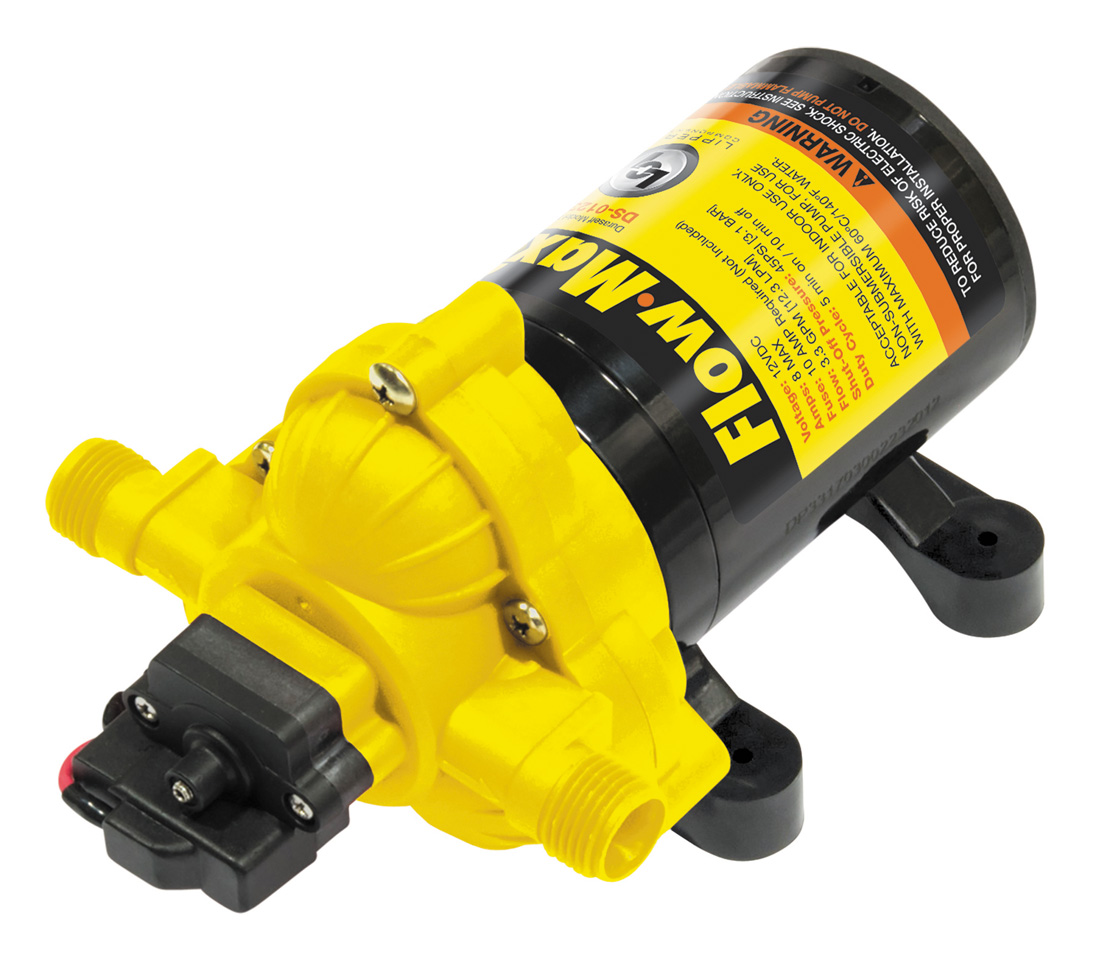
The Flow Max water pump is rated for 3 gallons per minute at 50 psi.
What a frustration to go through three water pumps so quickly! I’d be curious to know exactly what is causing the pump to quit working. Does it still run, but simply not pump water? Or does the motor not even operate? Are the same symptoms present each time? Does the fuse blow? It shouldn’t really matter whether the pump receives “exercise” while you are connected to city water, but it certainly cannot hurt to occasionally run the water pump, if for no other reason than to keep the seals moist inside. Every week or so, turn off the city water spigot and run some water through the pump just for a few moments.
It may be something as simple as the pump losing its prime. If I remember correctly, the 4008 does not have an internal check valve/backflow preventer. Almost every other pump does. It’s best if there is some static pressure left in the pump for it to self-prime. Try this: Install another backflow preventer to the outlet port of the pump itself. You can get ½-inch backflow preventers at any big-box store or reputable RV accessory store. See whether that solves the issue. Chances are, the pump is just fine; it just may not be keeping its prime.
As for the Flow Max, I have thoroughly evaluated that water pump, which comes with a two-year warranty, by the way. During my testing, it outperformed all the others. If you still have problems with the 4008, you certainly cannot go wrong switching to the Flow Max.
Tech Tips
Shower Relief
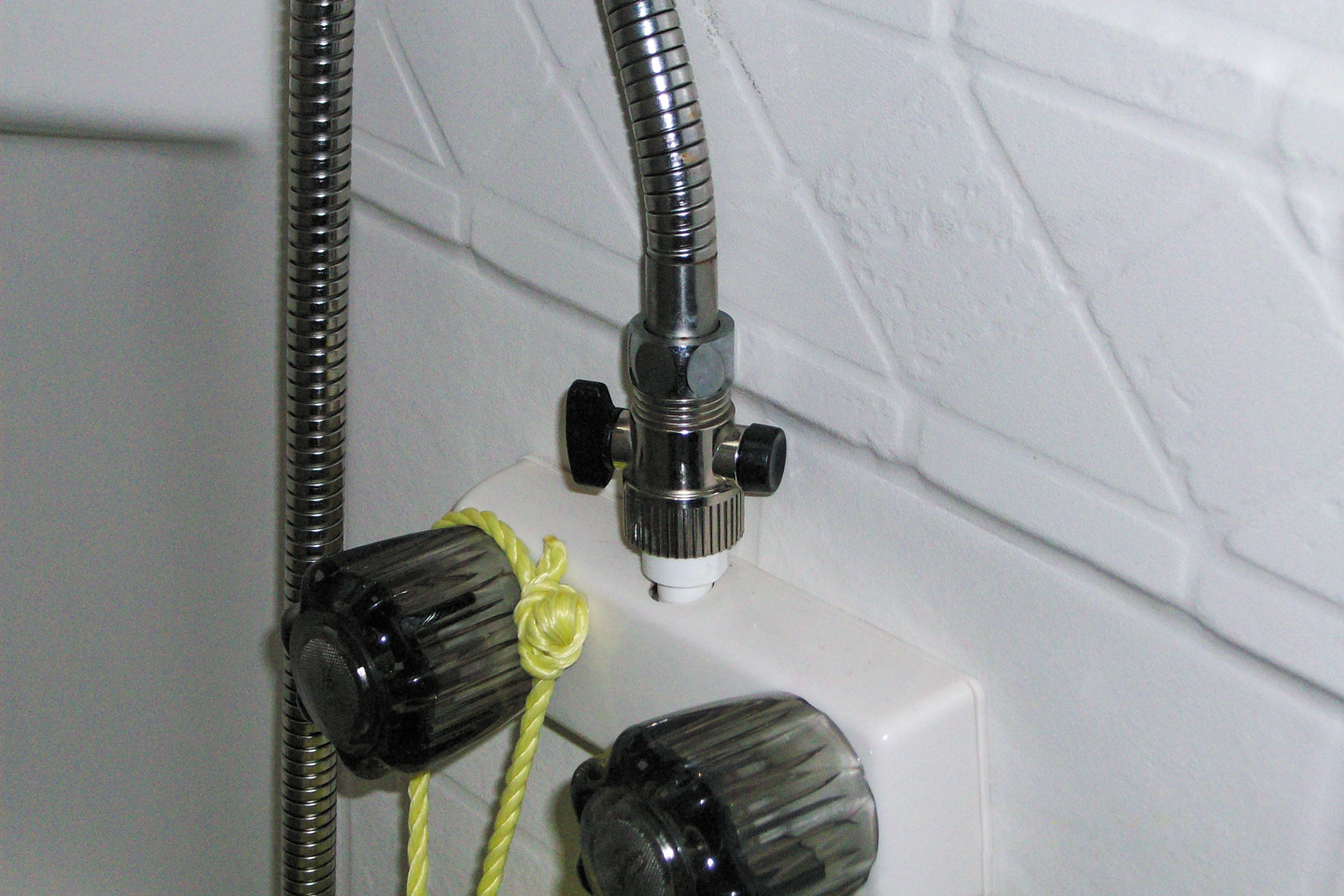 In the June 2018 “RV Doctor” column (page 16), Andy Switzer wrote about conserving water by turning it off briefly at his showerhead; when it comes back on, it’s scalding hot. I solved this by installing a small shutoff valve between the faucet fixture and the shower hose. Such valves are available at plumbing supply stores, and they are easier to use than the shutoff on the showerhead.
George Mullet, F337967
Sterling, Ohio