
February 2019
Fussy Fridge
I have an older Norcold four-door refrigerator in my 2001 Monaco Executive motorhome.
You previously have mentioned performing the “dollar bill test” on the door seals. It involves closing the refrigerator door on a dollar bill at various points around the seals, and tugging on the bill each time. If a slight drag or resistance is not felt, the seals should be replaced. From what I have found, it’s impossible to replace only the seals; the entire door must be replaced, which is incredibly expensive. Is that true?
Also, when the motorhome has been sitting with the refrigerator turned off, the gas flame will not remain on for very long. It lights just fine, but it goes out after about two minutes. If, however, the unit has been running on electric for more than a half hour or so, when I switch it to gas, it lights and stays on with no problem. Any ideas on this one?
Jim Kussy
Via email
 You are correct that some Norcold refrigerators require a complete door replacement should the seals fail. Thankfully, those seals seldom fail. As long as the RV remains relatively level, it’s not likely they will warp or become distorted. On some models, it’s possible for the doors to be adjusted to maximize the effectiveness of the seal.
As to your specific issue, I’m wondering whether the gas regulator — either the main pressure regulator down at the propane tank or the regulator within the refrigerator controls — is out of adjustment. It might be time to have a qualified service technician measure the gas pressure at the pressure tap on the refrigerator to verify that the delivery line pressure is set correctly.
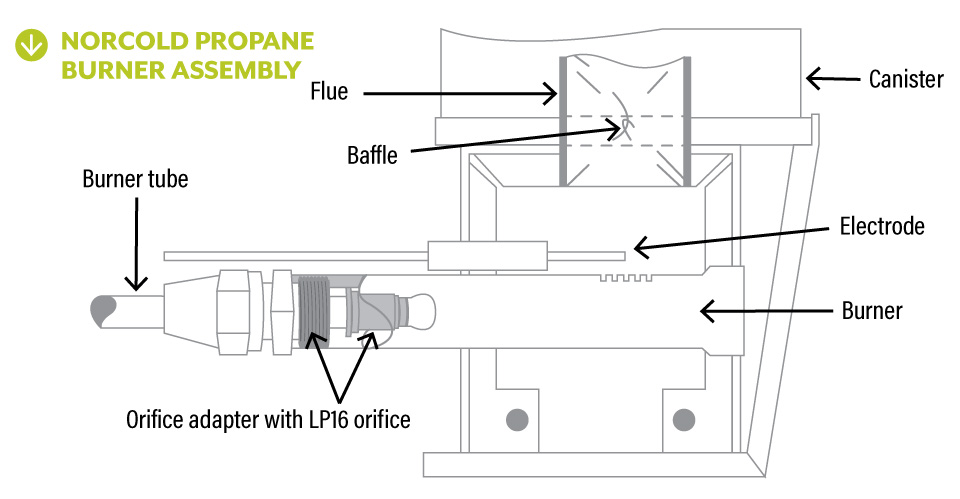
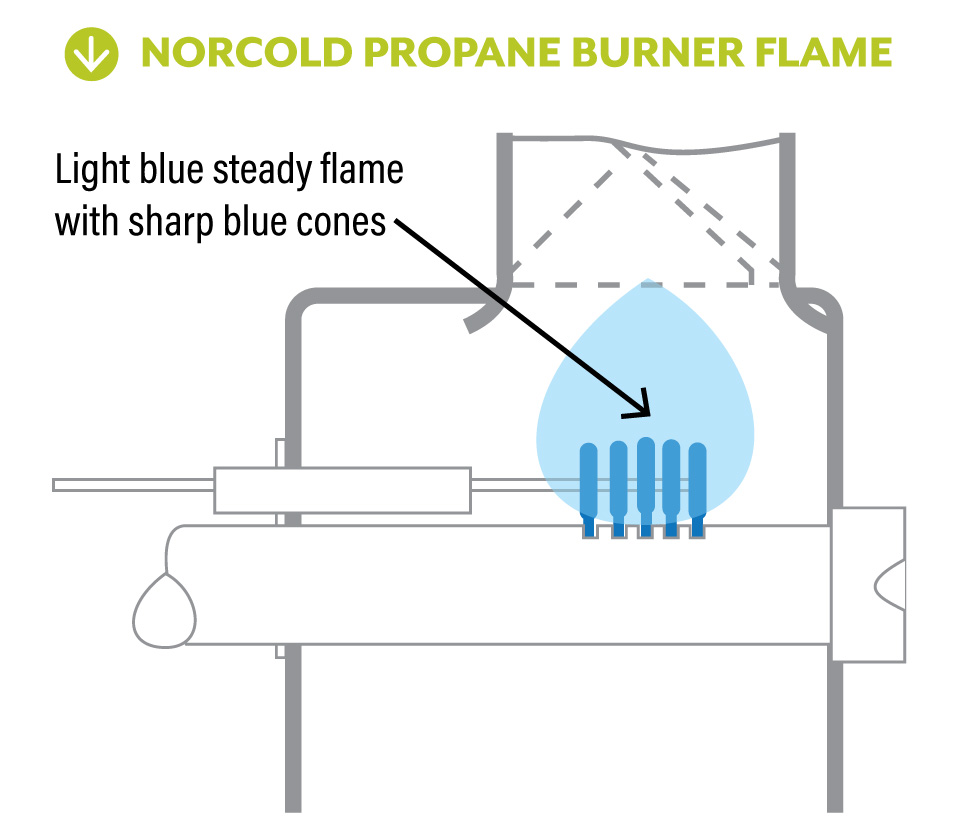
Also, cleanliness of the burner components is crucial. For example, a slight covering of carbon buildup on the flame sensor can cause problems. Such buildup on the electrode probe will insulate and cause erratic operation. Normal maintenance calls for removal of any carbon buildup, so be sure it is inspected during annual preventive maintenance. I recommend using 0000 steel wool to “clean” the electrode periodically. The tip of the sense probe should be positioned over the middle of the slots in the burner and centered on the burner tube. The propane flame should be mostly blue with sharp tips. Make sure the orifice is clean, as well as the primary air intake ports on the housing where the orifice threads into the burner.
Another thing to check is the gap spacing between the flame sensor and the burner. The fact that the unit works after it is warmed up (by the AC heating element) tells me there may be some physical movement happening as the metallic components heat and cool. If the flame sensor is slightly out of position and the refrigerator is cool, but then it works when the back of the unit is hot, the gap spacing just might need adjusting so that the board can acknowledge the presence of a flame from a cold start on propane. The gap between the flame sense electrode and the burner should be set to 1/8 inch to 3/16 inch.
So, the possibilities include gas pressure (at the refrigerator or main regulator); cleanliness of the burner and ignitor/flame sensor; and sensor positioning.
Spotty Roof
Is there a simple solution to take spots and mold spots out of a white rubber roof on my Southwind motorhome? I tried a rubber roof cleaner, as well as Tide with bleach, and neither works.
Bernard Baumann, F207488
Shakopee, Minnesota
This question comes up often, and it is important to remove mold and tree sap as soon as possible. I’m not sure which rubber roof cleaner you’ve tried, but Dicor and Protect All make cleaners that have worked for me. For very difficult stains, you might try Simple Green or even a clean, dry cotton cloth moistened with a little bit of mineral spirits. Do not saturate the rubber membrane with the mineral spirits; just dampen a cloth and work it into the stain. I know everyone says you should never use petrochemicals on a rubber roof, but even one maker of EPDM suggests a cloth dampened with a small amount of mineral spirits is okay for truly stubborn stains. Also keep in mind that EPDM normally does not require maintenance. But to keep it looking nice and to remove that layer of chalking, regular washings (three or four times a year) usually will result in a long life.
Back-Flushing
We have a 2017 Winnebago Vista motorhome. The only way I see to back-flush the black-water holding tank is to run a hose into the RV and run water into the tank through the toilet. Everyone thinks that this is a strange way to back-flush, but that appears to be the only way to accomplish this. Is this what I should do if I have a blockage?
John Bradford, F461741
The Villages, Florida
Running water via a hose through the toilet is not really back-flushing, since the incoming water is simply following the normal pattern of flow. Back-flushing, by definition, is forcing water back up and into the holding tank through the termination assembly (the sewer outlet fitting).
Some RVs are equipped with a garden hose attachment affixed to the side of the holding tank, along with a check valve to prevent waste water from coming out the inlet. Some even have nozzles or jets that protrude into the tank to help distribute the flow. Also, aftermarket products can be purchased, including a hose fitting attached to the sewer hose adapter so fresh water can be induced backward into the tank while it is still draining. In both instances, the water pressure is limited to the existing pressure emanating from that particular spigot. And therein lies the problem.
Normal campground or household city water pressure does virtually nothing to dislodge the contamination of waste that accumulates on the inner tank walls. Such sludge and contamination can, over time, cause electrical disturbances in monitor panel level indicators, rendering them inaccurate. In addition, there are health and hygiene considerations.
Tests have proven that it takes a tremendous amount of water pressure — 1,500 to 2,500 psi — to remove and fully clean the tank walls and level indicator probes. Pressure this high is simply not available through normal city water connections; you will need specialized equipment. I suggest that you contact All Pro Water Flow. The company has trained and equipped teams that can completely and properly rid holding tanks of accumulated waste residue. For a listing of their approved partners, visit https://goo.gl/DUF2Zh.
In my opinion, back-flushing through a dedicated sewer adapter fitting, or running a hose to the toilet, or utilizing those tank-mounted inlets results in nothing more than “rinsing” the tanks. It’s not a bad thing, but it certainly does not provide the force required to dislodge contaminants. I always recommend using copious amounts of fresh water after each evacuation anyway. It’s just that the effectiveness of such fittings and adapters often is either misrepresented or misunderstood.
I Want My RV TV
We’ve owned a used RV for two years but haven’t connected to DirectTV yet. Are there special deals for satellite TV service in an RV? With technology changing so much, are there any better options?
Carla Perala, F465305
Ishpeming, Michigan
I’m not well-versed in the satellite world. I did note an ad in the January 2019 issue of Family RVing that offers FMCA members $50 off a satellite antenna bundle from Dish. Visit https://get.dishformyrv.com/FMCA call (800) 970-9541; code FMCA. You also could seek information about the various satellite providers on the FMCA Forums (community.fmca.com). Under the “Communications and Technology” section, visit the “Electronics” category. Our active members are quite willing to offer their thoughts on just about any aftermarket product or service.
You definitely will need a receiver in order to connect your television to the antenna. Typically, receivers are leased from the service provider, and they can range from less than $100 to around $250, depending on whether you want high-def and the ability to record shows. Again, I must defer to the Forums, since I really haven’t evaluated the satellite world. You may find bargains by bundling various services — satellite, cell, home use, and internet — with a single provider.