
By Gary Bunzer, Technical Editor
Thirsty Battery
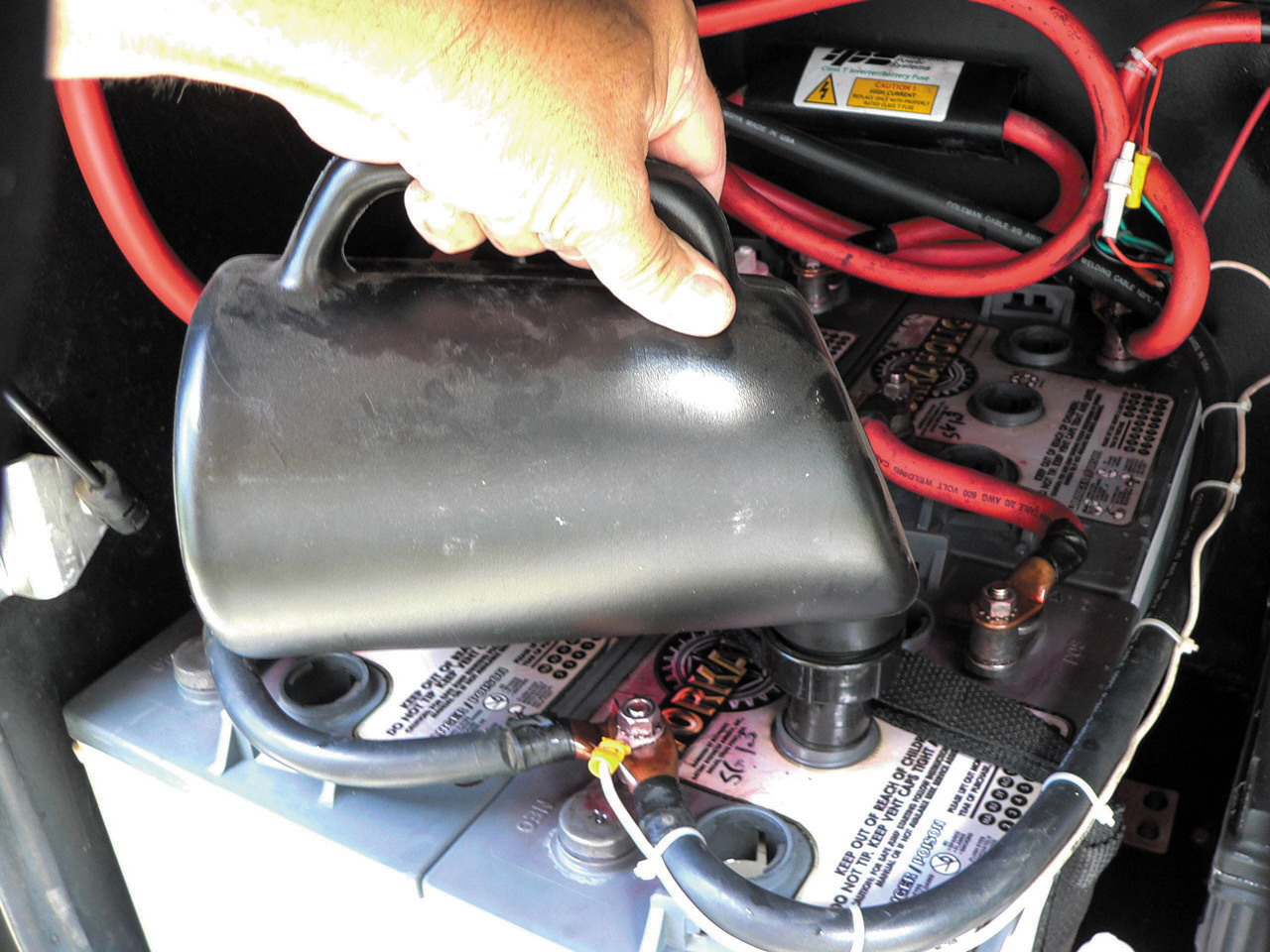
We have a 2007 Roadtrek SS Agile motorhome, built on a Sprinter chassis. When not traveling or camping, I leave it plugged into shore power to keep the refrigerator running. Every one to two months, I have to add water to the house batteries. Should I disconnect the house batteries while it’s plugged in?
— Jerry Doucet, Via email
With lead acid/wet cell batteries, it’s imperative, in my opinion, to not leave the coach unattended and plugged into shore power unless it is equipped with a sophisticated, three-step battery charger or unless you check the electrolyte level weekly, for the very reason you mention. Some factory-equipped charging converters have a propensity to overcharge the battery bank. Overcharging leads to a temperature rise, which in turn leads to a rapid evaporation of the water portion of the electrolyte, which leads to shorter battery life.
If it’s truly necessary to operate the refrigerator when not using the RV, it is okay to run the refrigerator on AC electric only. A switch to AGM batteries at some point, or the addition of a sophisticated battery charger, may make it easier to leave the coach plugged in during periods of nonuse. Until then, simply disconnect the batteries from the system to protect their integrity. If you don’t have a permanent battery disconnect switch, one can be added. Or, you can simply disconnect the last negative battery cable in the battery bank (the one that ultimately is grounded to the frame of the motorhome). That will take the entire bank out of the charging circuit.
Sharing A Breaker
I have a 2005 Holiday Rambler Navigator motorhome. The rear air conditioner and the electric range appear to be on the same AC circuit breaker. When the range is turned on, the rear air conditioner is turned off. When the range is turned off, the air conditioner will work. That’s the way it’s supposed to function. But mine does not. Holiday Rambler tech support was no help, as they no longer keep data for a motorhome that old. I cannot find the transfer box, either. It’s not behind the breaker panel. Has anyone else had this problem?
— Ron Stenseng, F350684, Ward, Arkansas
Not only are the bedroom air conditioner and the electric cooktop connected to that same breaker, but also the washer/dryer combo, if you have one. It’s not the transfer switch that determines which load is activated, but rather an energy management system (EMS), located somewhere in the motorhome. The transfer switch determines the source of the incoming AC voltage, either shore power or generator power. As with the EMS, all this happens automatically behind the scenes.
Unfortunately, neither the 2005 brochure nor the 2005 chassis manual I have on file mentions which energy management system Holiday Rambler used back in those days. And as you learned, Holiday Rambler, which has changed owners since your vehicle was built, does not have records going back that far. See if you can locate the EMS panel somewhere near all the controls and monitors inside the coach and look for a brand and model number. The problem could be something as simple as a disconnected or broken wire at or near the EMS that is not communicating with the controlling relays.
Perhaps your best bet is to post your dilemma on the FMCA Forums (community.fmca.com). A wealth of information is passed back and forth on the Forums, and I’m sure other Navigator owners would be happy to help you. They may at least be able to identify which EMS you have.
I wish I had more definitive news for you, but without actually looking at the coach, it becomes very difficult. In the meantime, be cognizant of the appliance you are operating so you don’t inadvertently turn on either of the other appliances on that same circuit. I’m sure the circuit breaker will do its job, but try to avoid the nuisance of a frequently tripped breaker.
Seeking An Opinion
I enjoyed your classes at the RV Basics workshop held in July 2018 just before the FMCA convention in Gillette, Wyoming. I’m now looking at making a change from a Type B motorhome to a Type A. The coach is a 2008 Monaco Dynasty with 33,000 miles. I’m not familiar with this brand or model, and I am curious as to your thoughts.
— Jeffrey Robinson, F476539, Port St. Lucie, Florida
The old Monaco Coach Corporation was headquartered in Oregon, but it’s now owned by REV Recreation Group, based in Decatur, Indiana. Today Monaco is basically an entirely new company, and produces nice coaches by any standard. The Dynasty was a featured model of the old Monaco, and replacement parts likely are not available from Decatur. However, engine and transmission components may still be available through their network of dealers.
That said, choosing any motorhome is a very subjective decision. If it has been kept in shape, it just might be a good buy. But at 11 years old, some issues may be beginning to arise. Before a purchase, I would strongly recommend an aftermarket predelivery inspection (PDI) to determine the exact technical shape the motorhome is in. You certainly don’t want to buy someone else’s problem. Try to locate a certified or master certified RV tech in your area to perform the PDI. Careful inspection of the battery banks, engine/drivetrain, and tires is especially important. Those are the big risk areas when purchasing an older motorhome.
Thanks for attending RV Basics. We are gearing up for another RV Basics program March 10 to 12, 2019, just before FMCA’s “Peachy in Perry” convention, March 13 to 16, in Perry, Georgia. For more information, visit www.fmca.com/rv-education-101.
Sink Odor
For weeks after purchasing a new Thor Motor Coach motorhome, I regularly discovered the bottom of the kitchen sink lid to be wet. Now, months later, a nasty gray-water smell comes from the sink after driving on the highway. Somehow, the trap is being sucked dry. It is interesting to note the trap is attached directly to the bottom of the sink drain (zero drop), and the smell ceases as soon as I add water. What’s going on here, and is there a fix?
— Gene Swift, F419531, Grosse Ile, Michigan
It sure sounds as though you may have a venting problem with the liquid-waste holding tank, along with, perhaps, a failed trap vent device under the sink. Here’s how to tell: Plug the sink and fill it with water, and then release the plug and watch as the sink begins emptying. You should see the typical tornado-like spiral of the water as it quickly drains. If it just tends to seep down with no vortex, chances are the vent is plugged or mispositioned, or the antisiphon trap vent device (ASTVD) has failed. The motorhome is still under warranty, so make an appointment at your dealership. This is definitely a warrantable situation.
For a permanent fix and to eliminate the need for future preventive maintenance, I suggest installing a HepvO sanitary valve in place of the P-trap. It’s a relatively easy DIY installation. I’d recommend it for both the galley and lavatory sinks. It enables you to gain extra storage space by eliminating a few fittings under each sink, including the ASTVD. P-traps have inherently been a problem in RVs for various reasons, but the addition of the HepvO valve eliminates all concerns. Many RV manufacturers are now installing them at the factory.
Generator Shuts Off
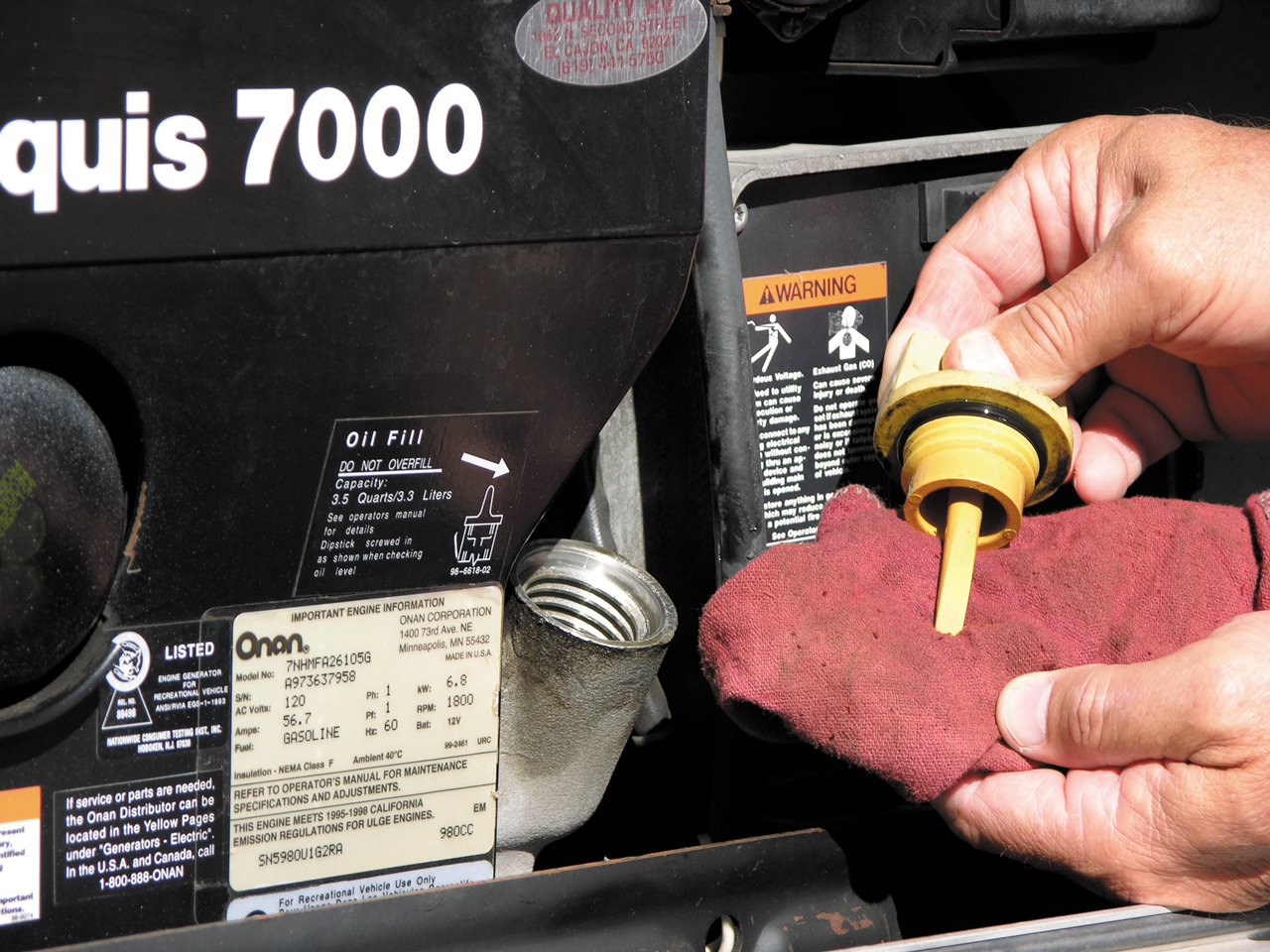
The oil level in the RV generator should be checked at least weekly to avoid activating the low-oil pressure switch.
My Cummins Onan 7000 generator stays running only if I keep the start button pushed in. When I release it, the generator dies. Help!
— Gary Faucett, F485404, Temple, Texas
The problem has a number of possible causes, but virtually all Cummins Onan models require the correct amount of oil pressure and the existence of enough AC voltage to flash the field to keep the engine running. So, first check that the crankcase is filled with oil and the battery is fully charged.
If I had the model number of your generator, the causes could be narrowed to a certain extent, but in most cases the problem can be attributed to either a faulty control board or voltage regulator, or a stuck oil pressure switch. Chances are it’s a faulty voltage regulator, but I’d need the model number and the spec number to dig deeper. Further troubleshooting is probably best left to a professional certified RV tech or a tech at Cummins Onan.