
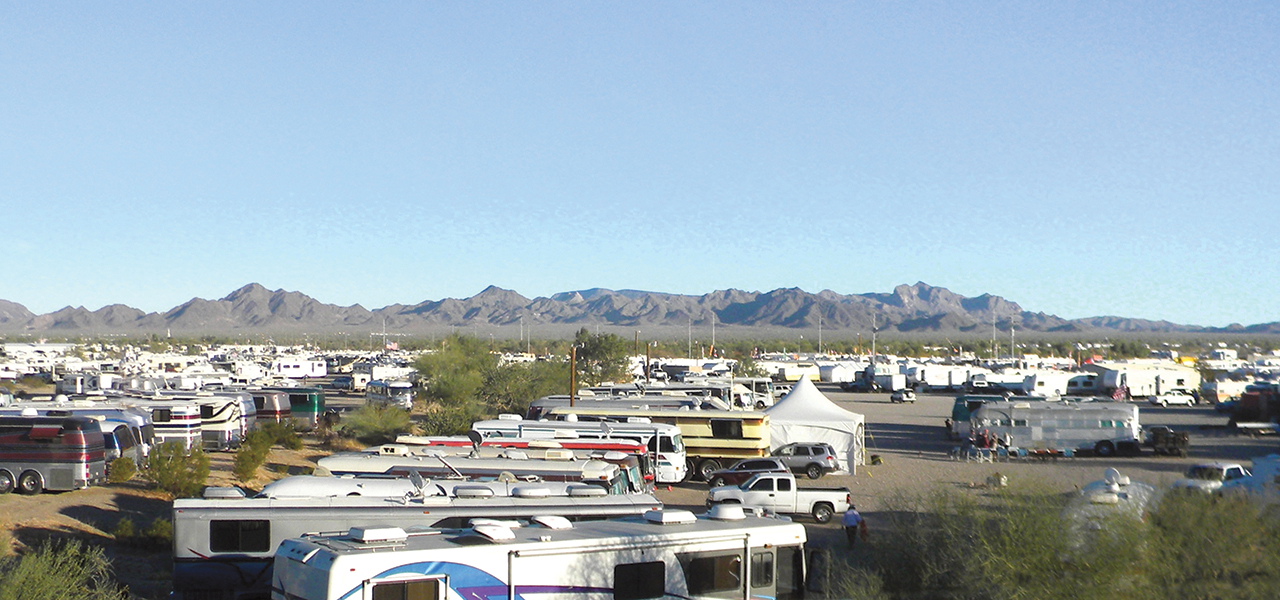
Winter RV travelers have turned this Arizona town into a yearly destination.
By Mary Taylor, F480792
December 2019
Every January and February, the small desert town of Quartzsite, Arizona, population 3,800 or so, is transformed by the addition of a gargantuan tent city and an influx of people in thousands of recreation vehicles. You may want to spend some time there prior to FMCA’s next international convention, March 26-29, 2020, in Tucson.
The best view of Quartzsite’s metamorphosis is from the crest of small hills a few miles west of town along Interstate 10. The Quartzsite Valley appears as you top the hills, revealing a panorama of RVs of all sizes and shapes scattered throughout a 15-mile-diameter circle around town.
Many RV groupings resemble old wagon train circles; others are in rectangular camps; and still other vehicles are parked solo. Numerous flags flutter high above the little settlements, and handwritten signs point the direction to RV cadres, some with quirky names. Of course, regular RV parks are in town, too, as are several Bureau of Land Management (BLM) locations. But it appears that most people prefer to find an open space somewhere and just settle in.
What brings so many RVers to Quartzsite? A brilliant combination of warmer winter weather and good marketing.
During those months, Quartzsite hosts three major sales shows. They attract RVers who are searching for a destination; have some (or lots) of change rattling in their pockets; or simply enjoy looking at stuff.
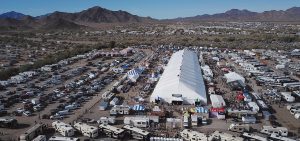
The desert around Quartzsite, Arizona, fills with RVs each winter. Many of their occupants attend the huge Sports, Vacation & RV Show.
The Annual QIA (Quartzsite Improvement Association) Pow Wow — Gem, Mineral, And Jewelry Show is January 15-19, 2020. The daddy of all the shows, the Quartzsite Sports, Vacation & RV Show (called “The Big Tent”) is January 18-26, 2020. Another biggie is the QIA Gold, Treasure & Craft Show, February 7-9, 2020. These three events bring thousands of RVers to town.
We traveled in our RV to The Big Tent show, so I’ll focus on that one, and then give an overview of other things you can do in the Quartzsite area.
Sports, Vacation & RV Show
A huge tent near the heart of town is full of all things RV, including endless RV products, parts, and enhancements, and information about related services. The show’s website claims the 2020 show will have more than 300 exhibits under 70,000 square feet of tent space. New and used RVs are offered also.
Around the perimeter of the main tent are smaller tents and displays, even bays for service and installation of items sold at the show. Encircling the RV-focused sites are true bargain-basement tables where you can find anything automotive, electrical, garage-, or kitchen-related. To keep the merchandise interesting to all patrons, there’s also an assortment of rocks and gems, ancient fossils, yard art, rugs, baskets . . . and the list goes on. One of our friends has frequently declared that Quartzsite is the place to find “the best choices and best prices for broken screwdrivers and rusty wrenches.” He’s right!
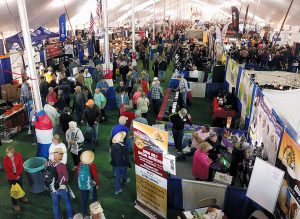
Shoppers check out RV-related merchandise under a giant tent.
Actually, that statement is way too negative. We found everything we needed for camping and had money left over to buy two of the best toasted cheese sandwiches we’ve ever eaten from one of the mobile kitchens scattered among the tents and stalls. We spent two days checking out the show; admission is free.
The opportunities to entertain yourself elsewhere in the area are numerous. For additional shopping, you can check out several markets and swap meet areas along Main Street and south of Interstate 10 in the Tyson’s Well area. They’re listed in the Quartzsite Visitors Guide, which is available at the town’s chamber of commerce, at local businesses, and online (see below).
Other Area Experiences
January through April are great times to visit. Dress in layers for the cooler mornings and warmer afternoons.
Once we had exhausted our shopping needs, we decided it was time to do something more physical, plus learn about the history of this part of Arizona. We elected to hike in the Kofa National Wildlife Refuge and Palm Canyon. The 665,400-acre preserve exists because a group of Arizona Boy Scouts campaigned to save the desert bighorn sheep, pronghorn antelope, and other native wildlife in the area. The refuge was established in 1939.
Camping, hunting, and hiking are permitted in this desert ecosystem.
As you scan the desert terrain in the Quartzsite area, the palm trees that define Palm Canyon are the last thing you would expect to find. We drove down Interstate 95 to the Palm Canyon section of the Kofa Refuge. This pleasant little canyon has what may be the only native California fan palms in Arizona. A half-mile hike up a rather rocky trail leads to a well-marked spot for viewing the palms tucked in a narrow side canyon. It’s possible to scramble to the trees, for even more exercise.
Besides Palm Canyon, we explored the Crystal Hills area of the refuge, where we saw crystals and quartz rocks scattered along the trail. Limited rock collecting is permitted. It was somewhat surprising to see a few established camping sites — with no amenities, of course.
A mispronunciation created the name of our next stop, the Hi Jolly Monument. In the mid-1800s, after the Mexican-American war, Congress created the U.S. Camel Corps. Plans called for surveying the land to create a wagon route, using camels as transportation. Along with the camels came a man from Syria named Hadji Ali, among others. It didn’t take long until his name was shortened to the more easily pronounced “Hi Jolly.” The Civil War halted the camel project, but Hi Jolly stayed in the area and endeared himself with the locals.
World War II is the focus of the next monument. In 1942 the U.S. government established three relocation camps in Arizona for American citizens of Japanese descent. The largest, the Poston War Relocation Center, was near the Colorado River south of Parker, on the Colorado River Indian Reservation. Poston held more than 17,000 Japanese internees. They were put to work building dams, canals, roads, and schools, which would enhance the reservation. When the camps closed after the war, all the improvements reverted to the local Indian tribes.
Most of the buildings from the Poston camp have been demolished or lay in ruin today. In 1992, camp survivors and their descendants erected the Poston Memorial Monument, south of Parker. From Quartzsite, it’s reached by driving north on State Route 95 to the town of Parker.
Before Quartzsite existed, Tyson’s Well was the only settlement around. It faded away until miners arrived in search of various minerals, and dubbed the spot Quartzsite. Tyson’s Well Stage Station Museum focuses on early Quartzsite history. It’s operated by the Quartzsite Historical Society and is located in a restored adobe building founded in 1866. Artifacts fill the inside; outside behind the building are mining equipment, an original assay shack, and a newer mini village hand-built by a local resident.
Four-Wheeling Excursions
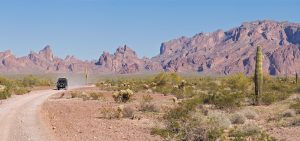
The Quartzsite area’s warm winter temperatures and desert views make for great off-road experiences.
If you own an off-road vehicle and like off-road driving, try the Arizona Peace Trail, which connects Yuma to Bullhead City. This 750-mile loop trail system includes roads surfaced with dirt, sand, or a combination. Elevations range from 170 feet to 7,070 feet.
The trail is primarily suited for off-highway vehicle use, but some portions can be enjoyed by people with modified 4x4s and stock SUVs. Be sure to check the following websites and a map before you plan your trip: www.arizonapeacetrail.org; https://connectedhorizons.com; https://www.jeeptheusa.com/quartzsite-jeep-trails.html.
In our off-road discovery of this area, we chose to visit the long-abandoned Swansea Townsite in Parker (not on the Arizona Peace Trail). The site is about 54 miles from Quartzsite via some sandy or dirt roads, so don’t try this unless you have a four-wheel-drive vehicle. For details and a map, see www.blm.gov/visit/search-details/274876/1.
Mining in Swansea began in 1862, but development stalled until a nearby railroad line was built after the turn of the century. By 1909 the mine was successful enough that Swansea had a population of well over 500, served by a general store, a post office, saloons (of course), and even a movie theater.
Well-placed signage on the site leads you to the protected openings of several mines, foundations of the store and general offices, and the remains of housing for the miners.
After retracing our tracks down the sandy, curving, narrow road from Swansea, we decided to return to the RV show for one of their huge ice cream cones and then spend an evening around the fire at our wagon train circle. It seems we weren’t much different than the thousands of RVers spread out around Quartzsite after all.
Camping Info And More
Along with numerous commercial RV campgrounds, several areas are available for inexpensive or free camping. The La Posa Long Term Visitor Area (LTVA) is available to self-contained units only, for a low fee. Check the website for permit lengths, costs, and regulations: www.blm.gov/visit/la-posa-long-term-visitor-area.
For more information and campground listings, visit:
Quartzsite Area Chamber of Commerce & Tourism
1240 W. Main St.
Box 640
Quartzsite, AZ 85346
(928) 927-5200
www.quartzsitetourism.com/explore-quartzsite
For a printable Quartzsite Visitors Guide (pdf), visit:
http://quartzsitevisitorguide.com/about-us.html