
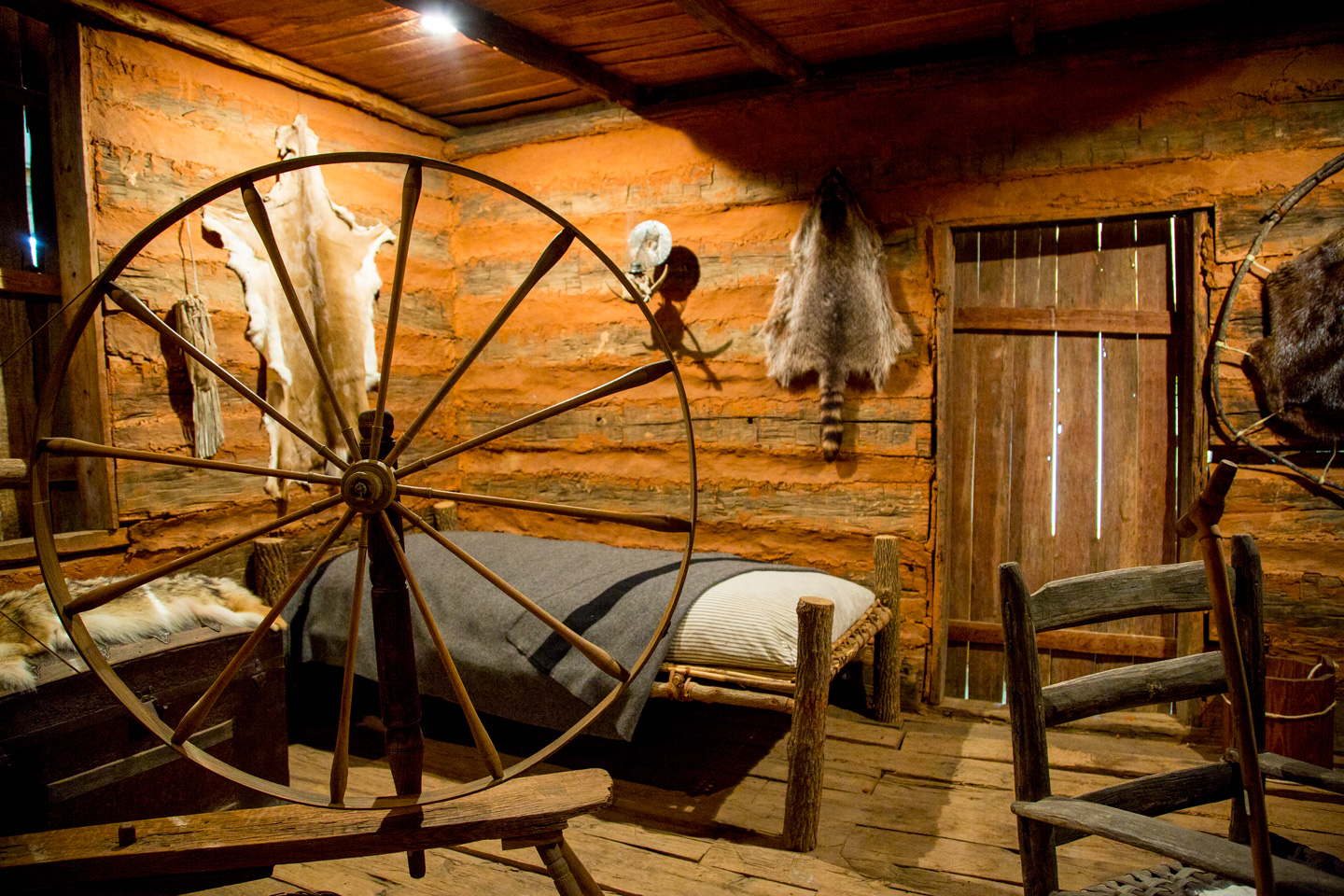
A log home built by an inventive Cherokee Indian in Sallisaw, Oklahoma, is preserved in his honor.
By Richard Bauman
December 2019
The most famous Cherokee of the 1800s wasn’t a chief or an amazing warrior. He was a crippled craftsman who realized the value of written language. He was simply known as Sequoyah. Today, it generally is accepted that giant sequoia trees, and, consequently, California’s Sequoia National Park, were named for him, as was a landmark in Oklahoma.
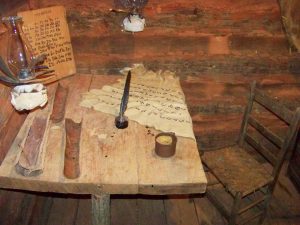
Items similar to what Sequoyah might have used rest atop a desk inside the cabin.
Sequoyah’s cabin in Sallisaw, Oklahoma, doesn’t fit one’s expectation of the dwelling of a famous person, let alone a man of words. The one-room log home doesn’t have shelves overflowing with books, but it does contain a table made from roughly hewn logs. On it is a single inkwell with a quill pen. Taking up the rest of the cabin’s floor space is a large spinning wheel and a narrow bed covered with a gray blanket. Some cooking utensils are near the fireplace in what was Sequoyah’s last abode.
Sequoyah’s Cabin Museum, listed on the National Register of Historic Places, shares with visitors the remarkable history of the man who created the written language of the Cherokee Indians.
Sequoyah did not speak or read English. But he was intrigued by the English speakers’ ability to make marks (words) on paper and have others understand those marks. He saw this could benefit his people, and in 1809 he started creating a writing system for the Cherokee Nation.
Sequoyah was born around 1770 in what is now eastern Tennessee. His father, identified by some sources as Nathanial Gist, may have been a fur trader. Nathanial was long gone before the child was born, leaving the boy’s Cherokee mother to raise him. His English name was George Gist (or Guess).
It’s unclear whether he was born with his deformity. Some historians say he became lame because of an accident when he was young. Some translations of the Cherokee word “Sequoyah” mean “pig foot.” He became a blacksmith and silversmith and is reputed to have been a fine craftsman.
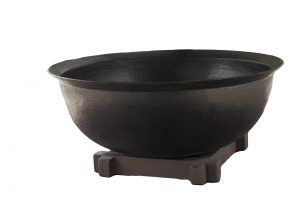
A basin used for boiling saltwater is displayed outside the cabin.
Sequoyah first tried to create symbols for Cherokee words, but he abandoned that effort. He then concentrated on creating written characters to represent the 85 distinct syllables, or sounds, in the Cherokee language. A syllabary is a list of sounds, typically a consonant followed by a vowel. An example would be the sound “ta.”
Leaders and other members of the Cherokee Nation began to use his syllabary, saw its worth, and officially adopted it in 1825. Ironically, this made the Cherokees more literate than most of their European-American neighbors. It is one of the few times that preliterate people have independently created an effective writing system.
In light of his contribution to the Cherokee Nation, Sequoyah was honored with a silver medal and an annuity of $300. It’s said that after receiving the medal he proudly wore it every day of his life.
Sequoyah built the one-room log cabin in 1829 after moving to Oklahoma. Today it is in a well-maintained 10-acre park and contains numerous artifacts from the time he lived there. In 1936, Works Project Administration employees constructed a stone building around the cabin to preserve it. It and the cabin are in excellent condition, and testify to Sequoyah’s craftsmanship, and the WPA’s as well.
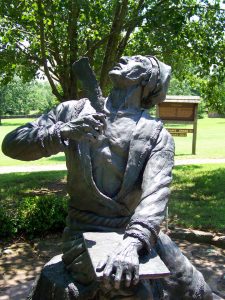
A statue depicting Sequoyah looking heavenward is outside the Oklahoma cabin he built in 1829.
Just outside the protective building is a larger-than-life statue of Sequoyah, quill pen in hand, tablet on his knees, looking skyward, as if awaiting inspiration from above. Around the base of the statue are carved the symbols he used to create the written language.
Inside the building, in addition to the cabin, are examples of farm implements from the 1800s, and early symbols Sequoyah used to create the Cherokee language. Documents printed in the Cherokee language include the New Testament, newspapers, and the book of Cherokee laws and constitution. Even a copy of the Oklahoma Driver’s Manual, printed in Cherokee, is here. The Cherokee Advocate, printed in Cherokee and first published in September 1844, was Oklahoma’s first newspaper in any language.
As the tribe’s written language became accepted, Sequoyah started traveling to Cherokee communities, explaining and promoting its use so Cherokee documents and information could be transmitted more easily. In 1843, he heard of a band of Cherokees who were living in Mexico and headed out to visit them. He never made it back home. He became ill and died somewhere in either Texas or Mexico. The location of his grave is not known.
Although no stone plaque marks his grave, Sequoyah has an even better memorial — the written Cherokee language, benefitting his people yet today.
Further Info
Sequoyah’s Cabin Museum
470288 State Route 101
Sallisaw, OK 74955
(918) 775-2413
Open Tuesday through Saturday. A small admission fee is charged. Ample parking is available. The site is in eastern Oklahoma, approximately 10 miles north of Interstate 40.
History enthusiasts may want to buy a Cherokee Passport museum package. For $15, it includes admission to this and several Cherokee-related museums in Oklahoma; tour information; and cultural facts. Go to the Visit Cherokee Nation site at www.visitcherokeenation.com to learn more.