
Be surrounded by wildlife at this park on Florida’s Gulf Coast.
By Bert Henderson, F385218
April 2020
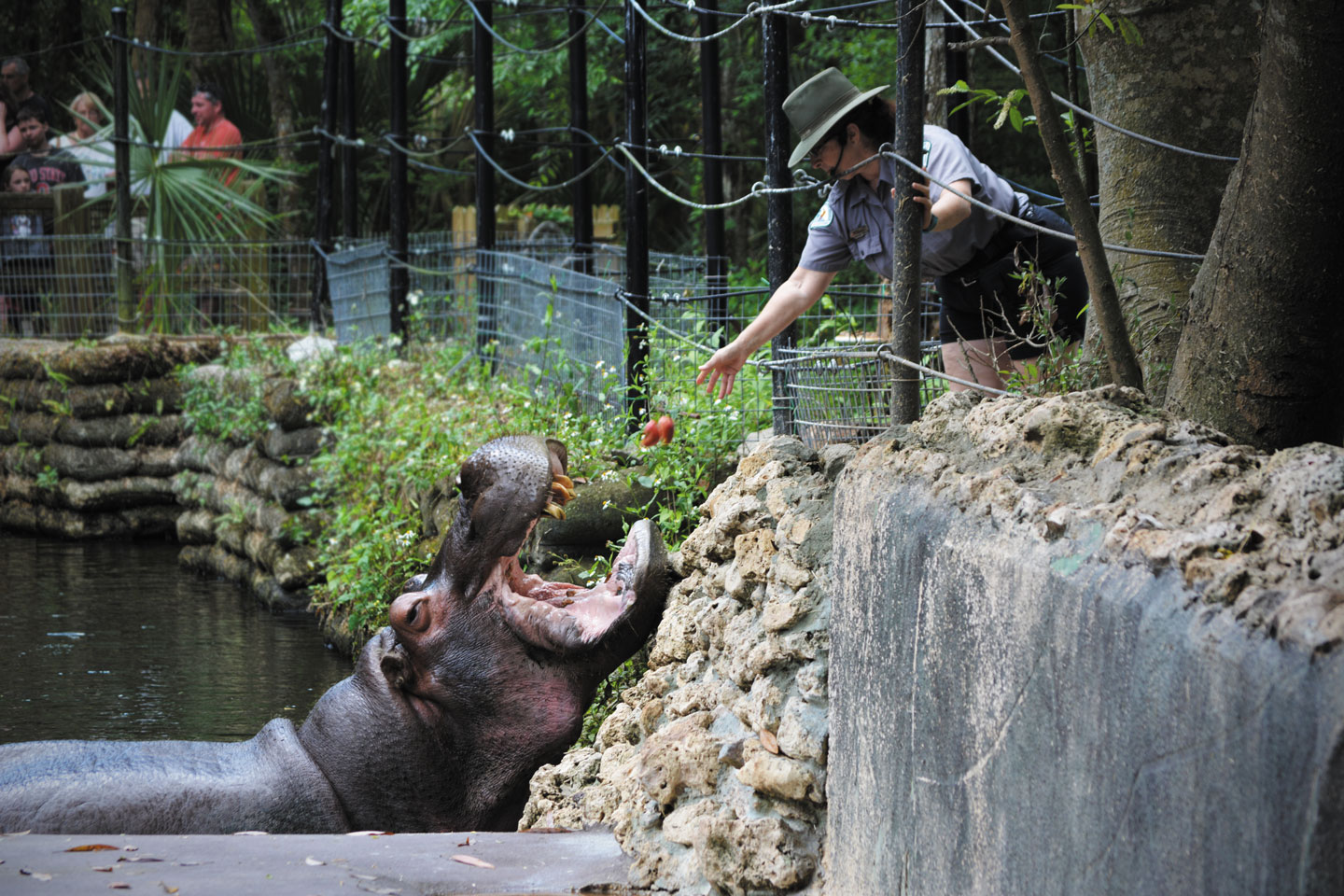
Ellie Schiller Homosassa Springs Wildlife State Park. It’s a long name for a wonderful place. Known as a year-round home for West Indian manatees, the park is also an animal education center, with mammals such as panthers, bobcats, foxes, deer, wolves, black bears, and otters; birds such as eagles, hawks, vultures, and owls; and, of course, plenty of alligators. Plus, assuming he’s still around and breaking records as the oldest of his kind in captivity, you, too, can meet Lu the hippopotamus.
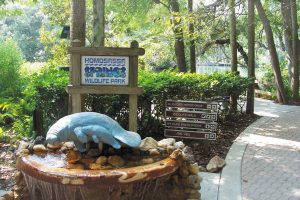
A statue depicting a mama manatee and her baby reflects one of the park’s purposes — to offer education about the endangered West Indian manatees that can be found in these waters. Injured manatees are brought here, too, to be healed before they’re released back into the wild.
The park lies approximately one hour north of Tampa along Florida’s Gulf Coast. It’s also only an hour and 30 minutes from Orlando. Its location makes it a convenient day-trip destination, or a stop along the way for RVers headed elsewhere.
Visitors enter the preserve by taking a tram or a boat ride. You also can walk to the main entrance via the ¾-mile Pepper Creek Trail.
The tram is the fastest way to go, and it may be your only option if the weather is not cooperating. If it is nice and you opt for the boat, you’ll likely see alligators, raccoons, and deer; birds small and large, such as nesting ospreys; and turtles, including alligator snapping turtles, painted turtles, and red-eared sliders.
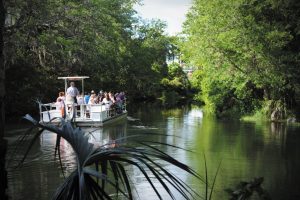
One of the ways visitors can enter the park is by boat, from which they can observe many local species.
The park’s Wildlife Education Center offers hands-on activities for little ones. The Manatee Care Center helps to get injured manatees back in the swim of things and educates visitors about these important mammals. If you visit between April 1 and November 15, you will learn a lot at the live manatee program, offered three times per day.
At 12:30 p.m., get near the bridge between the alligator lagoon and the hippo pool. Lu the hippo is so accustomed to being fed regularly that he entertains with his quirky antics, all the while earning a daily supply of fruits and veggies.
Presentations with small live animals take place daily at the Wildlife Encounters Pavilion, too.
Many of the park’s animals are trained with positive reinforcement concepts. Andrea Junkunc, a park services specialist, said the training results in the animals participating in their own medical care. This averts the need for drugging them during exams and reduces physical stress and risk. “All of the park’s animals are conditioned to go into their houses at night,” she added.
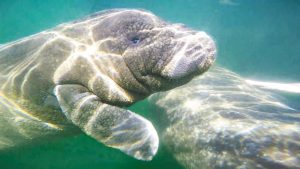
Manatees are attracted to Florida springs in the cooler months because their water is warmer than that in the Gulf of Mexico.
This park has an old-time shine to it, even in 2020. It was originally a 1900s train stop. Passengers walked a short trail to the spring, and the train ran alongside what is now Fishbowl Drive. In the 1940s this spot was turned into a commercial attraction, and it was expanded in the 1960s. At one point, a commercial animal company called Ivan Tors Animal Actors housed some of its trained critters here in between their appearances in movies and TV shows (remember “Flipper” and “Sea Hunt”?). Lu the hippo, now age 60, was brought here through that company many years ago.
With its numerous opportunities to learn and observe a variety of animal species, Ellie Schiller Homosassa Springs Wildlife State Park invites visitors to discover the “wild side” of Florida.
DETAILS
Ellie Schiller Homosassa Springs Wildlife State Park
4150 S. Suncoast Blvd.
Homosassa, FL 34446
(352) 628-5343
www.floridastateparks.org/parks-and-trails/ellie-schiller-homosassa-springs-wildlife-state-park
The park is located on the west side of U.S. 19/98. Admission is $13 for age 13 and up, and $5 for children 6 to 12. Children 5 and under admitted free. The park is open daily from 9:00 a.m. to 5:30 p.m.
Parking is free, and ample space is available for RVs. No overnight parking, however. Dogs are not permitted to tour the park, but owners can let them stay in their RV or use the complimentary outdoor pet kennel located near the visitors center.