
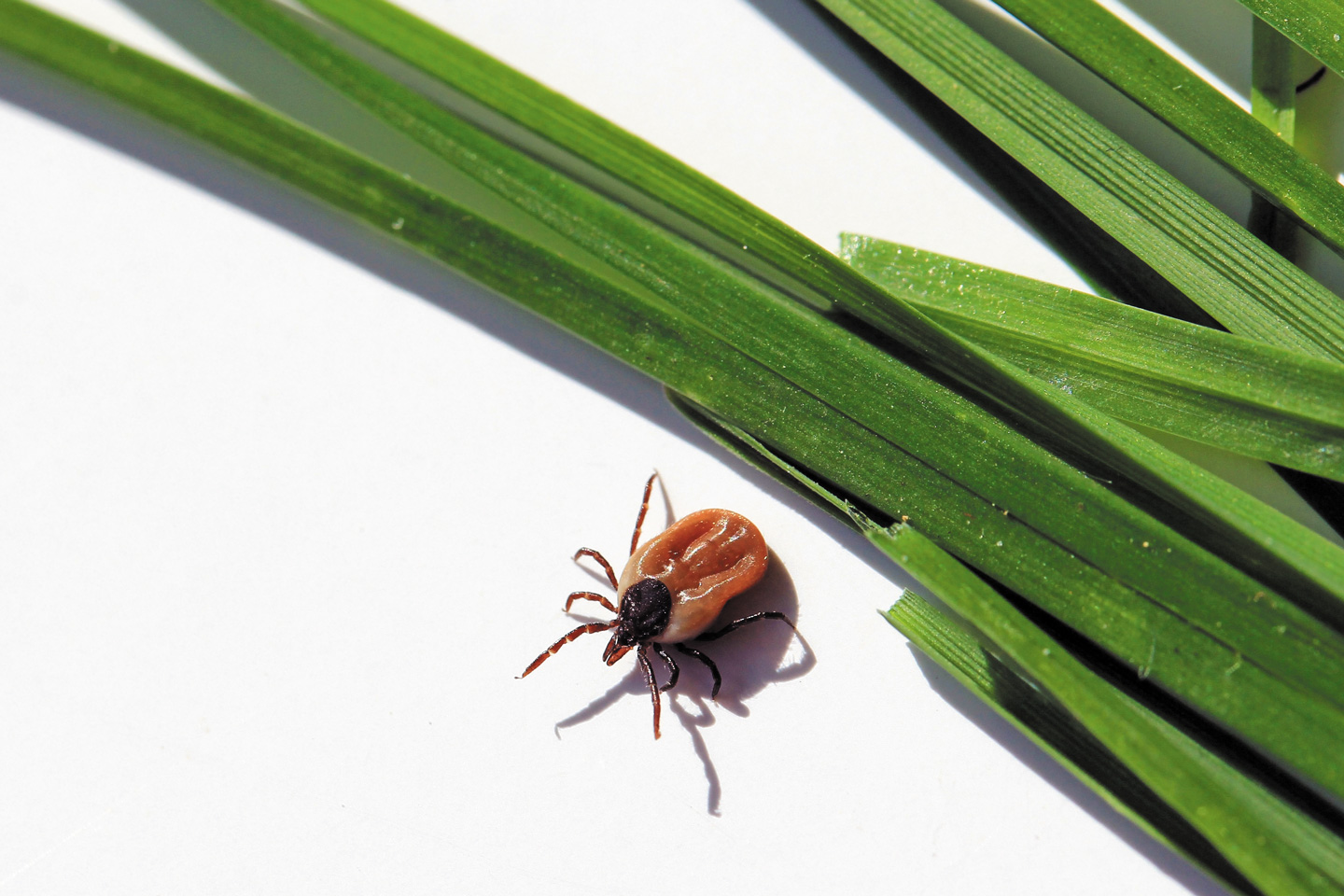
Threats posed by these tiny parasites require people who venture outdoors to be vigilant.
By Phillip Meeks
May 2020
Just a mention of the word “tick” can send some folks running indoors. Ticks can be a reality for anyone who spends time outside, and while they aren’t necessarily something to prevent a family from camping, hiking, fishing, or picnicking, a few basic precautions are wise.
The United States is home to an estimated 90 species of ticks. Humans rarely come in contact with some tick species, as they spend their time in caves or animal dens. Others, though, are quite common, and if you’ve ever waded through tall grass or picked blackberries, chances are you’ve encountered a tick.
SPECIES AND PROBLEMS
Ticks can be tricky to identify, especially when one considers that adult and immature stages of the same species can be quite different in appearance, as can males and females. Once a tick emerges from the egg, it progresses through the life stages of larva, nymph, and adult. The adults and nymphs have eight legs; the larvae have six. A tick at any stage may seek a host and a blood meal. The “seed ticks” or “turkey mites” that people may speak of are, in fact, the immature stages of any number of tick species.
Internet references may be useful for identification. Local park staff or cooperative extension offices also may have the knowledge or resources to pin down the species of specimens brought to them.
The blacklegged tick (also known as the deer tick), the western blacklegged tick, the Lone Star tick, the Gulf Coast tick, the brown dog tick, the American dog tick, and the Rocky Mountain wood tick are species of particular concern, as they’re capable of transmitting diseases to humans.
Symptoms of many tick-borne diseases can be quite similar, including fever, headaches, joint and muscle pain, and fatigue.
Lyme disease is known to be carried by only two species: the blacklegged tick and the western blacklegged tick. The U.S. Centers for Disease Control and Prevention (CDC) fields 30,000 reports of this disease annually, although it’s likely that many more cases go unreported. Symptoms include those already mentioned, as well as a rash at the site of the bite. If treatment is delayed, the heart and nervous system can be affected, and chronic infections also may result.
Around the Great Lakes region, the blacklegged tick also can transmit the rare Powassan virus disease. Many people infected with the virus do not have symptoms, but some people experience fever, headache, vomiting, and weakness. Severe cases can result in long-term neurologic symptoms, and the disease may advance to encephalitis and meningitis.
The Lone Star tick can transmit a sickness with similar symptoms to Lyme disease, called Southern Tick-Associated Rash Illness, or STARI. The female adult is one of the easiest to distinguish, noted for the white dot — lone star — in the center of her back. As with Lyme disease, STARI can lead to chronic infections.
Not a disease per se, but another issue that can come from a Lone Star tick bite is alpha-gal syndrome, an allergy to red meat that comes about when a certain molecule is passed into the bloodstream.
The brown dog tick, the American dog tick, and the Rocky Mountain wood tick all have been known to transmit Rocky Mountain spotted fever, a condition that in severe instances can lead to amputations, paralysis, hearing loss, and mental disability if antibiotic treatment is delayed.
You may wish to gather more information about the ticks in your area, the diseases they transmit, and treatments. The CDC’s website is a good resource: www.cdc.gov/ticks/index.html.
A NEW THREAT
In 2017, a new invasive tick was confirmed in New Jersey: the Asian longhorned tick. As of early February 2020, it had been found in 11 more states. According to the CDC, the tick appears to be less attracted to human skin. However, testing of ticks collected in the United States is ongoing, and the CDC says it’s likely some ticks will contain germs that can harm people. Whether the ticks can pass the germs along to people and make them ill is still unclear.
The tick reproduces asexually; that is, females don’t need a male to reproduce. As a result, populations can explode when the environment is conducive to their survival.

Apply tick repellent and wear light-colored clothing so ticks are easily seen.
AN OUNCE OF PREVENTION
Ticks can be active year-round, but, of course, the warmer months are when humans normally come into contact with them. You may have heard that they drop out of trees onto their victims, but that is a myth. Nor are they able to jump onto you as you walk past. Rather, they wait patiently on vegetation — usually at knee height or less — and grab onto whatever animal comes into direct contact with them. Once on your legs or feet, they begin to crawl upward.
New ticks and new diseases may come along, but first-tier preventative measures remain pretty much the same: Wear light-colored clothes so you can see when ticks attach themselves to you; wear long pants, and tuck them into your socks so ticks have no access; and strategically apply repellents.
Products that contain 20 percent to 30 percent DEET are effective at keeping ticks away, but some people are allergic. Picaridin, unlike DEET, is odorless, nongreasy, and does not dissolve plastics; it can provide four to eight hours of protection. Permethrin is an active ingredient that can be applied to pants, shirts, and hats (but not directly to skin) and allowed to dry. Clothing pretreated with permethrin is on the market, and manufacturers claim that it’s good for up to 70 washings. Botanical products such as citronella or oil of eucalyptus also may be worth considering.
When it comes to pets, it’s vital to check them daily. Consult with your veterinarian about protection options, which may include vaccines or repellents.

Pets should be checked daily for ticks. A vet can suggest protection options.
INSPECT YOURSELF, SURROUNDINGS
A “white flag” inspection is a good way to survey tick populations where your RV is set up. Take a 3-foot-by-3-foot piece of white cotton or flannel, affix it to a pole, and drag it over grassy and shrubby edges. Ticks will grab onto the fabric. They easily can be collected and identified against the light background.
When you’ve been hiking, fishing, or otherwise tromping through grass and brush, it’s wise to inspect yourself as soon as possible and find ticks before they make a meal of you. They prefer body areas where they’re well-hidden, or spots where clothing hugs skin the tightest: the scalp, waistline, groin, armpits, and the backs of knees.
If you see that a tick has attached itself to your body or that of a family member, stay calm. Remove it by using tweezers to grab the whole tick and pull it out.
PATHOGEN CONCERNS
Identifying a tick species is one thing. Determining what germs it carries is another. Labs can perform the latter for a fee. Two of them are Old Dominion University in Norfolk, Virginia (https://sites.wp.odu.edu/tick-team/) and the University of Massachusetts Amherst Laboratory of Medical Zoology (www.tickreport.com). Their websites have a submittal form and instructions for submitting a collected tick. Sending every tick you encounter is probably overkill, but in a situation where you’ve found a tick that’s been attached for a while, the testing could provide some peace of mind.
Unfortunately, ticks are a reality that we must accept. It’s not a reality that an outdoor enthusiast will ever learn to love, but neither should the existence of these parasites suck all the joy from our travels. A bit of wisdom and some reasonable caution go a long way toward protecting you from negative encounters.