
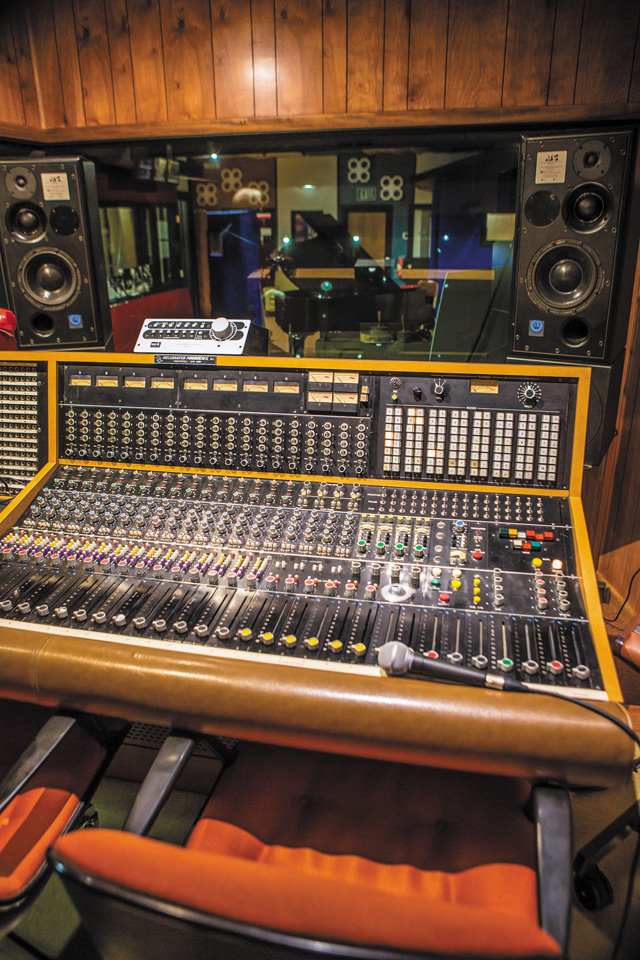
Visit the small towns in northwest Alabama where millions of hit records were made.
By Josephine Matyas, F468364
June 2020
My husband, Craig, and I often follow routes that tourism folks designate as American music trails. We come by it honestly, as we’re both professional writers; plus, Craig is an accomplished musician. Guitars and hand-percussion instruments ride along with us in our Type B motorhome, because we never know when we’re going to come across a musical wellspring like Muscle Shoals.
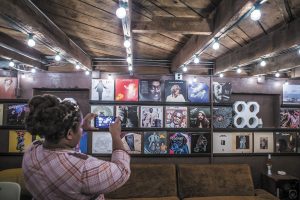
A visitor photographs copies of album covers representing some of the hits produced at Muscle Shoals Sound Studios.
You may have first heard of Muscle Shoals thanks to some lyrics: “Now Muscle Shoals has got the Swampers. And they’ve been known to pick a song or two.” That line is from the 1974 Lynyrd Skynyrd hit “Sweet Home Alabama.” It leaves some people wondering what it means and others jumping up in recognition. The Swampers were a group of session musicians who created not only music, but music history in Muscle Shoals, Alabama.
It would be easy to miss Muscle Shoals if you didn’t know where to look (the northwest corner of Alabama) or if you were distracted by the Tennessee towns of Nashville or Memphis, both of which are within a couple of hours from there. But lovers of blues, country, and rock music can’t get a more pure musical experience than in Muscle Shoals.
The Muscle Shoals Sound
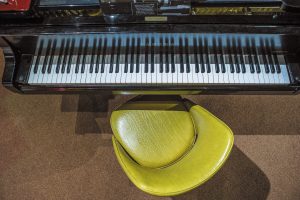
Muscle Shoals Sound Studios features original instruments.
In years past, recording studios paid talented musicians to play backup parts in songs they recorded. Most people never knew the names of these session players, who took duties on bass, drums, keyboards, and so forth, but they added feeling to the tunes in an unmistakable way. Ben Tanner, a Muscle Shoals record producer and sound engineer and a keyboardist with the Grammy Award-winning Alabama Shakes, said, “There’s a feel to the way these session players played. It’s about the way their parts are interlocked . . . their music translated into hits.”
The Muscle Shoals sound attracted singers from across America in the 1960s and early 1970s. “They just wanted to make their music here,” said Mr. Tanner. And come they did: the Allman Brothers Band, Paul Simon, Cher, Aretha Franklin, Willie Nelson, Paul Anka, Otis Redding, and Jerry Lee Lewis, among others.
The Studios
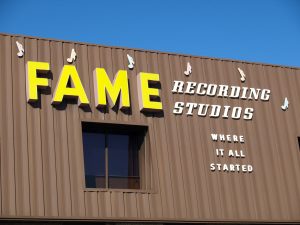
FAME Recording Studios in Muscle Shoals, Alabama, begins by claiming this is “where it all started.”
The area that locals call The Shoals encompasses the towns of Florence, Tuscumbia, and Sheffield, as well as Muscle Shoals. It’s home to several recording studios, but two have the longest and deepest histories: FAME, located in Muscle Shoals, and Muscle Shoals Sound Studios, in Sheffield. Both are still working studios and are open for public tours.
The front lobby of FAME (Florence Alabama Music Enterprises) has changed little since the late record producer Rick Hall opened the boxy, industrial-looking studio. Wood-paneled walls are lined with photos of musicians who rehearsed in Studio B and recorded in Studio A, including Percy Sledge, known for “When A Man Loves A Woman”; Wilson Pickett, who recorded “Mustang Sally”; and Clarence Carter, known for “Patches.” Over the decades, FAME has put its thumbprint on hundreds of hit records.
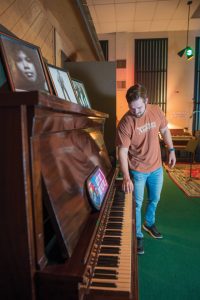
A piano is among the memorabilia on view at Fame Recording Studios.
Rick Hall’s genius was in bringing together a group of musicians to create a certain sound. His most famous assembly of studio musicians was known as The Muscle Shoals Rhythm Section — nicknamed the Swampers. His phone rang off the hook as producers and singers wanted those session players to make their tracks sparkle.
Even today, musicians are using the FAME studios to make new music history; artists such as Jason Isbell, Allison Krauss, Michael McDonald, and so many more walk through the doors. You can, too, by taking a tour. Contact (256) 381-0801; www.famestudios.com.
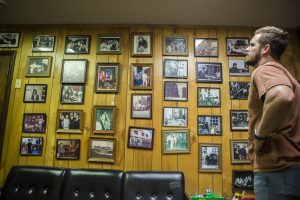
Memorabilia lines the walls at Fame Recording Studios.
Back to the Swampers. In 1969, the funky-sounding house band separated from FAME to set up its own recording studio in a concrete-block building that had seen life as a coffin warehouse and a gospel studio. Muscle Shoals Sound Studios — at 3614 Jackson Highway, the address that became the name of a Cher album — has undergone a top-to-bottom refurbishment to restore the original studio space.
Working in their new digs, the rhythm section players were dubbed the “Swampers” and it stuck, especially after the success of the song “Sweet Home Alabama” (which Lynyrd Skynyrd recorded in Georgia, by the way; not here). This was where they recorded songs that influenced entire genres, such as:
- 1971’s “Brown Sugar” by the Rolling Stones.
- 1972’s “I’ll Take You There” by the Staple Singers.
- 1973’s “Kodachrome” and “Loves Me Like A Rock” by Paul Simon.
- 1976’s “Night Moves” and 1978’s “Old Time Rock and Roll” by Bob Seger.
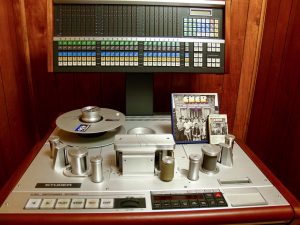
The first album made at Muscle Shoals Sound Studios is displayed atop a tape-recording deck. Released in 1969, the collection of tunes was named for the studio’s address.
Local legend says the last few verses of another song the Rolling Stones recorded, “Wild Horses,” were written by Keith Richards on a bathroom break. Artists including Dr. Hook, Bob Dylan, Helen Reddy, and others also made musical memories here.
The studio walls are lined with gold records and awards. The original Yamaha baby grand piano used in “Kodachrome” is still in the studio. The vocal booths used by Cher and Linda Ronstadt are preserved. The control booth is up and running, and wall graffiti marks the spot where Swampers’ bassist David Hood parked himself right outside the drum booth. By visiting the space, you are marinated in musical history. Contact (256) 978-5151 or visit www.muscleshoalssoundstudio.org for more information.
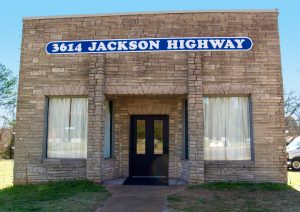
Muscle Shoals Sound Studios.
In 1979 the Swampers moved into another building, at 1000 Alabama Ave. in Sheffield. It was visited by stars such as The Oak Ridge Boys, Jimmy Buffett, and Isaac Hayes. Today that studio is home to a film and music production company called Cypress Moon Studios. It is not open for tours, but reportedly there are plans to build a walk of fame commemorating the site’s importance.
More Nods To History
Studios are not the only places where musical achievement can be explored in The Shoals. Florence is the 1873 birthplace of W.C. Handy, the musician who called himself the “father of the blues.” Handy was born in a modest two-room log cabin, restored as the W.C. Handy Home & Museum.
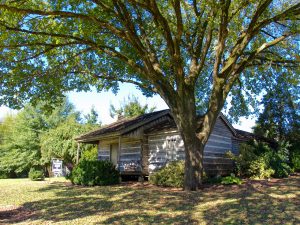
The log cabin birthplace of W.C. Handy in Florence.
Handy popularized the 12-bar, three-chord format of expression used by African Americans in the South by incorporating the style into his own compositions (most famously, “St. Louis Blues”). He published sheet music for songs that previously had been heard only on street corners, on front porches, and in rural juke joints. He helped create a blues craze and along the way assumed his nickname.
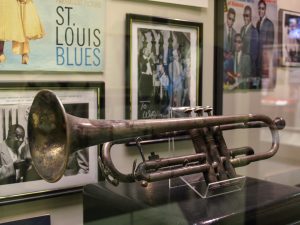
A trumpet played by W.C. Handy is on display at the Alabama Music Hall of Fame.
W.C. Handy and other Alabama musicians are honored at the Alabama Music Hall of Fame in Tuscumbia, about 7 miles south of Florence. The museum celebrates the music of the state as well as The Shoals, which the New York Times once described as “a holy place in the evolution of rock ’n’ roll.” In addition to the Swampers, the stuffed exhibit hall celebrates Hank Williams, Nat King Cole, Percy Sledge, Wilson Pickett, Emmylou Harris, Lionel Ritchie, and others. Memorabilia on display ranges from original sheet music and photos to the tour bus of the band Alabama, and even W.C. Handy’s trumpet. Parking is free and is suitable for RVs of all sizes. More info is available from (256) 381-4417; www.alamhof.org.
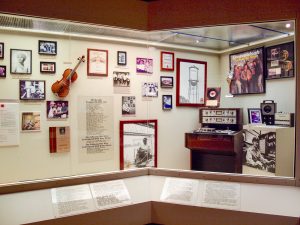
Many items relating to the area’s proud history are displayed in Tuscumbia at the Alabama Music Hall of Fame.
Around Town
Musicians can get their guitar fix in Muscle Shoals at the Shoals Guitar Boutique, which has a large selection of new and used guitars available for strumming. The Shoals Gold Record Room, in the SunTrust Bank in Florence, is a free, feel-good stop that inspires. The expansive floor is tiled to resemble enormous guitar necks and strings, and walls are lined with gold records produced or recorded in The Shoals. A music-themed mural depicts The Shoals’ musical landmarks and instruments.
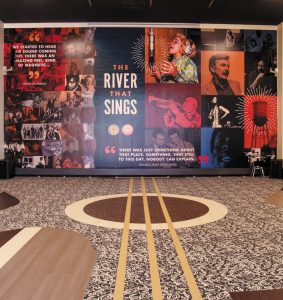
In Florence, the SunTrust Banks’ Gold Record Room boasts a guitar design on the floor.
Visitors might also like to see the Frank Lloyd Wright-designed Rosenbaum House in Florence, and Ivy Green, the Hellen Keller birthplace and home in Tuscumbia. For more details about tourism here, contact the city of Florence: (256) 740-4141; www.visitflorenceal.com.
Camping Info
Exploring all this musical history was simple; we used McFarland Park Campground as our home base, and because it is right in Florence, it was near these sights. The campground is on the banks of the Tennessee River. It has pull-through sites (up to 60 feet) with hookups. It is pet-friendly, and many sites are shaded. An alternative, 30 minutes east of town, is Joe Wheeler State Park, with 116 campsites (110 have full hookups).
McFarland Park Campground
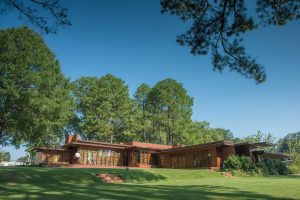
The Frank Lloyd Wright-designed Rosenbaum House is in Florence.
McFarland Park Road
Florence, AL 35630
(256) 740-8817
Joe Wheeler State Park
4401 McLean Drive
Rogersville, AL 35652
Campground: (256) 247-1184
www.alapark.com/parks/joe-wheeler-state-park