
Every RV comes with various weight ratings. Here’s how to apply that information.
By Steve Froese, F276276
July 2020
You’ve probably read articles that stress the importance of weighing an RV for safety reasons. Typically, those articles lack details about how to apply such information. I’ll cover that here, along with a process for weighing your RV.
All RVs sold in the United States and Canada are required by law to have a tire information and inflation label, and a weight information label. The latter should include the following details, with some variations depending on the type, make, and model year of the RV. In each instance, it is important to familiarize yourself with the specifics for your unit.
Gross vehicle weight rating (GVWR): The maximum permissible (and therefore safe and legal) weight of a fully loaded RV. For a motorhome, this includes the vehicle, occupants, cargo, fluids, and the tongue weight of any towed object. It is important to be aware of your RV’s GVWR as well as the individual gross axle weight rating (GAWR) numbers. In fact, it is possible to be within the GAWR but still have an overloaded tire as a result of an RV’s unbalanced side-to-side weight.
Unloaded vehicle weight (UVW): The weight of the vehicle as built at the factory. This weight generally includes full fuel, oil, and coolant, but does not include propane or water. However, as noted above, UVW may depend on several factors. The information label may indicate what is included.
Sleep capacity weight rating (SCWR): This rating, used only for pre-2008 vehicles, is the manufacturer’s designated number of sleeping positions multiplied by 154 pounds (70 kilograms). For example, an RV with one queen-size bed and two single bunk beds would indicate a sleeping capacity of four people. For the purposes of the SCWR, each person is assumed to weigh 154 pounds. Ours is not to question how the industry came up with this number. In our example, four people multiplied by 154 pounds equals 616 pounds (279 kilograms). As a side note, the number of seatbelts in a motorhome theoretically is tied to the SCWR. In other words, the SCWR should not exceed the number of seatbelts. However, this is not always the case, so for safety reasons, make sure the number of occupants in your RV does not exceed the number of seatbelts, regardless of the sleeping capacity.
Occupant and cargo carrying capacity (OCCC): The weight that a motorhome can carry in cargo and people. To calculate OCCC: GVWR – (UVW + full propane weight). Any extra dealer-installed equipment and the hitch tongue weight will reduce the OCCC. The rating became effective on June 2, 2008. Before then, the cargo carrying capacity (CCC) rating applied to motorhomes. To calculate CCC: GVWR – (UVW + total water weight + full propane weight + SCWR). The number of people actually occupying the RV could exceed the SCWR, in which case this must be taken into account.
Gross combination weight rating (GCWR): The maximum allowable combined weight of a motorhome and a towed vehicle; or, a towing vehicle (such as a pickup truck) and a towable RV. This will be higher than the GVWR, but you must ensure that a towed vehicle or trailer does not cause the GCWR to be exceeded.
Towables Only
Cargo carrying capacity (CCC): The GVWR – (UVW + full propane gas weight).
Hitch weight/tongue weight: The weight exerted at the vehicle-trailer coupling point when the trailer is fully loaded and hooked up for towing. Hitch weight/tongue weight should be about 10 percent to 15 percent of the gross vehicle weight (GVW).
Pin weight: The weight pressing down on a fifth-wheel hitch by the RV. The recommended amount of pin weight is 15 percent to 25 percent of the GVW.
For reference, fresh water weighs 8.3 pounds/gallon (1 kilogram/liter); propane weighs 4.2 pounds/gallon (0.5 kilograms/liter); gasoline weighs 5.6 pounds/gallon (0.67 kilograms/liter), and diesel fuel weighs 6.8 pounds/gallon (0.81 kilograms/liter).
All this means that you should never exceed the weight ratings of your RV. Therefore, it is important to know the rated and actual weight values of your unit.
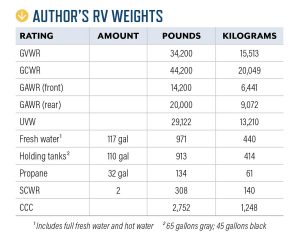
Let’s examine the real-world example of my motorhome, which is a 40-foot diesel pusher. Take a look at the accompanying chart (above).
My motorhome is a 2006 model. Using the pre-2008 formula for motorhome CCC noted above, here’s the calculation: 34,200 – (29,122 + 971 + 913 + 134 + 308) = 2,752 pounds. This weight must include our dogs, cat, kids, and all the cargo we have on board. While diesel-pusher coaches are built on heavy-duty chassis designed to support large amounts of weight, the same can’t be said for all chassis or RVs.
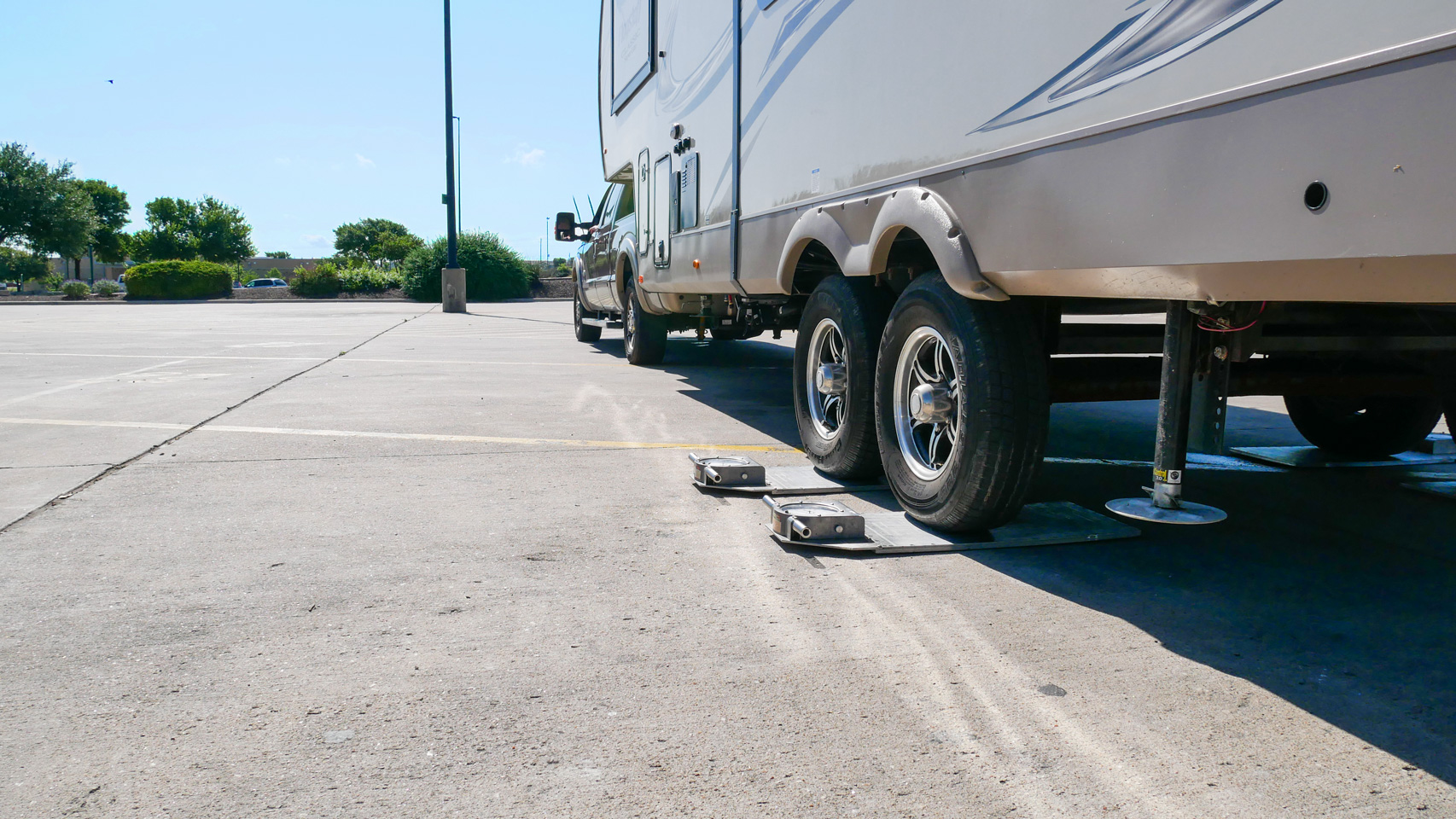
 Be sure to calculate and make note of the GVWR, the GAWR for all axles, and the OCCC (or CCC) for your RV. Then weigh your RV with the load it would normally carry for travel, including fuel, propane, water, and holding tanks, as well as all occupants and cargo on board. Next, weigh each wheel position (you can ignore dual configurations — simply weigh them as a set), as well as each axle individually. You can calculate the axle weights by adding together the wheel weights for each axle, but if you are collecting wheel weights anyway, it doesn’t take long to weigh the axles. Do not simply acquire the axle weights without getting the wheel weights, as the wheel weights are important for determining tire inflation pressure.
If you are a travel trailer owner, or you are considering purchasing one, it’s extremely important to ensure that the towing capacity of your towing vehicle is sufficient for your RV. Therefore, it is important to know your gross vehicle weight. Tongue weight can be determined by unloading only the hitch onto a scale while the rest of the trailer is off the scale. Also be sure to weigh the vehicle/trailer combination to ensure you are not exceeding the GCWR. And be sure the trailer and towing vehicle are fully loaded as for travel, including people, pets, etc.
Once you have the ratings and actual weights in hand, compare them. For instance, first check that your actual gross vehicle weight (GVW) does not exceed the GVWR. Similarly, ensure that the individual axle weights do not exceed the GAWR for each axle. Keep in mind that while your actual gross vehicle weight may be under the GVWR for the vehicle, you may be over on one of your axles. This is why it’s important to collect GVW, GAW, and wheel weights, as they are all vital for safe and legal RV operation.
Returning to the example of my RV, my gross axle weight for both axles, as well as my gross vehicle weight, are well within rated limits. Also, the combined weight of my RV, Toyota Prius, and tow dolly falls well within the GCWR of 44,200 pounds.
If your GVW is within the rated value but one or more of your axle weights are higher than the GAWR for that axle, try to correct this by shifting the cargo. While some large loads, such as the engine, refrigerator, tanks, etc., cannot be moved, much of the cargo likely can. This may seem like an annoying and possibly futile exercise, but it is important.
RV weighing is available at FMCA conventions from RV Safety & Education Foundation (www.rvsafety.com). I recommend this service, which uses individual wheel scales to get those important numbers. Other options include RV Weigh-Mobile Weigh Station, www.rvweigh.com; Weigh It Portable RV Scales, www.weighitrv.com; and some RV service facilities.
Remember that manufacturers determine these weight ratings for your safety as well as the longevity of the components in the RV. Keep your rig happy and your family safe!