
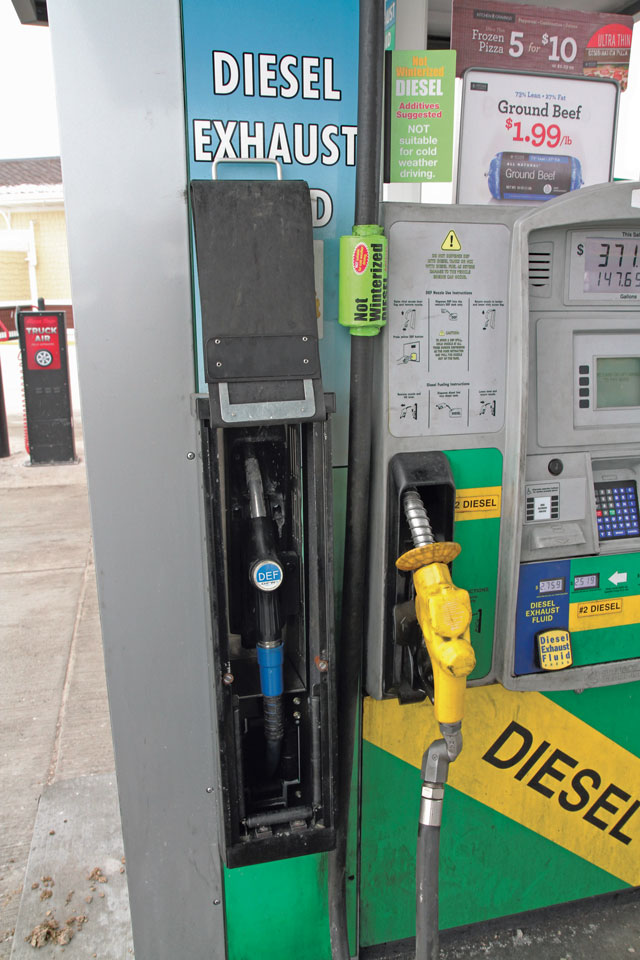
In diesel motorhomes with SCR technology, DEF is an integral component for meeting emissions standards.
By Mark Quasius, F333630
November 2020
For most owners of diesel-powered motorhomes built over the past 10 years, it’s important to become familiar with diesel exhaust fluid, or DEF. The liquid, which reduces the amount of air pollution created by diesel engines, is required for almost all such motors in order to meet U.S. Environmental Protection Agency emissions standards.
The current standards went into effect in 2010 and required major changes in the design of diesel engine emissions systems. Engine manufacturers started to incorporate selective catalytic reduction (SCR). In most motorhome brands, the changes began to appear in the 2011 model year.
SCR is considered an “after-treatment” technology. It destroys harmful emissions after combustion, which allows engine manufacturers to fine-tune engines to produce maximum power, efficiency, and fuel economy. SCR injects a decomposition agent — DEF — into the exhaust stream, where it forms ammonia vapor. The ammonia and atmospheric pollutants in the exhaust (known as oxides of nitrogen) flow into the SCR catalyst, where they react to form harmless nitrogen gas and water vapor.
For motorhome owners, the biggest impact of the emissions standards — aside from cleaner exhaust — is the need to deal with DEF.
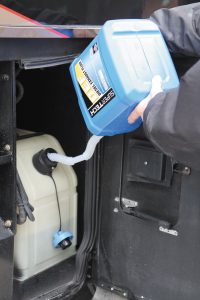
Refill a DEF tank as needed to avoid engine performance problems.
What Is DEF?
DEF is formulated exclusively for use in diesel engines that incorporate SCR technology. It is clear and colorless and has a slight smell of ammonia. The nonhazardous solution is composed of 32.5 percent urea and 67.5 percent water, but don’t try to make it yourself. Engine manufacturers specify that DEF should by certified by the American Petroleum Institute (API), the organization that rates engine oils and other petroleum products. The API Diesel Exhaust Fluid Certification Program allows DEF producers to display the API-certified label on DEF packaging.
DEF production must meet International Organization for Standardization (ISO) standards, specifically ISO 22241, which ensures that DEF is produced with a urea concentration of exactly 32.5 percent. That concentration gives DEF its lowest freezing point, 12 degrees Fahrenheit.
Contaminated fluid can damage SCR injectors and catalysts, so production quality is closely monitored, and the level of impurities is held to strict tolerances. Urea used in the manufacture of fertilizer is not allowed, and only distilled or deionized water may be used. Even DEF containers are regulated by ISO 22241. DEF is corrosive to carbon steel, copper, and aluminum, which precludes the use of containers made of those metals. A DEF container bearing the API DEF Certification Mark meets the ISO 22241 standard and is safe to use in a vehicle.
The amount of DEF a motor-home consumes varies with the size of the engine and how hard it’s working. Some people say that DEF usage equals 2 percent of diesel fuel expended, but that is a generalization. In lighter RVs with small-displacement engines that are driven leisurely, the figure may be as low as 1.5 percent; for large, heavy coaches with the 15-liter Cummins ISX engine, the figure can be as high as 4 percent, depending on the vehicle’s load and how hard the driver accelerates.
Handling DEF
DEF isn’t difficult to handle, but some things should be kept in mind. Bulk DEF is available at truck stops from dedicated DEF pumps located on the driver’s-side fuel island. DEF pump nozzles usually are next to the diesel fuel pump and behind a rubber flap. The flap helps to prevent mistakenly using the diesel pump nozzle, and to keep the DEF nozzle from freezing in cold weather. DEF also is available in 2.5-gallon containers at auto parts stores, fuel stations, and most large retailers. For a fairly comprehensive listing of DEF retailers, visit www.discoverdef.com.
DEF can evaporate if stored at high temperatures for prolonged periods, but field tests have shown no significant risk of evaporation from DEF tanks as long as the tank or container is kept securely closed. DEF’s shelf life of two years is reduced if DEF is exposed to direct sunlight or if the temperature remains above 86 degrees Fahrenheit for sustained periods. DEF packaging lists an expiration date, so remember that if you stock up. Ideally, DEF should be used within one year of purchase, and it should be stored in a location where temperatures do not drop below freezing or exceed 85 degrees. DEF that appears cloudy or colored is likely contaminated or old.
DEF is always stored in its own tank on the motorhome and never should be put into a diesel fuel tank; nor should diesel fuel ever be put into a DEF tank. Fortunately, there are safeguards to help prevent cross-filling. Standard diesel fuel nozzles measure 0.87 inch (22 millimeters) in diameter, while DEF nozzles are 0.75 inch (19 millimeters) in diameter, which makes it difficult to accidentally insert a diesel fuel pump nozzle into a DEF tank. Also, DEF tank caps are blue to differentiate them from diesel fuel tank caps. Diesel fuel is lighter than DEF and will float on the top of the DEF if it gets into the tank. But even a small amount of diesel fuel will damage the SCR system, so if that happens, do not run the engine. Instead, call a service center immediately and do not drive the vehicle until the diesel fuel is removed from the DEF tank.
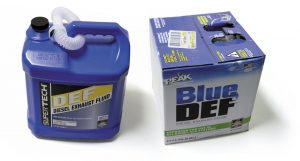
Options include Walmart’s Super Tech DEF (far left) and Blue DEF from Peak, commonly found at truck stops and auto parts stores.
On the other hand, it is possible to insert the smaller DEF nozzle into a diesel fuel filler neck. Again, if that happens, do not start the engine. DEF contains 67.5 percent water, which can result in disastrous effects if mixed with diesel fuel, including exploding fuel-injector tips. Call for help to have the fuel system drained or cleaned to remove the DEF.
Some bulk DEF pumps have magnetic switches built into the nozzle. The DEF tank has a magnet in the filler neck that allows the DEF nozzle to open and dispense DEF. The nozzle does not allow any flow without that magnet, such as when inserting the DEF nozzle into a fuel tank filler. However, not every DEF pump has the magnetic switches, nor do the 2.5-gallon jugs, so pay attention to the tank when you are adding DEF.
DEF is not hazardous to handle, but it can stain clothes. If you spill it on clothing, wash it off with water. DEF spilled on the ground can be rinsed away with water or wiped up with a paper towel or rag. As noted earlier, DEF can be corrosive to carbon steel, copper, or aluminum, so rinse those metals with water if DEF comes into contact with them.
DEF In A Motorhome
Because DEF corrodes certain metals, DEF tanks are made of polypropylene. There are limits on the length of the hoses that connect the DEF tank to the engine’s emissions system, so the tank is located at the rear of a diesel-pusher chassis and at the front of a front-engine vehicle such as a Super C or Sprinter chassis. Some side-radiator chassis don’t have enough room to place the DEF tank on the driver’s side of the coach, so it is located on the curb side. Unfortunately, DEF pumps at truck stops are always on the driver’s side to accommodate the driver’s-side DEF tanks on large trucks, an arrangement that may not work well for an RV. However, chassis manufacturers have made efforts recently to add driver’s-side DEF fills as a convenience for motorhome owners.
As noted previously, DEF freezes at 12 degrees Fahrenheit. In cold temperatures, DEF will not flow until it is warmed sufficiently. The warmup occurs fairly quickly when the engine’s cooling system moves heated engine coolant through a heating element in the DEF tank. DEF begins to flow quickly enough that emissions controls do not issue an error code.
When the engine is shut down, you may hear an electric pump running for approximately 60 seconds. The pump drains all the DEF from the hoses and returns it to the tank to prevent freeze damage to the lines and valves. DEF expands about 7 percent when frozen, so a bit of air space is needed above the DEF in the tank to allow for expansion during cold weather. The filler neck in a DEF tank generally is low enough to prevent overfilling, but if the curbside tank also has a second driver’s-side filler cap, you should keep an eye on this. If you store your coach in winter, it’s not necessary to drain the DEF tank, but it is a good idea to keep the DEF level low rather than topping it off.
Here’s a simplified overview of how SCR works. Engine exhaust, containing atmospheric pollutants known as oxides of nitrogen, passes through a diesel particulate filter that catches soot and ash. The exhaust then flows into a decomposition reactor. There, the hot exhaust comes in contact with a light mist of DEF, which is sprayed from an electronically controlled dosing valve. In the decomposition reactor, a chemical reaction forms ammonia. The oxides of nitrogen and ammonia pass from the decomposition reactor to an SCR catalyst chamber where they react to form nitrogen and water vapor. The end result is exhaust with near-zero hazardous emissions.
DEF is a critical component; without it, the emissions system will not work. The EPA requires that the vehicle emissions system be fully operational at all times, so certain safeguards are in place to ensure that the vehicle will not operate without DEF.
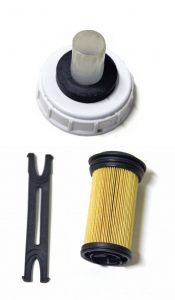
A Magnevator accessory (top) activates DEF pumps with a magnetic valve so portable DEF jugs can be refilled. The Cummins DEF filter includes a small tool for removing the filter from the housing.
A gauge on the instrument panel shows how much DEF is in the tank. It may be an analog gauge, or, in some cases, it may consist of four LED bars within the diesel fuel gauge. Four green bars mean the DEF tank is full; three green bars indicate it’s three-fourths full, and so on. Typically, when the level of DEF in the tank reaches 10 percent, the last green bar turns amber, “LOW DEF” is displayed on the instrument panel’s information center, and a warning icon appears. The vehicle continues to operate normally, but more DEF should be added as soon as possible.
When the DEF level drops to 5 percent, the LED bar turns red, and the information center display says “ENGINE PERFORMANCE DERATE IMMINENT.” When the level drops to 3 percent, the display says “ENGINE PERFORMANCE DERATE ACTIVATED,” and engine torque output is reduced by 25 percent. You’ll be able to limp off the road at reduced power, but you’ll be burning DEF as you do.
When no DEF remains in the tank, the red LED bar remains illuminated and the information center display says “SPEED RESTRICTION ON. DEF REQUIRED.” Engine torque is reduced by 40 percent, and the vehicle speed is limited to 5 mph, just enough to pull off the road. At that point, DEF must be replenished to at least 10 percent of tank capacity to be able to drive to a location where the tank can be filled. It’s wise, therefore, to carry a 2.5-gallon jug or two of DEF, even if you normally refill with pump DEF at truck stops.
DEF systems aren’t high-maintenance, but DEF can age past its shelf life if a motorhome is stored for long periods or is run only briefly and infrequently. In that case, it’s a best practice to drain DEF from the tank and replace it with fresh every year.
A DEF filter, located near the bottom of the DEF tank, should be replaced every 200,000 miles or two years, whichever comes first. The filter’s cover is easily removed with a 1 1/16-inch 12-point socket wrench and extension. In some cases, you may be able to remove the DEF filter cap with channel-lock pliers, but if it’s tight, you might damage the cap. The filter is at the base of the tank, so you’ll be looking up at it. Just be sure that you are off to one side when you remove it, because a bit of DEF will dribble out of the filter housing. The Cummins DEF filter is a small cartridge; it comes with a small tool to yank the filter out of the housing. Don’t forget the filter when servicing the chassis. A plugged or restricted filter can lead to a failed DEF pump, which is an expensive repair.
A DEF system is not difficult to maintain. Changing the filter every two years and keeping the DEF fresh should result in a trouble-free system and a clean-burning diesel engine.