

Here’s how to safeguard your RV’s electrical appliances.
By Mark Quasius, F333630
December 2020
Many RVs are equipped with a variety of electrical appliances. Air conditioners, residential refrigerators, and sophisticated entertainment systems all demand clean electrical power, which is even more critical when factoring in digital technology related to multiplex wiring that controls such things as lighting, slideouts, and power window shades.
But while RVs have become more sophisticated, many campgrounds have not kept pace. Often, campsites were added but the main power was not upgraded to ensure that adequate voltage is available at every pedestal. Plus, pedestals themselves take a fair amount of abuse. Circuit breakers are rated for a given number of manual on-off operations. As they weaken over time, they may prematurely trip as they overheat. In addition, problems may exist with the wiring inside the pedestal, such as loose connections that can cause arcing at the connectors or an open neutral.
To safeguard the RV electrical system, every RV owner should employ power protection. Some RVs come equipped with a basic protective device, but it may not be adequate. Therefore, it’s important to understand what you have, what is required to meet your needs, and what is available.
Surges And Spikes
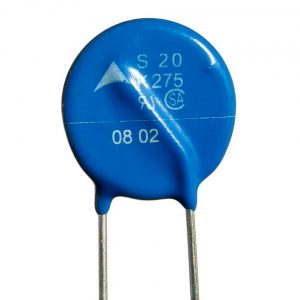
A metal oxide varistor, or MOV, diverts electricity to ground in the event of excess voltage.
The electrical components in an RV are designed to work within a specific voltage range. I like to compare voltage in a circuit to water pressure. If an RV’s water pressure is too high, the result is burst water lines and hoses. Likewise, voltage that exceeds the maximum specified level will damage or destroy electrical components.
Surges and spikes both are forms of high voltage. A spike lasts only for one or two nanoseconds (one or two billionths of a second), whereas a surge lasts three nanoseconds or long-er. In either case, damage can occur.
Surges and spikes are fairly easy to stop. A metal oxide varistor, commonly known as an MOV, serves as a shunt to divert electricity to ground when incoming voltage is excessive. An MOV looks like a small disc and consists of metal oxide sandwiched between two semiconductor layers. Each layer has a wire lead, with one wire connected to the incoming power and the other connected to ground. The MOV acts as a variable resistor. When incoming voltage is within specifications, the MOV has a high resistance and the incoming power passes it by without affecting the MOV. However, when the voltage exceeds the MOV’s maximum tolerance level, the MOV goes to low resistance and the current flows through the MOV to ground, dampening the surge or spike and protecting the RV from a damaging increase in voltage. Think of it as a safety valve on an air compressor that bleeds off excessive air pressure to prevent damage.
Surges and spikes are measured in joules. One joule is the amount of energy dissipated as heat when a current of one ampere passes through a resistance of one ohm for one second. In other words, the bigger the surge, the higher the number of joules. Not all MOVs are the same, and ratings can vary. So, when searching for a surge protector, look for one with the highest possible rating in joules. The higher the rating, the better the protection. A large enough surge can exceed the capacity of a surge protector. In that case, the MOVs destroy themselves while attempting to save the electrical system. The self-sacrificing MOVs then must be replaced to restore surge protection. Some units may need to be returned to the factory for repair, while others can be serviced in the field with a simple circuit board swap.
Open Neutral Danger
Fifteen-amp, 20-amp, and 30-amp pedestals have only three conductors — hot, neutral, and ground. A 50-amp receptacle has four conductors — two hots, commonly known as L1 and L2; one neutral; and one ground. A break in the neutral conductor creates an open circuit, and the RV loses power.
Let’s say you have a 5-amp load on the L1 phase and another 5-amp load on the L2 phase. Current will flow between L1 and L2 without any current flow on the neutral wire. But if 30 amps is on one hot pole of a 50-amp supply, and 20 amps is on the other pole, the two phases are not in balance; the excess, 10 amps, flows down the neutral conductor. If the neutral conductor fails, the condition is called “open neutral.” It causes up to 240 volts to pass between the two hot phases, because the resistance in each phase is not equal. Those 240 volts will destroy any electrical component in their path. It’s important, therefore, to remember that an open neutral can be disastrous to an electrical system, because of the presence of up to 240 volts on 120-volt electrical components.
High Or Low Pedestal Voltage
We’ve covered how high voltage from spikes and surges can destroy equipment. Another problem occurs when a campground continually provides voltage that exceeds the maximum allowed. This may stem from a utility transformer that is set too high in order to allow for long runs to a campground that has power pedestals spread over a large area and an inadequately designed electrical grid. This scenario isn’t as common as low voltage, but it does exist.
Generally, the most common danger to an RV’s electrical system is low voltage at a pedestal. This can be a temporary situation known as a brownout, or it can be a condition that persists over a longer time. Many campgrounds have added sites over the years or upgraded from 30-amp pedestals to 50-amp pedestals. But a campground’s electrical grid may never have been properly designed for the increased load. Once guests arrive in the afternoon and start switching on their air conditioners, the voltage drops as the demand for power increases.
Electrical components are rated in wattage, which is a true measurement of power. Wattage equals voltage multiplied by amperage. Amperage is a measurement of current flow. Each conductor is rated for a maximum amperage; excess amperage causes heat to build up from resistance in the circuit, which is why circuits utilize fuses or circuit breakers for overcurrent protection. Wattage is always constant, so when the voltage drops, amperage increases.
Here’s an example: If a 120-volt air conditioner is designed to pull 20 amps as a starting surge, it will pull 24 amps if the voltage drops to 100 volts. The excessive amperage caused by low voltage will increase heat in the wires, and eventually will damage the compressor motor or capacitors. Other electrical components also can be damaged this way.
Choosing A Surge Protector
A surge protector guards against surges and spikes, but many units do more. You are more apt to have problems caused by low voltage than a surge, so it’s important to check a surge protector’s specifications to know the type and level of protection it offers.
To adequately protect an RV from surges and spikes, look for devices rated at 3,000 joules or more. Suppliers such as Progressive Industries, Hughes Autoformers, and Southwire offer units that meet or exceed that level of protection.
Some portable units are designed to hang on a power pedestal. The advantage is that they easily can be moved from one RV to another. But they are exposed to the weather and potential theft.
Hardwired units are mounted inside the RV, protected from weather and theft. Many have a remote display that can be mounted in a convenient location so that voltage, amperage, and error messages easily can be viewed from inside the RV. Installing a hardwired unit typically is a matter of splicing into the incoming shore power cord inside the RV prior to the transfer switch and running a small phone-type cable to the remote display.
It’s best to choose a surge protector that handles more than surges; it also should monitor voltage levels. Standard tolerances on 120-volt components are plus or minus 10 percent, which means a range between 108 and 132 volts. RV surge protectors with voltage-monitoring capabilities typically lower the minimum voltage a bit to allow for temporary voltage dips when heavy loads are applied to a 50-amp power supply. Therefore, it’s not uncommon to see units with low-voltage cutout values as low as 102 volts. If the voltage exceeds the maximum or drops below the minimum, the device will disconnect voltage from the RV to prevent damage.
Reverse polarity, miswired pedestals, and open neutrals are dangers as well, so a surge protector should be capable of disrupting power to the RV should any of those conditions exist. Some sort of notification also is necessary to clearly indicate why the RV’s power has shut off. This can be as simple as a few illuminated LEDs on the surge protector itself; or it can be a digital display, either on the surge protector or mounted in the RV living area.
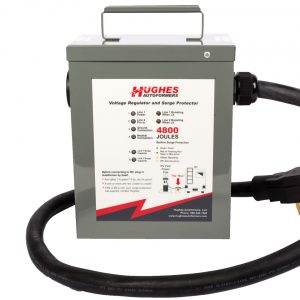
Hughes Autoformers model RV220-50SP
Most surge protectors can delay applying power to an RV when the vehicle is first plugged into the pedestal. The delay, which may be as long as two minutes, is designed to allow air conditioners time to bleed head pressure from the compressor to reduce the amperage surge when the compressor starts. Many modern air conditioners have an automatic delay built in; in that case, some surge protectors can be set to eliminate the startup delay.
Voltage Boosters
As noted, a good surge protector halts incoming power when the voltage drops below parameters. Without power, it may be possible to run the generator, but that consumes fuel, makes noise, and may not be allowed in your RV park. Another option is a voltage booster such as the 30-amp and 50-amp models from Hughes Autoformers.
If incoming campground voltage is 115 volts or higher, the Autoformer passes the current through with a 2 percent boost. If the voltage drops to 113 volts or lower, the Autoformer goes into “boost mode” and boosts the voltage by 10 percent. That makes it possible to operate with pedestal voltages as low as 95 volts by boosting it to 104 volts or better. If the voltage drops below 95, the Autoformer won’t be able to boost voltage to an acceptable level, but such conditions are rare. Usually, the voltage drop is marginal — just enough to make the difference between having good RV power or not.
The Autoformer has built-in surge/spike protection, and the module also is replaceable. If it is used up, it can be swapped out for a new surge module. The Autoformer does not protect against sustained high or extremely low voltages, so it should be used in conjunction with an auto-shutoff-type surge protector. In that case, the Autoformer should be placed in front of the surge protector; that is, the Autoformer is connected to the pedestal, with the surge protector next in line, and then the RV. Otherwise, the surge protector will cut off incoming voltage, preventing the Autoformer from boosting the voltage if needed.
Automatic Transfer Switches
Southwire Company makes a line of automatic transfer switches. Some units, such as the 50-amp model 41260, offer some protection against surges, reverse polarity, and open neutrals but not low or high voltage protection. Model 41260 comes as original equipment in a number of RVs, but be sure to purchase a surge protector that offers full electrical protection, including low and high voltage safeguards.
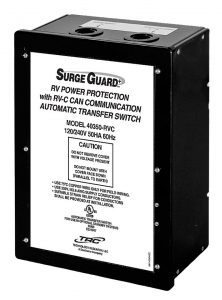
Southwire model 40350-RVC
Another automatic transfer switch from Southwire, model 40350-RVC/40450-RVC, offers full electrical protection, including for low and high voltage. It has RV-C network compatibility, so it may be found as original equipment on the latest high-end RVs with multiplex wiring systems that feature a touch-screen display. It also is available with a remote monitor panel for nonmultiplexed systems. Transfer switches such as model 40350-RVC/40450-RVC protect generator power as well as shore power. If a new transfer switch is installed, the original one is removed, so there’s no need to find additional space for the replacement, nor is it necessary to cut into the shore power cord.
An RV equipped with a model 40350-RVC/40450-RVC transfer switch does not need additional protection, but you may choose to carry an Autoformer for those times when the voltage needs a bit of a boost. Another feature of model 40450-RVC: It automatically switches from generator power when shore power returns after an outage.
Sooner or later, everyone will encounter power outages, low-voltage brownouts, and surges, so it makes sense to protect your RV’s electrical components. A good surge protector is inexpensive insurance and a good investment.
Products
Following are some power-protection devices available from three well-known suppliers.
Hughes Autoformers
While not a complete power-protection system, Autoformers can be used in conjunction with a surge protector to boost incoming voltage rather than just shutting down power to the RV. Hughes recently added a line of surge protectors. Products have a three-year warranty.
Model RV220-50SP is a 50-amp voltage booster that features 4,800 joules of surge suppression, in addition to a 10 percent voltage boost when incoming voltage drops below 113 volts. An array of LED lights provides diagnostics of park power. The Autoformer can be mounted inside a vehicle with an optional connection kit. A 30-amp model also is available.
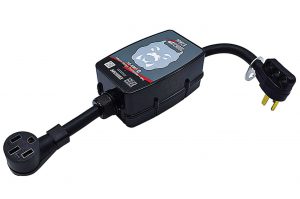
Hughes Autoformers 50-amp model PWD50-EPO
Hughes recently introduced the Power Watchdog series of surge suppressors. Portable and hardwired models, for 30-amp and 50-amp power supplies, are available. The 50-amp model PWD50-EPO offers 4,800 joules of surge protection. It also protects against open neutrals, reverse polarity, and high or low voltage. Power Watchdog surge suppressor models feature wireless Bluetooth communications; a free smartphone or tablet app makes it possible to view power status at any time in the immediate vicinity of the RV.
FMCA members receive a 10 percent discount by using coupon code FMCA.
Hughes Autoformers
(888) 540-1504
www.hughesautoformers.com
Progressive Industries
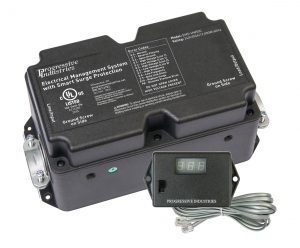
Progressive Industries model EMS-HW50C
Surge protectors are available for 30-amp and 50-amp power supplies in hardwired and portable models. The Electrical Management Systems (EMS) series includes some models equipped with embedded displays, while others have remote display capabilities. EMS products have a limited lifetime warranty; hardwired units can be serviced in the field rather than sent back to the factory.
Model EMS-HW50C is a hardwired 50-amp unit that provides 3,580 joules of surge protection at 88,000 amps. It protects against low voltage (less than 104 volts) and high voltage (more than 132 volts), open neutral, open ground, reverse polarity, miswired pedestals, and high and low frequency. An LED display scrolls through various voltage, amperage, and frequency readings, as well as status or error codes. The display can be mounted near the device or in a remote location inside the RV. The unit is field serviceable in the event of a major surge. A 30-amp model, EMS-HW30C, is available.
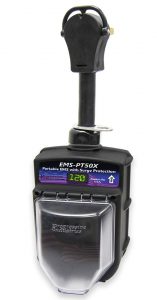
Progressive Industries model EMS-PT50X
Model EMS-PT50X is a portable 50-amp unit that offers 3,580 joules of surge protection at 88,000 amps. It protects against low voltage (less than 104 volts) and high voltage (more than 132 volts), open neutral, open ground, reverse polarity, miswired pedestals, and high and low frequency. An LED display scrolls through various voltage, amperage, and frequency readings, as well as status or error codes. A 30-amp model, EMS-PT30X, is available.
Progressive Industries
(800) 307-6702
www.progressiveindustries.net
Southwire
Southwire’s Surge Guard surge protectors are available as hardwired and portable models for 30-amp and 50-amp power supplies. A line of automatic transfer switches also is available. Certain products have a limited lifetime warranty with connected equipment coverage.
Model 35550 is a 50-amp hardwired unit that provides 3,850 joulesof surge protection. It protects against low voltage (less than 102 volts) and high voltage (more than 132 volts), open neutral, reverse polarity, open ground, and miswired pedestals. The unit mounts in an RV compartment; an optional remote LCD monitor displays voltage, amperage, and status or error messages. Model 35530 is similar but is designed for 30-amp power supplies.
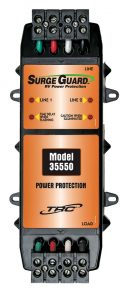
Southwire model 35550
Model 34950 is a 50-amp portable unit with 4,200 joules of surge protection. It plugs into a pedestal; accepts your RV’s power cord; and protects against low voltage (less than 102 volts), high voltage (more than 132 volts), open neutral, open ground, reverse polarity, miswired pedestals, load-side open neutral, and load-side elevated ground protection. LED lights and an LCD display show voltage, amperage, and status or error messages. The 34950 shuts off power if the receptacle overheats. Model 34930 is the 30-amp version. Models 34951 (50 amp) and 34931 (30 amp), both portable units, offer over-current protection and Bluetooth communication compatible with the Model 40301 wireless display.
Model 40350-RVC is a 50-amp automatic transfer switch offering 3,350 joules of surge suppression. It guards against low voltage (less than 102 volts) and high voltage (more than 132 volts), open neutral, open ground, reverse polarity, miswired pedestals, and high or low frequency. An optional remote monitor displays voltage, amperage, and power system status messages. Model 40450-RVC is similar, except it features shore power sensing that transfers automatically to generator power when energized. Once the generator shuts down, shore power activates after a three-second delay.
Southwire
(800) 780-4324
https://rvpower.southwire.com/products/surge-protection/