
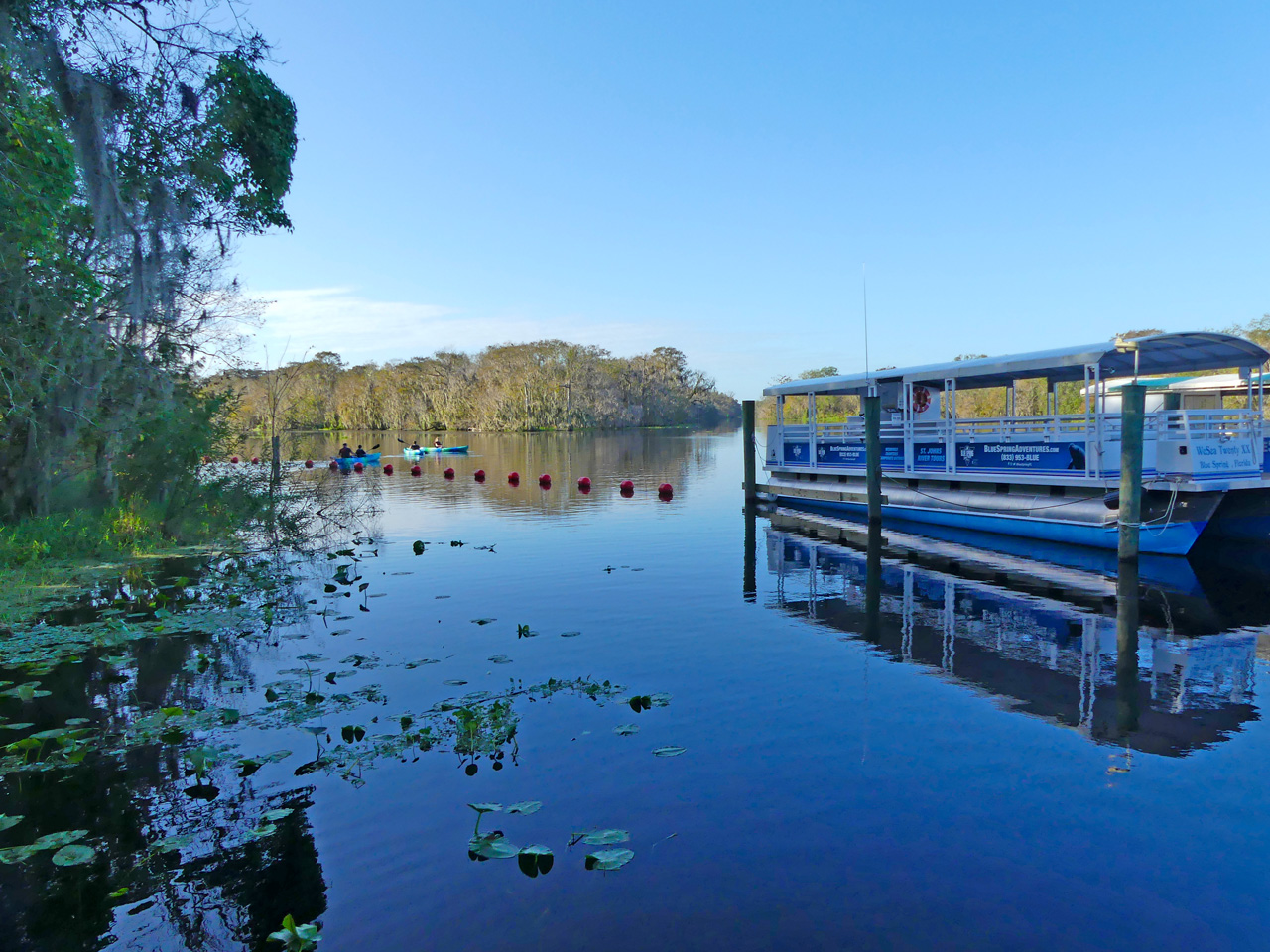
From manatees to murals, warm springs to wildlife, the western portion of Florida’s Volusia County has it all.
By Kathleen Walls
February 2021
When “The Undersea World of Jacques Cousteau” television series filmed an episode titled “The Forgotten Mermaids” at Blue Spring in northeast Florida in 1971, it focused attention on a little-known mammal: the manatee. Today, Blue Spring is a state park, where visitors flock to see this endangered creature — believed to be the inspiration of the mermaid’s legend — as it swims in the crystal-clear waters there.
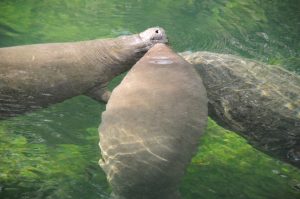
Hundreds of manatees winter in Blue Spring State Park.
Blue Spring is the largest first-magnitude spring along the St. Johns River, emptying about 100 million gallons of water into the river each day. Opened in 1972, after the state purchased land to protect the area — sparked in part by the Cousteau visit — the park now is one of Florida’s most popular, with more than 500,000 visitors annually. The park allows diving and cave diving for certified divers, along with a host of other outdoor activities, among them paddle boarding, kayaking, and canoeing. Water activities are suspended during the manatee migration.
Beginning in November, manatees enter the spring run from the St. Johns River. They are sensitive to cold, and since the spring remains at 72 degrees year-round, it is one of their favorite refuges. They stay until mid-March or so, when the weather warms, and then return to the river.
“When Jacques Cousteau came here there were about 10 or 11 manatees,” said park ranger Darrell Thomas. “And this past season we broke our record and there were 583 manatees.”
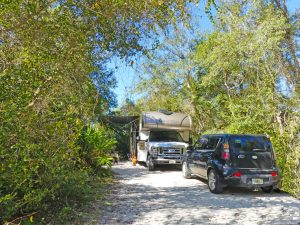
Blue Spring’s campground is within walking distance of the water.
Blue Spring State Park also is an RV heaven, with 44 campsites that can accommodate RVs up to 40 feet long. Each site has a picnic table, water, electricity, and a grill. Best of all, campers are within walking distance of the spring, and just minutes from a multitude of activities and attractions.
One of the highlights is Blue Spring Adventures’ Nature Cruise, a two-hour boat ride on the St. Johns River. The knowledgeable captains point out alligators, egrets, limpkins, herons, and other wildlife. Another must-see within the park is the Thursby House, which was built in 1872 by Louis Thursby, one of the first European settlers in the area. The St. Johns River gave him a way to ship the oranges he grew. Mr. Thursby built his home atop one of the shell middens left by pre-Columbian people.

An anhinga sighted during a boat tour.
Blue Spring State Park sits within western Volusia County, between Daytona Beach and Orlando. Fourteen communities along the St. Johns River make up the tourism area known as West Volusia. West Volusia also has two other state parks, as well as year-round events ranging from art and food-and-drink festivals to rodeo and jazz festivals. The towns are filled with antique shops, art, boutiques, restaurants of all types, and museums. There is, in short, something for everyone. What follows is a sampling.
De Leon Springs State Park
De Leon Springs State Park, in De Leon, has a spring that stays a constant 72 degrees and ranges in depth from 18 inches to 30 feet. Swimming and diving are allowed.
The visitors center tells of the people who lived in the area for the past 6,000 years. The earliest recorded dwellers were the Mayaca, who left behind the shell mounds. The site was once a plantation and was converted into a resort in the 1950s and 1960s. The park is on the Great Florida Birding and Wildlife Trail. While hiking in the park, visitors may encounter deer, turkeys, wild hogs, and Florida black bears.
Water activities include kayaking, canoeing, or a 50-minute eco/history boat tour on Spring Garden Run aboard the M/V Acuera. Spring Garden Run starts at the park and connects with the St. Johns River in about 10 miles.
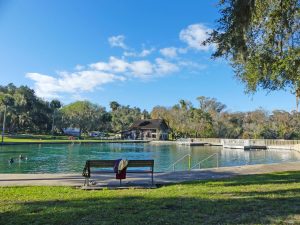
De Leon Springs State Park is located along the Great Florida Birding and Wildlife Trail.
De Leon Springs also boasts a popular breakfast destination called the Old Spanish Sugar Mill Restaurant, which is built on the remains of a sugar-making operation from the 1830s. Tables are equipped with griddles so guests can make their own pancakes. Remnants of the mill — the brickwork, boiling kettles, mill machinery, and the original mill wheel hub — are located behind the restaurant.
Hontoon Island State Park
Hontoon Island State Park in DeLand is accessible only by boat. A replica Owl Totem tells of the island’s early dwellers, the Mayaca. The original totem was recovered in 1955. At first it was attributed to the Timucuan, a neighboring tribe, but later research determined it to be the work of the Mayaca. The early inhabitants used the totems to show which clan lived in an area.
The interpretive center offers more about the history of the island and its abundant wildlife. Camping is limited to tents or primitive cabins. You can rent a kayak, canoe, or bicycle to explore the island. You might see an alligator — or more. Park manager Rene Acuna tells about encountering a bear on the trail: “I saw him; he saw me. He was only a couple of hundred yards away. He took up almost the entire path. It startled me, as I am so used to seeing the smaller animals.”
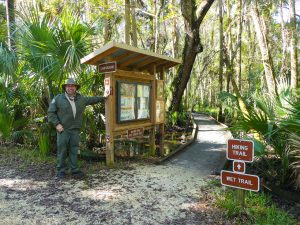
Rene Acuna, Hontoon Island State Park manager, at the hiking trail.
A lunch spot just across from the park, Hontoon Landing Deli, serves great sandwiches. You might meet two sandhill cranes near the front or an egret that frequents the rail overlooking the river.
Gemini Springs Park
Gemini Springs Park — located between the towns of Enterprise and DeBary — is a 212-acre park that pumps up about 6.5 million gallons of water from its two springs daily. A large flock of Florida white ibises often visit the spring, as well as many other water birds. A paved trail wanders across the spring run, along with several wooded trails. A tent-only campground, a dog park, and lots of picnic tables fill the park.
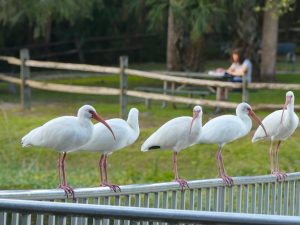
White ibises are a frequent sight at Gemini Springs Park in DeBary.
Green Springs Park
Green Springs is a smaller, 31-acre emerald green spring, located in Enterprise. It’s one of Florida’s few sulfur springs, which Native Americans considered sacred and believed had healing powers.
Downtown DeLand
A very popular attraction in Downtown DeLand is the original creation on the “Wings of the West Trail,” a painting by local artist Erica Group. Wings of the West now is a series of six different wings murals that are sought out by photo takers who enjoy posing with them. The remainder are scattered throughout the county, with each pair placed in a location featuring outdoor activities.
The first pair, the “DeLand Wings,” is around the corner from West Volusia Visitors Center, which sports one of DeLand’s many murals on its front. Murals are big (and little) in DeLand. Ask for a map to see the Wings locations and the 20 mini-masterpieces in the Miniature Art Adventure. Just down the alley is a cozy dining experience at BakeChop. DeLand is also home to the famous Athens Theatre, dating to 1921.
Lyonia Preserve And Environmental Center
Lyonia Preserve is a 360-acre wildlife refuge in Deltona, and its hiking trails are one of the few places you might see a Florida scrub jay. Appropriately, it’s home to the “Scrub Jay Wings,” painted on a wall near the preserve’s butterfly garden. Inside, the Lyonia Environmental Center has interactive exhibits and wildlife, including king snakes, a ball python, a pair of turtles named Tuttie and Frutti, a few fish in the turtle tank, and a blue-tongued skink named Igor.
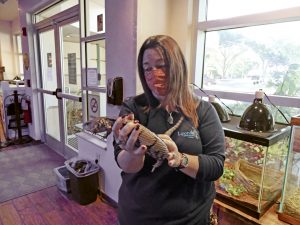
Manager Sandy Falcon holds a blue-tongued skink at the Lyonia Environmental Center.
Lake Woodruff National Wildlife Refuge
Inhabited by the Timucuan Indians and their predecessors dating back 8,000 years, Lake Woodruff in De Leon Springs is now part of the National Wildlife Refuge system. If you hike the refuge, you’ll find Indian mounds and middens. Encompassing 22,000 acres, it is the home of the second-largest premigration number of endangered swallow-tailed kites.
The refuge is also home to the “Swallow-Tailed Kite Wings” painting. You hike a short distance around a lake near the entrance to reach this set of wings.
Barberville Pioneer Settlement
Located in the town of Barberville, the settlement takes visitors back to earlier days when Florida was the wild frontier. The buildings range from the late 1800s to early 1900s. Central School of Barberville, which dates back to 1919, was the first building at the settlement. Thanks to the efforts of several local teachers, other historically significant buildings from the region ultimately were moved to the site, and a village was formed.
In the school, one room illustrates classrooms of that era. The desks have inkwells. An old-fashioned world globe sits on the teacher’s desk. There is a blackboard, a dunce cap, and a stool to seat the wearer. Another room is filled with different types of looms. Various kinds of yarn and samples of woven articles are on display, along with old treadle sewing machines, handmade quilts, and memorabilia and photos from that time.
Among the other buildings is a country store, the heart of every small Florida settlement. Naturally, there’s a village church, Midway United Methodist Church, circa 1890. The homes range from the simple Lewis Log Cabin, the oldest building in the settlement, dating to 1875, to the 1879 Underhill House, which was the first brick home built in Volusia County.
During events, a blacksmith makes things at the flaming forge in the well-equipped blacksmith shop. Docents are in costume at the cabins and around the grounds. Pierson Railroad Depot, circa 1885, and a caboose represent rail travel. Peacocks, chickens, goats, donkeys, and more wander the grounds. And the settlement is home to a Wings mural, with colorful peacock wings painted on an antique wooden barn.
Cassadaga Spiritualist Camp
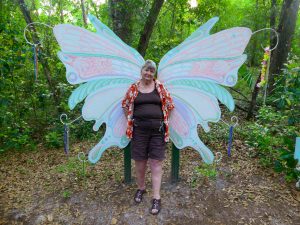
“Fairy Wings,” at the Cassadaga Spiritualist Camp, is one of six Wings of the West murals in the West Volusia region.
Cassadaga is one of the most unusual places in Florida. It is home to a Spiritualist community, called a “camp,” as they have been known since the mid-1800s. Early camps were often tents and open only part of the year. Nowadays, people come here for either a reading or healing, but it’s a fun destination with a lot of history and a beautiful lake.
The village is filled with Victorian homes dating to the early 20th century and is on the National Register of Historic Places. One of the homes has a tree with a carving. Supposedly, the tree would not die even when people tried to cut it down. Legend says a little girl lived in the house by the tree. She was sickly and could not go outside much. One of her favorite pastimes was playing with pennies. Over the years, homeowners found stacks of pennies around the house. The present homeowner hired a woodcarver to do a carving of an angel giving pennies from heaven to the little girl.
Cassadaga also includes the Fairy Trail, a small garden with fairies, gnomes, and enchantment. Within the trail you’ll find “Fairy Wings.”
Indoor Attractions
The West Volusia region offers indoor attractions also. DeBary Hall in the town of DeBary was once the winter home of Frederick DeBary, a wine importer, who had it built in 1871. He called it a hunting lodge, but the elegant mansion is anything but rustic. Visitors can view the furnishings and learn about the family history.
In the visitors center, an Imagidome Theater presentation explores the historic St. Johns River. You “step aboard a steamboat,” and the captain gives you a bit of history as you travel the river to the magnificent hunting lodge. The “ride” is so realistic, you feel as though the river is rocking beneath you.
About 25 minutes away is Stetson Mansion, built in 1886 for John B. Stetson, famed for his hats. It once was the largest, most elegant home in Florida, with then unheard-of electric lighting, thanks to family friend Thomas Edison.
Nature, history, outdoor recreation, shopping, dining, culture: The communities within the West Volusia tourism area offer all this and more for visitors to explore.
More Info
West Volusia Tourism Bureau And Visitor Center
16 W. New York Ave.
DeLand, FL 32720
www.visitwestvolusia.com
(800) 749-4350
(386) 734-0162