

Putting pen to paper may seem old school, but it’s both rewarding and a great way to enhance today’s technology.
By Phillip Meeks
February 2021
I’m not a technophobe by any stretch of the imagination. I text. I email. And I maintain two social media accounts. Most of the books I read are electronic, and I’m never more than a few steps from my smartphone. But to me, there’s something about putting pen to paper that the latest electronic gadget just can’t duplicate.
I’m not suggesting you ditch your smartphone with its abundance of apps, but I do think an argument can be made for old-school stationery — not as a replacement for electronic records, but as an enhancement to them.
It began for me about 9 years ago. I always kept an assortment of composition books and spiral-bound notebooks lying around, using them to jot down an occasional idea or to draft a letter or compile a grocery list. But then I was awakened to the beauty of bringing all of that into a single compilation — a simple journal that is as much a part of my daily carry these days as my keys, wallet, and wristwatch.
Carrying a journal goes beyond Indiana Jones romanticism. Notebooks are practical. They’re personal. They’re efficient. The specific style of notebook system I’ve come to appreciate is the traveler-style journal that originated in Japan. It’s a simple, unstitched leather cover with interchangeable “inserts” held together by elastic bands. It’s this ability to swap out one booklet while keeping the rest of the system intact that makes it such a powerful and personalized tool.
“Traveler journal” is a bit of a misnomer, though. These systems are excellent to document road trips and summer travels, but the real value, I believe, comes in how they can tie together your adventures and your mundane day-to-day journeys.
The Proper Chemistry
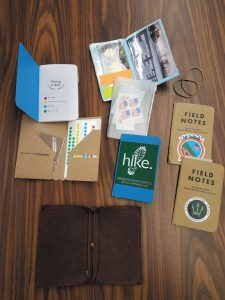
A travel journal can be personalized as much as the user desires, becoming an all-in-one source that holds various inserts and items that are easily accessible.
If you’re going to use a journal to its fullest potential, it has to be one with which you connect. A bit of Goldilocks trial and error may eventually bring you to the perfect size, thickness, and materials. If you prefer crafty and quirky, then consider a quilted fabric cover, or make it yourself out of duct tape. Some people are drawn to simple leather, but even then, decisions about the thickness, the color, and the leather type are personal.
And certainly, the story behind the journal can inspire. Did you buy yours at a leather shop in Mexico? Craft it from a pair of cowboy boots that belonged to a beloved relative? Make it while snowbound in a cabin in British Columbia?
What’s important is to make it yours. Make it something you want to carry, all the time.
I began by purchasing a standard-sized journal from Midori. Once I became acquainted with the design and organization, I had an itch to make my own — only scaled down to accommodate the 3½-inch-by-5½-inch field notebooks I used at work. With some basic instruction from the internet and zero leather-crafting experience, I had my highly functional and diverse everyday journal in hand.
The compact size of this journal means it can ride in a cargo pocket or jacket all day and is therefore always convenient.
Divisions
How you divide up your journal’s functions is what ultimately shapes it to your lifestyle. Consider a section or insert with permanent information such as phone numbers and emails, product codes for often-needed RV parts, serial numbers, mileages, or insurance policy numbers.
A maintenance log for your RV is another good use for this piece, so that you easily can look back to see when tires were replaced and filters or belts were changed.
I keep all my passwords in my journal, but only because it rides on my person. This may not be ideal if a journal remains in a purse or a backpack.
It’s true that some of this information is redundant if you have a smartphone. You have phone numbers and emails plugged into those as well, but on more than one occasion, having that data handwritten within easy reach has saved the day. My notebook never has a dead battery, nor is it likely to be rendered completely useless if dropped in a creek.
Beyond this permanent information, an insert dedicated to lists and planning is handy. It’s a good place to jot down ideas for destinations, websites to explore later, maintenance to-dos before your next adventure. This is likely to be the insert that fills up the quickest. Once full, the nature of the traveler journal makes it a simple matter to replace.
If you partake in photography when you travel, this can be an ideal spot to record shutter speeds and exposures, and thereby fine-tune your skills.
A third insert could be for creative expression, with the goal of filling these pages with poetry, prose, or sketches during your next trip. Many take a scrapbooking approach and attach tickets, photos, or brochure clippings to the pages with paste or tape.
Of course, another section could be a calendar — monthly or weekly or a combination. My journal has become my primary planner — among other roles — and I abandoned the electronic equivalent that I formerly used.
Writing It Down
A basic level of commitment is needed if you make the leap to everyday journaling. For example, it took me a while to stop jotting to-do lists and phone numbers on scrap paper and old receipts that I may or may not find later and to write in my journal instead.
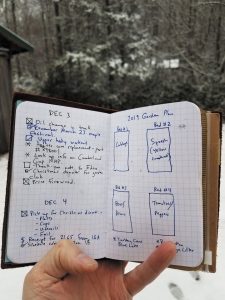
In the author’s journal, anything and everything can be recorded, including to-do lists and planning notes.
Bullet journaling is a method I adapted to in my note taking. Different types of bullets are designated for a particular kind of note. For instance, a circle could signal an upcoming event to remember, a square a to-do item, an asterisk an item to research online, and so forth.
Nature journaling is another use for one of your inserts, and one that can be equally handy at home or on the road. Setting a goal of learning 10 new trees over the summer, or cataloging which bird species you saw at your favorite park, are good ways to track your learning. If you participate in any Christmas bird counts or monarch butterfly monitoring, your journal is a perfect spot to record your data, making it easy to visualize trends over time or across regions.
The choice of writing instrument can greatly enhance the journaling experience, as well as influence your paper choice. Thanks to the internet, you can readily discover which types of notebooks or inserts are fountain-pen-friendly, for example. I’ve sometimes made my own inserts when I have standard-sized paper that I wish to fit it into my journal, and that’s a simple and satisfying project in and of itself.
Storage Options
An assortment of zippered pouches, card slips, and folders are available that can transform a traveler journal into a wallet. These easily slide behind the elastic band of your journal system and serve as a convenient place to stash cash, credit cards, business cards, and receipts. Stamps, paper clips, and notecards can be good things to have close, too.
Traveler journal enthusiasts often refer to “dashboards” — laminated photos or other graphics fitted between inserts. Dashboards typically are used to store sticky notes of various sizes. You never know when you may need to leave a message on someone’s door or computer.
A traveler-style journal isn’t the only option for RVers to keep up with the multiple facets of their lives and journeys year-round, but its flexibility makes it a good choice. Regardless of what notebook or system you use, consider writing things down this year. You’ll likely find that there’s something meditative about putting pen to paper in a world where you don’t really have to.