

Losing a travel partner need not signal the end of the road for RVers.
By Janet Smith
March 2021
You traveled the country as a couple, seeking new experiences, new friends, and endless adventures. RVing was a team sport; perhaps one of you drove the rig and did the mechanical stuff, and the other took care of the bills, the housework, and keeping in touch with family. But now there is only one of you. Is this the end of the road, or a new beginning?
Deciding whether to settle down or stay on the road is a very personal decision, one that can be made only by you. RVing alone can involve some unique emotional challenges, especially after a loss. This is very true if you made friends with couples along the way. While your friends may be supportive now that you are solo, you may not feel like you fit in anymore.
I spent more than 20 years working as a mental health counselor, so in that regard, you can say I’m a “trained observer.” More recently, I’ve spent the past six years on the road as a full-time solo RVer. I’ve had the opportunity both to observe and to converse with my fellow travelers, most of whom are married couples. I’ve observed a few challenges they may have down the road when their significant other is no longer with them.
However, many of these challenges can be overcome. If you’re considering the solo RV lifestyle, you need to know what to expect. By knowing what may lie ahead, you can prepare yourself.
What are some of the common emotional challenges?
One of the most common emotional challenges after the loss of a partner is the urge to replace that person. Don’t jump right into the RV singles scene. Resist the longing to find someone new and to make that person over to fit into the life you had before. Not only is that not fair to the one you’ve lost, but it’s definitely not fair to anyone new.
After a lifetime of being one half of a whole, now may be the time to really just be you, without the responsibilities and projected identity others can place on you. The things you thought defined you have changed. So, who are you now? This may be a good time to travel, savoring the little joys of life, without the opinions of others.
Missing friends and family probably is the most painful emotional challenge. However, you simply need to remember, you are never that far away. They usually are just an email or a phone call away. All you need is cell service or an internet connection. And you can always arrange to visit them.
You also can invite family and friends to join you for a weekend, as part of their vacation. Many full-timers say that although they don’t see family as often, their visits are now more meaningful. Furthermore, when living in an RV, it’s usually not a big deal to visit family and friends. You can park at their home, or at a nearby RV park, staying for as long as you like.
You’ve decided to take the solo journey
If you do choose to carry on alone, you probably will experience at least one moment when you cry to yourself, “What am I doing here? Why in the world did I EVER think this was a good idea?”
You may find that any character flaws you have are now magnified. Are you needy? Do you become frustrated or angry easily? Are you feeling at a loss, and don’t know what to do next? Emotional challenges happen when you realize you haven’t ever confronted life on your own. Just remember, you have a lifetime of experience, and now is simply your opportunity to use it.
Overcoming practical fears
A lot of people will ask you, “Are you afraid to RV alone?” I want you to ask yourself, are you afraid to take a car trip by yourself to the next city over? Can you fix little things, such as tightening a screw or changing a light bulb?
Ask yourself, what are my biggest fears about going solo and living full-time in an RV? Below are some common fears:
- *I’m afraid of driving something that big.
- *I don’t know how to cook.
- *I’m afraid of what will happen if I break down in the middle of nowhere.
- *I’m afraid of being alone.
I’m afraid to drive something that big
While there may be men who lose their driver, it’s been my observation that among married couples, it’s often the men who do most of the driving. Men may not like driving the rig, but they rarely seem afraid of it. On the other hand, women often are afraid to drive or tow the RV, for a variety of reasons. They may feel their petite size is an issue, or perhaps they’ve been “brainwashed” to think they can’t . . . you know, the old myth about “women drivers.” So, this section primarily is addressed to the ladies who may suddenly find themselves single and on the road.
There are many women on the road, some smaller in stature, and some older than you, driving or towing RVs. If they can do it, so can you! You don’t need to be tall or strong to drive even the biggest motorhome. You just need some practice. You can recruit an experienced driver to help you if you need to. The hardest part is backing; it’s okay to ask the staff or a neighbor at an RV park to spot you. You also can ask for a pull-through space. In any case, take it slow, and you’ll soon find it’s not as hard as it looks.
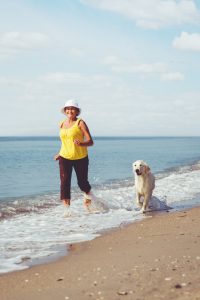
A dog can provide protection as well as companionship.
Did you know that FMCA offers RV driving classes? It does, in conjunction with The RV Driving School, and all the training is done with your RV. The RV Driving Class is held over two days. Classroom training takes place on day one and behind-the-wheel training on day two. In addition, a one-day RV Backing Class provides two hours of classroom training in the morning and three-and-a-half hours of individual back-up practice in the afternoon. Check FMCA.com for the next place and time.
You don’t need to jump into the deep end of driving the RV alone right away. Consider your first six months of traveling solo as a learning curve; there is no need to drive long distances. I’m sure you can find someplace to go within 100 miles of where you are right now. You can start with short trips, driving just 50 or 100 miles at a time. There is no need for any stressful, long-distance driving. Also, try taking the less-crowded and slower-paced state routes versus the big interstates.
I don’t know how to cook
Well, maybe it’s time to learn how to cook a few simple, healthful meals. Breakfast is a good place to start. Frying up eggs and potatoes is pretty easy. Throw in some veggies to make a healthful omelet. Lunch can be a nice sandwich with lettuce or sprouts. You also can find healthful frozen meals at the grocery store. Learning to cook, rather than eating out, not only benefits your health, but it also saves you money.
What happens if I break down?
As long as you stay on the major roads, you probably will have cell phone coverage. Then all you need to do is call roadside assistance. In fact, you may already have FMCA’s Roadside Rescue® emergency road service, so you don’t need to worry. If you don’t have it, you should sign up for it.
If you’re really afraid of being stranded, or out of touch with friends and family, consider investing in a 4G cell booster for your phone and mobile internet. This helps to boost a weak signal, going from one to two bars possibly up to three or four bars in remote areas. You also can purchase a personal emergency locator beacon, which operates via satellite.
I’m afraid of being alone
You miss your partner, family, and old friends, and may be drawn to connect with people on the road. However, you may be unsure about who, and how much to connect. Also, you may wonder whether the new people you meet are safe.
One option for better connections is to join an RV group, such as one of the hundreds of FMCA chapters. There are many RV travel groups out there, based on different activities, including solo RVers and women traveling alone.
If you don’t already have a pet, consider adopting a dog rather than a cat. While RVing generally is safer than living in a city, a dog can provide protection as well as companionship. And while small dogs are cute and seem ideal for RV travel, consider adopting a bigger pooch. A dog between 30 and 50 pounds is still a good size for RV life. Unlike a dog with some muscle and teeth, little yappers don’t scare bad guys. However, you might think twice about getting a pit bull, Rottweiler, German shepherd, or Doberman. Some RV parks ban certain breeds, such as pit bulls, or big dogs. Likewise, some towns also have bans against pit bulls. A medium-sized dog could be a good choice.
Off into the sunset
Many who have experienced loss have said, “I just can’t go on in the RV lifestyle alone.” If you really can’t, that’s okay. But if deep down you love the nomadic life, there is no reason to hang it up for sticks and bricks. You might find living solo on the road is surprisingly easy and satisfying. If you are well prepared, not only physically and financially but also mentally and emotionally, you may never go back. You may discover being cut loose on your own is the ultimate liberation.