
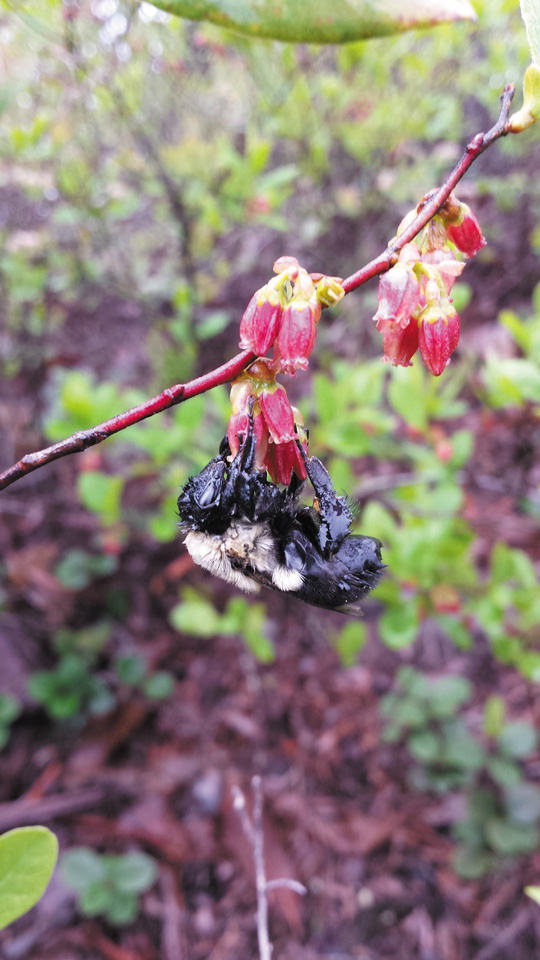
Close encounters with bees, wasps, or (yikes!) scorpions can be a pain — literally. But a little caution and self-care can take the sting out of getting stung.
By Phillip Meeks
August 2021
Few things can turn a good vacation bad like a painful sting. A decade from now, that idyllic view from a favorite campsite might not be as vivid as the yellow jacket nest you encountered at the same spot. Whether it’s paper wasps that nest beneath your RV’s awning, a caterpillar you brush against on a hike, or a scorpion hiding in your shoe, a sting is a fast way to create unpleasant memories among all your good ones.
As with anything else, stinging creatures can be as fascinating as they are intimidating, and worthy of respect — from a distance, of course.
Bees And Wasps
While in the process of being stung, one will care little of the distinctions between wasps and bees, but there are differences. Generally, bees tend to be stockier, rounder, and hairier than wasps. Those hairs are important for the transfer of pollen. Wasps are more apt to be thin, with the telltale pinched connection between the thorax and abdomen (the “wasp waist”). However, this isn’t obvious with hornets, which are, in fact, a type of wasp.
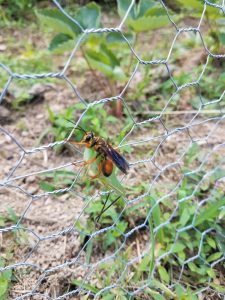
Typically, wasps and other stinging creatures only sting as a defensive measure, protecting their home or themselves.
With any of these, a sting can occur when you come into direct contact with the insect, such as stepping on a foraging honeybee, but another high risk occurs when a colony is being defended. In other words, if you accidentally wander too close to a nest, the bee or wasp defers to its instincts.
Yellow jackets (Vespula spp. or Dolichovespula spp.), paper wasps (Polistes spp.), honeybees (Apis mellifera), and other so-called social bees and wasps, therefore, are a greater threat than solitary ones such as cicada killer wasps (Sphecius speciosus), great golden digger wasps (Sphex ichneumoneus), and orchard mason bees (Osmia lignaria). Roughly 8,000 species of bees and wasps are found in the United States, and the good news is that most of those are solitary rather than social.
From time to time, sensationalized accounts of stinging insects make their way into mainstream news (think “killer bees” or “murder hornets”). If you’re concerned about a particular species during your travels, land-grant universities in the regions you visit are the most reliable source of factual information — not only in regard to bees and wasps but also for the other creatures discussed. An easy way to pinpoint accurate information is by typing “giant Asian hornet cooperative extension” or “Texas Africanized bees.edu,” for example, into a search engine.
Ants
Hymenoptera is the insect order in which bees and wasps are classified. It’s also where ants fall. Some, but not all, species of ants are capable of inflicting a painful sting, and one of the most notorious examples in the continental United States is the red imported fire ant (Solenopsis invicta). This species is native to central South America but is now widely naturalized through much of the southern half of the continental United States. A disturbed fire ant releases an alarm pheromone, which causes other ants to sting, so it’s quite possible that one misstep into a nest results in dozens or even hundreds of stings.
Velvet ants (Mutillidae family) look like large, hairy, and colorful ants but are actually wingless wasps. Although docile, they can deliver a painful sting — so painful, in fact, that they garnered the nickname “cow killer ants,” although they don’t actually kill cattle.
Caterpillars
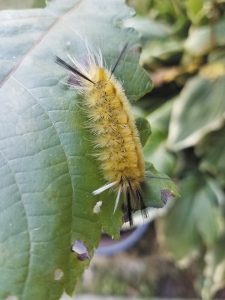
Some innocent-looking caterpillars have furry spines that sting and deliver venom into the skin, which can cause an allergic or even toxic reaction.
Stinging caterpillars (Arctiidae family) are the larval stage of certain species of moths. While some fuzzy caterpillars — such as the winter-predicting-according-to-folklore banded woolly bears (Pyrrharctia isabella) — are harmless and normally can be handled with no discomfort, others have hollow, venomous spines that can cause a sensation similar to a bee sting.
What can cause even greater discomfort with caterpillar stings is the basic instinct to brush away the creature delivering the pain. Doing so with a stinging caterpillar can result in even more spines delivering venom into the skin.
Some examples of stinging caterpillars include saddlebacks (Acharia stimulea), io moths (Automeris io), and buck moths (Hemileuca maia).
The puss moth or southern flannel moth (Megalopyge opercularis) is another stinging caterpillar that has made an appearance in popular press in recent years, because of its resemblance to a toupee and a hairstyle that some find familiar.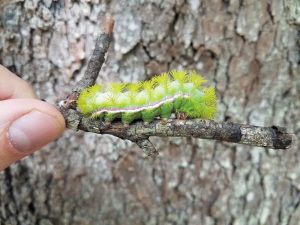
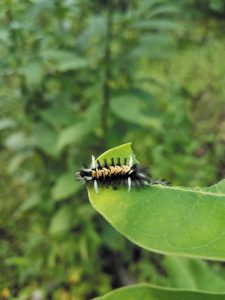
Some species of tussock moth (Erebidae family) can also cause discomfort. Tussock moths lack venom but can have urticating hairs — hairs with tiny barbs that can lodge in the skin of anyone who brushes against them, causing an itchy rash.
Scorpions
More than 70 species of scorpions are found in the United States. Most of these are in desert regions, but the southern devil scorpion’s (Vaejovis carolinianus) range is the Southeast, and the Hentz striped scorpion (Centruroides hentzi) calls the Gulf Coast region home. Scorpions are arachnids like spiders and ticks and may be drawn to moisture, so be mindful of leaving crumpled towels or damp shoes outside the RV in scorpion country.
Scorpions may also enter structures during periods of heavy rain, drought, or cold in a quest for moisture, shelter, or prey.
According to the University of Arizona, the Arizona bark scorpion (Centruroides sculpturatus) is the only species of medical significance in the United States, although a sting from any species should be monitored closely.
Reactions
It’s normal for a sting to cause localized itching, redness, and slight swelling, sometimes lasting for days. Venom transmitted via a sting may also result in either a toxic reaction or an allergic reaction. With a toxic reaction, the body responds to the venom, and depending on the amount delivered and its strength, this may lead to nausea, headache, fever, and convulsions. But toxic reactions usually don’t impact breathing.
A severe allergic reaction (anaphylaxis) to a sting will be characterized by swelling of the throat and tongue, a weak and rapid pulse, and breathing difficulty. A sting allergy can prove life threatening, so if you or a family member has such an allergy, speak with your doctor about a prescription for an epinephrine auto-injector, and keep it handy during your travels. Or, consider a round of immunotherapy prior to going out on the road.
 Short of an allergic response, pain is likely to be the most significant takeaway from a sting encounter. An Arizona entomologist named Justin Schmidt allowed dozens of bees, wasps, and ants to sting him over two decades, and then he ranked the pain on a scale of 1 to 4, with 4 being the worst. The Schmidt Sting Pain Index ranks bullet ant (Paraponera clavata), warrior wasp (Synoeca sp.), and tarantula hawk wasp (Pepsis sp.) stings among the most painful. In comparison, paper wasps, bald-faced hornets, and honeybees earned a 2 on the same index. Velvet ants or cow killers were ranked 3.
Of those scoring a 4, only the tarantula hawk wasps are found in the United States, specifically in the American Southwest.
If a severe allergy isn’t suspected, first aid for a sting would involve steps to prevent swelling, itching, and inflammation. In the case of a honeybee, the stinger may still be attached, so scrape it out with a fingernail or credit card. Wash the stung area with soap and water, if possible, and apply a cold compress (which could be a shirt dipped in cold water or ice wrapped in a towel) for 20 minutes. This reduces swelling. Then apply calamine lotion or a paste made with baking soda and water. If the sting continues to hurt, oral antihistamines can help as well, as can over-the-counter pain relievers.
Something else to remember is that unless it’s an invasive species, such as the red imported fire ant, these creatures play important roles in the ecosystem. Whenever it’s possible and safe to do so, try to give stinging insects and arachnids a wide berth rather than killing them out of fear. As with any other wild creature, everybody is happier when respectful distances are maintained.
What Is It?
Many online resources can help you to identify a flying or crawling insect. They include the Insect Identification website (www.insectidentification.org), as well as the Picture Insect – Bug Identifier app, available for iOS and Android.