
All RVed up but nowhere to go because of a breakdown? Being knowledgeable and prepared can help to make the best of a bad situation.
By John L. Hawkins, F395477
October 2021
It has been more than a decade since I wrote my first article about roadside assistance for Family RVing (“Beating the Breakdown Blues,” June 2011), and a lot has changed since then. The production of motorhomes and travel trailers has gone through the roof. From first-timers and families enjoying getaways to those lucky enough to reach retirement and travel for extended periods, there are more of us on the road than ever before.
We all share one thing in common: None of us wants to suffer a breakdown and become stranded on the side of the road. Still, it happens. As vice president of the large wrecker division of Miller Industries, a world leader in towing and recovery, and an RV owner myself, I have fielded calls to rescue movie stars, musicians, NASCAR drivers, and NCAA college coaches, as well as ordinary people in the middle of their vacation. Breaking down is not fun. The goal of this article is to help you make the best of a bad situation — and keep you safe in the process.
Take Control
Let me begin with a very direct and frightening fact: More tow truck drivers per capita in the towing and recovery industry die in the line of duty each year than law enforcement and fire departments combined. That is how dangerous it is to be sitting on the side of the road, especially on an interstate. So, if or when the need for towing or breakdown assistance happens, the quicker you’re back on the road and rolling again, the better.
How, exactly, do you get back on the road fast? It usually will begin with a phone call for assistance from a tow truck. Just how do you go about finding one? Well, many of you may have warranty coverage. Some of you may have bought that package with your insurance, while others may have joined a motor club. But here is what you must understand when you dial that 800 number: You’re calling a large call center, and the person on the other end only follows an outline process sheet and has little, if any, knowledge about your RV. In no way am I saying you did the wrong thing, nor am I making any negative reference to these services. I am just stating a fact. You must professionally and politely take control of the conversation. Here’s how:
*First, give them your cell number, so if the call gets dropped they can call you back.
*Ask to talk directly with a representative from the company that is being dispatched. Why? That company makes a living providing the service you want, and the more information you can give them, the better they can help you. If they are not capable of servicing you, they would know the closest towing company that could.
*If you do not have a roadside assistance plan, look at a map and find the closest city. Do a Google search for “heavy-duty towing” in that city and start calling providers on your own. In some cases, communication is easier this way, because there is no middle person.
*Also, if a city, county, or state law enforcement officer stops to offer assistance, he or she should have a list of towing companies that rotate service for them. You have the right to what is called “owner’s request.” If you supply the information listed in the next section, he or she will understand you’re aware of your needs and then may be better prepared to recommend a company that has the proper equipment.
Be Proactive
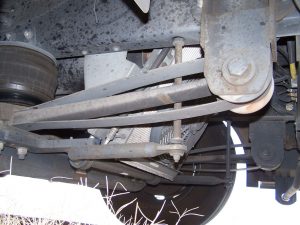
This Freightliner chassis motorhome has a composite/fiberglass spring with shields; nothing should be attached, which could damage the springs.
The key is being prepared. You should have the following information written down and stored next to your vehicle registration and insurance records. Note that some of this information applies only to motorhomes, while some applies to travel trailers and fifth-wheels as well. (Read on for a few tips specifically related to travel trailers.)
- *Make, model, and year of your RV.
- *The weight of your RV — by axle: front, rear, and tag (if applicable).
- *The length of your RV.
- *The height of your RV.
- *For motorhomes: The distance from the front bumper to the centerline of the steer axle in inches.
- *For motorhomes: Type of front suspension. This is critical for the towing company to know, because it determines what type of truck is sent. Production motorhomes often use truck chassis such as Freightliner and Spartan. They probably have a standard “I” beam suspension with either a steel spring package or possibly a composite/fiberglass spring package (will have protective shields). Higher-end motorhomes will have an “A” arm suspension with air bags. Knowing which type you have is critical.
Be prepared to communicate how many people are in your vehicle. If you do not have another vehicle with you and you have more than two people, that needs to be addressed. You cannot ride in any kind of vehicle while it is being transported.
Also, contact your coach manufacturer or dealer ahead of time (do it today) to determine where the chassis air fitting is that allows an external air source to provide air to the system for the brakes and/or air bags. A tow truck driver may spend an hour trying to locate this. Be proactive.
And, always have a complete set of fan belts for all the engine needs, as well as for the auxiliary generator. Being able to replace a broken belt may save you a lot of money, time, and a tow.
For Travel Trailers
First, be prepared to outline whether the trailer is a bumper-pull or a fifth-wheel. Why? A car carrier and/or small wrecker can tow a bumper-pull but not a fifth-wheel. The wheel lifts do not elevate enough for high fifth-wheels. A fifth-wheel will require an integrated model tow unit and the proper attachment. And some fifth-wheels have a ball at the base of the neck, requiring a coupler attachment, or an actual mini fifth-wheel. Make sure you note which one is on yours.
Also, I highly suggest carrying extra bearings for the axle hubs — and not just one set. I just had this happen over Memorial Day: A family waited from Saturday night until Tuesday morning for a store to open. And always have a bottle jack to jack up the trailer axle so you can remove the tire with the seized bearings.
Get Comfortable
On motorhomes, the auxiliary generator often is located in the nose of the coach. If you break down and have to wait for the service provider, you may not want to start the generator so you can be comfortable waiting inside the coach. Why? The tow operator almost always needs to remove part of the exhaust system to get the proper clearance for the underlift while towing. If it’s hot, he or she will have to wait for it to cool, and that costs you time and money.
For RVs wherein the generator is not in the front, this is not an issue. But you’re still in jeopardy being on the side of the road in your vehicle. I always recommend getting comfortable outside of the coach in a safe place — lawn chairs, umbrella, cooler with water — when and if possible.
Since my last article, some of the heavy-haul towing manufacturers have built a “motorhome trailer.” These have adjustable wheel wells in the floor in an attempt to lower the overall height of the vehicle being transported. But, at best, the deck height is still 30 inches. This means with a coach loaded on the deck, heights could be anywhere from 13 to 16 feet, and many older bridges and overpasses will be a challenge. This should be a discussion point with the service provider for both motorhomes and fifth-wheels.
Know Your Location
Knowing your location and being able to explain it is critical. Mile markers on interstates and turnpikes are huge assets, but if you’re traveling on the back roads, pay attention to landmarks — rivers, churches, schools, ballfields, etc. — that can pinpoint your location.
If you must pull over, do your best to find a place where you can get off the road, one that is as level as possible. Parking lots are an asset. On the interstate or turnpike, pulling over onto the shoulder is dangerous, but it may be your only choice. If you have to pull over on the shoulder, here are some key tips:
*Pull over as far as you can. If the passenger-side tires go onto the grass, make sure the grass is relatively level and hard enough to handle the weight.
*Please do what the truckers do (by law) and put out a set of triangle reflectors or traffic cones. Set the first marker 150 to 200 feet back from the rear of the RV, and then add one every 50 feet in between. If a vehicle starts drifting over onto the shoulder, you want them to see or hit these warning signals, alerting them and giving them time to get back into the lane of traffic. And always keep an eye on the traffic; do not turn your back on it.
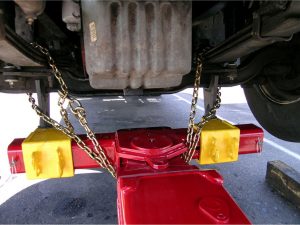
A motorhome built on a truck chassis with standard axles can be towed safely by lifting the I-beam axle, as shown here, and adding chains to secure the lift to the axle.
Towing Prep
When you see the tow vehicle approaching, you likely will breathe a huge sigh of relief. I know; I’ve been there and done that. The driver will have multiple skills and knowledge of your needs, from fuel pumps to brakes to starter motors to tires to drivelines to batteries to radiators to DEF and DPF needs, and on and on. They have seen pretty much everything. Still, informing the driver about what you have been challenged with — that is, the rea-son your RV is parked on the side of the road — is appreciated.
Unless your motorhome has no rear suspension, it will be towed from the front. I prefer lifting coaches by the tires, but a truck chassis with standard axles can easily and safely be towed by lifting the I-beam axle. Either way, your vehicle will be riding on the suspension, just like it would be if you were driving.
Many motorhomes have an Allison automatic transmission, and unless the engine is running and moving oil through the transmission, it cannot be towed for more than 6 to 8 miles at no more than 30 mph. So, either the driveline or the two half-shafts must be disconnected. By doing this, the transmission is now dormant and, thus, safe to be towed. (NOTE: In areas with heavy traffic, a tow driver may pull only the passenger-side half-shaft for safety reasons. This is okay until he or she can pull the other side safely, usually within 20 or so miles.)
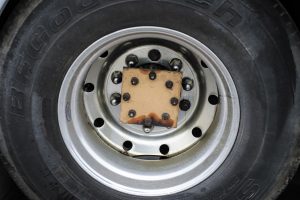
When towing automatic-transmission coaches, tow operators add particleboard or plastic to the pulled half-shafts to keep the lube in place.
The driver must also supply air from the tow truck to motorhomes so equipped. It is here — with the knowledge you have from calling the OEM or dealer, as mentioned earlier — where knowing the air supply location comes in handy, for both of you!
The driver also has to attach a tow light bar to the rear of the coach. Today, most tow light bars are wireless, but if lines are required to go from the rear of the tow truck to the rear of the motorhome, they cannot rest against the paint. You will see drivers attach them to the mirrors to get them away and then use tennis balls or shop rags tied in knots to protect the sides of the coach. If not, it’s a good time to lend your own bath towels to the cause.
Sacrifice For Service
Today’s heavy-duty tow trucks capable of handling a disabled RV start at $300,000 and can easily cost $500,000 depending on model and capacity (industry specialized recovery units are close to $1 million). These companies are family owned, and they operate 24 hours a day, 7 days a week, 365 days a year. The operator misses ballgames and birthdays and climbs out of bed at 3:00 a.m. in the rain, snow, or heat to supply us our servicing needs. They have the knowledge and experience to conquer the task.
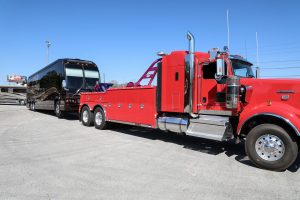
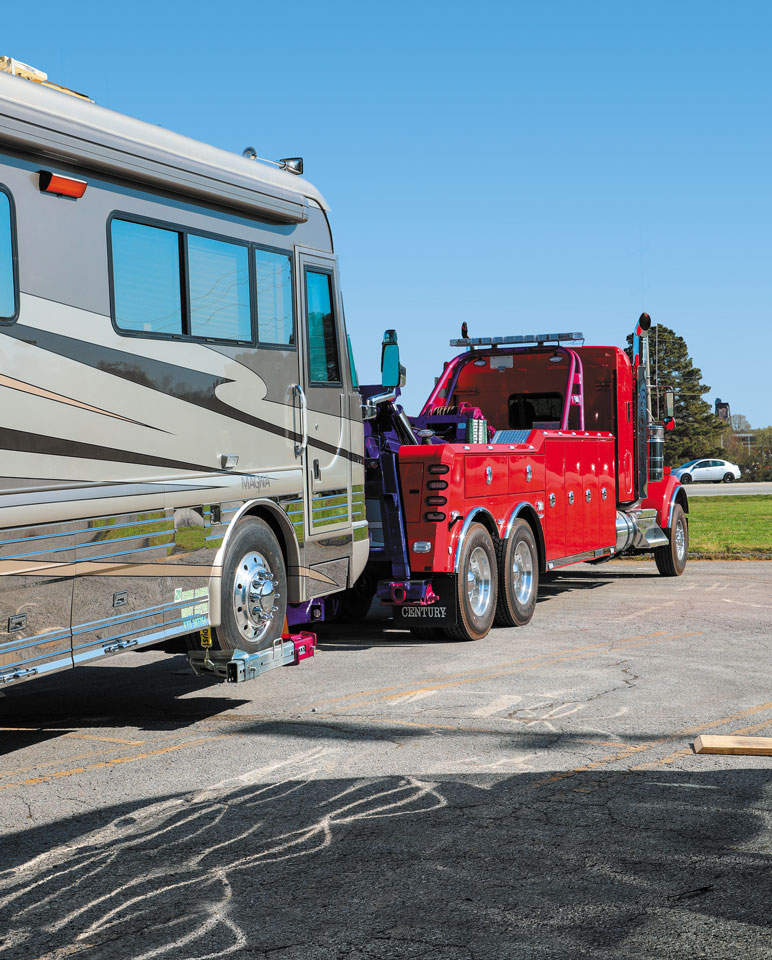
Trucks capable of towing a larger motorhome such as this one represent a substantial investment for the tow company.
As with all businesses, however, you have the right to have the job done responsibly and professionally. The information you provide assists both you and the service provider to be successful with the task at hand. And it is hoped that the end result is that you are left with a feeling of being cared for and on the way to addressing the root cause of the breakdown. Remember, these tow companies service all the major repair locations within their towing area, and they can be a guiding light to getting you back on the road.
It is my sincere wish that you never have to experience the need to be towed, but, if you do, you are now better informed. Safe travels, and enjoy the roads of this great continent.
When You Call For Roadside Assistance
*First, give them your cell number in case you get disconnected.
*Ask to talk directly to a representative from the company that is being dispatched.
*If you do not have a roadside assistance plan, look at a map and find the closest city. Do a Google search for “heavy-duty towing” in that city and start calling companies on your own.
*If a city, county, or state law enforcement officer stops to offer assistance, supply them with the necessary information. This will help them find the correct company to give you a tow.
*Provide detailed information about your location. Mile markers and landmarks are huge assets that can pinpoint your location.
Provide The Proper Information To The Dispatcher
Motorhomes:
- *Make, model, and year of your RV.
- *The length of your RV.
- *The height of your RV.
- *The weight of your RV by axle: front, rear, and tag (if applicable).
- *The distance from the front bumper to the centerline of the steer axle in inches.
- *Type of front suspension: standard I-beam with steel spring; composite/fiberglass spring with shields; A-arm suspension with air bags.
- *If traveling with more than two people, let the driver know how many people are in your vehicle.
- *Provide the location for supplying air to the chassis.
Travel Trailers & Fifth-Wheels:
- *Make, model, and year of your RV.
- *The length of your RV.
- *The height of your RV.
- *The weight of your RV.
- *Let them know if the trailer is a bumper-pull or a fifth-wheel.