
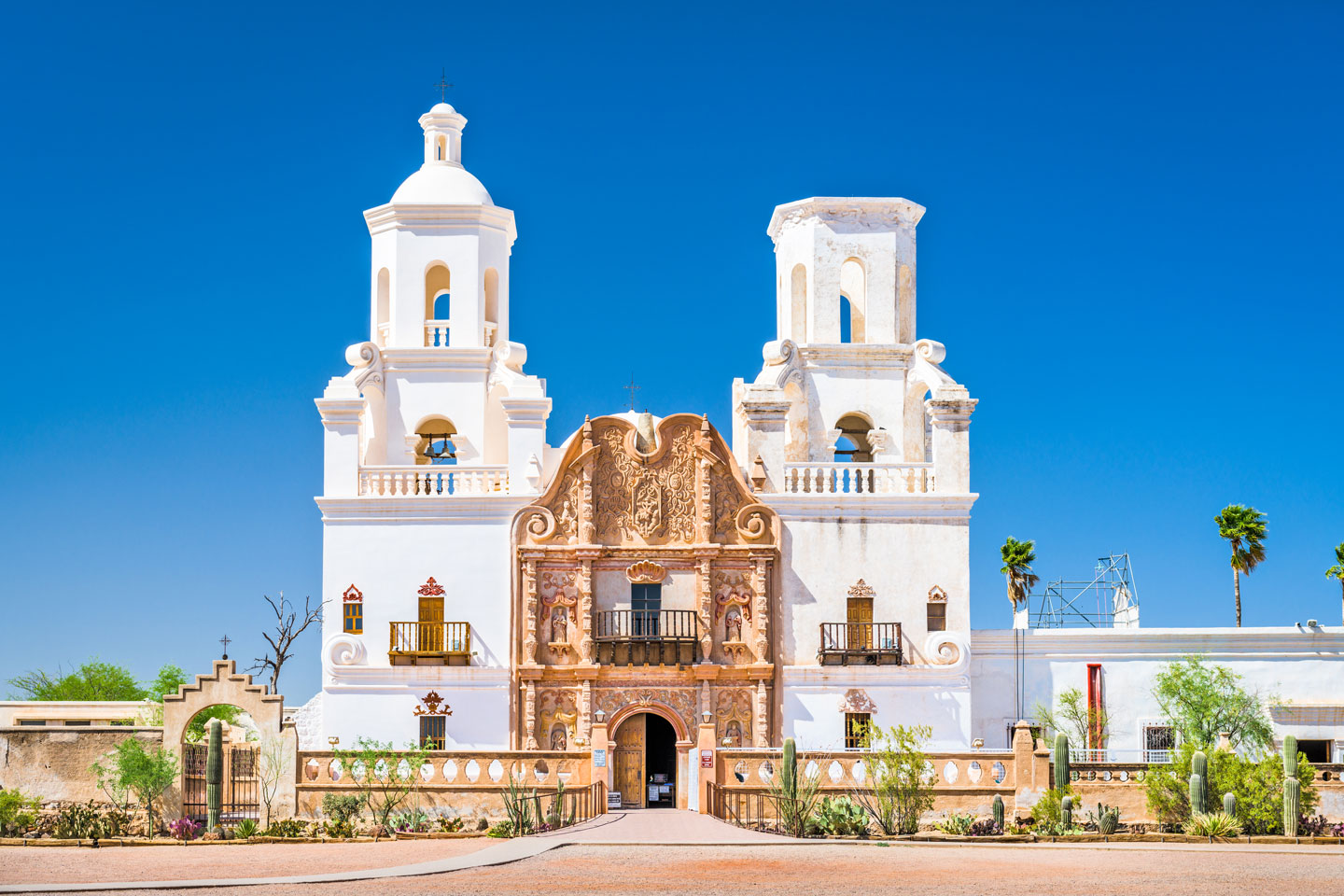
Just south of Tucson, Arizona, San Xavier del Bac Mission stands as an active church, an architectural wonder, and a testament to the Jesuit priest who founded it 300 years ago.
By Ann Bush
October 2021
Barely 10 miles south of Tucson, Arizona, off Interstate 19, is one of the oldest and best-preserved Spanish Colonial missions in the United States. Its stark white walls and ornate baroque façade dazzle above the flat desert for many miles. Often called the White Dove of the Desert, San Xavier del Bac Mission is one of eight missions established in Arizona when the Spanish ruled the area for almost 600 years before Europeans arrived.
On my way to Phoenix many road trips ago, I couldn’t resist the temptation stimulated by my curiosity gene, so I detoured off the freeway when I spotted this massive white structure in the distance. Rising out of a sage-filled prairie that seemed to go to the end of the Earth — or at least to Mexico — I didn’t need road signs to guide my SUV toward the church.
This was long before pandemic rules were in place, and a sizable crowd formed a haphazard line for the guided tours that started every 30 minutes. My wait was almost too short, as I used the time to explore the beautiful courtyard. Seven graceful arches surround a patio and a fountain once fed by natural springs that probably refreshed horses carrying church-goers.
The Catholic mission was founded in 1692 by Jesuit priest Eusebio Kino, and its remarkable building — now a National Historic Landmark — was added roughly 100 years later by Franciscan monks following the Jesuits’ expulsion from the territory. Original plans for San Xavier were for the mission to be the center of a larger system, with a dual purpose of providing religious services and educational programs to the native people. This explains the comfortable historic meeting rooms neighboring the church that were built for larger groups to gather.
Construction of the mission began in 1783 and came to an end in 1797, a remarkable endeavor considering the lack of resources in the area. Enduring wars, an earthquake, and harsh elements from the environment, the mission is in remarkable condition as a result of the loving care of the local Tohono O’odham American Indian tribe and is considered the most significant relic north of Mexico.
Native plants fill the mission’s courtyard.
The Spanish Colonial architectural style is clear, with white stucco walls and stunning three-story bell towers shouldering a baroque entryway enhanced with Franciscan reliefs. There is clearly a difference between the twin towers, as one appears to be under renovation, with parts on the top missing. The visitor quickly assumes the tower is being repaired, but that is not the case. The tower has always looked as it does today, and the reason remains a mystery. Old bookkeeping records suggest that taxation laws exempted buildings under construction, and, therefore, the church remained unfinished. Another legend is that the tower has been left in this state until the “Excellent Builder” comes to complete the mission.
On this hot, sunny day, the coolness of the interior was a surprise. In my previous life I worked with the preservation of historic structures, and I know that the air conditioning available is supplied by nature through intelligent design and expert choice of building materials.
The next surprise comes when your eyes adjust to the darkness and your breath is taken away. I have traveled throughout Europe and South America, visiting many ancient churches, and can verify that this simple church in Arizona can match the beauty and quality of any of them.
The entire structure is roofed with masonry vaults, making it unique among Spanish Colonial buildings within U.S. borders. Little is known about the people who created the artwork that covers almost every inch inside, including the ceiling. Some believe that artists from Queretero in New Spain (now Mexico) were probably commissioned by the Spanish royal family.
The main gold and red altar is decorated in Mexican baroque style. Its elaborate columns were built in guild workshops and carried by donkey through the Pimeria Alta valley to the mission. Research has proven that more than 50 statues were carved in Mexico, then transported hundreds of miles to be gilded by local American Indian artists before installation. Once the sculptures were in place, area craftsmen — some of them ancestors of the mission’s current restoration workers and caretakers — added clothing created from gesso.
After Mexico gained its independence in 1821, San Xavier del Bac became the property of Mexico. The last resident Franciscan friar departed shortly thereafter, and the mission lost all funds with which to maintain the facilities. The Tohono O’odham did what they could, operating a school for many years and protecting the mission from Apaches.
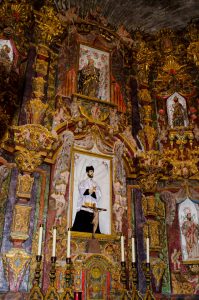
The main altar’s elaborate gilded columns were transported by donkeys to the mission.
In 1854, the United States purchased the area with the Gadsden Purchase, and San Xavier once again became a Catholic-held entity under the Diocese of Santa Fe.
Many more transitions of ownership followed, including a time when the Sisters of St. Joseph of Carondelet opened a school for Tohono O’odham children. Within my generation, the mission became a nonprofit entity, supported partially by the Catholic Church. Mass is still held every weekend and is open to the public.
Restoration Efforts
Throughout these years, only basic care was performed to prevent the daily decay of the massive ornate interior and its thousands of artifacts and art pieces. Wood was used in most of the carvings, which swells and shrinks from variations of climate and humidity. In order to clean the artwork and walls, a special mixed cleaner must be used sparingly and carefully to remove grime without removing paint. Paints were made of natural materials, which are almost impossible to replicate today, and fade with time.
Most of the hand-painted artwork cannot be removed and taken to a climate-controlled building with equipment available to comfortably work on the objects. Instead, most of the restoration and maintenance work must be done inside the church, sometimes on bended knees or lying on the floor. It is excruciating and exhausting work.
During my trip, restoration of the interior was in full mode thanks to a flurry of donations from the public. With awe, our tour group silently watched art students and restoration experts, some from the Tohono O’odham tribe, painstakingly clean, repair, repaint, or polish the intricate art objects, furniture, and murals.
Exterior renovation began in 1989 to remove a botched 1980 renovation coat of cement plaster. The historic brick beneath was refinished with traditional lime plaster. Today, there is much more to be done with little funds, and work continues as donations arrive.
Yet, one tower remains unfinished.
The Missionary
Born Eusebio Chini (the Spanish version of his last name is Kino) to a noble family in Italy, Father Kino became a legendary figure during his era in the New World. After surviving a serious illness young in life, he thanked God by adopting Francisco as a second name in honor and devotion to St. Francis Xavier. He vowed to become a priest and dreamed of missionary work in China. He became a well-educated mathematician and cartographer, often teaching math and science during his training to receive Holy Orders and be ordained as a priest.
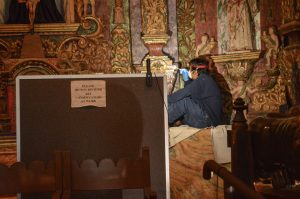
Today, the chapel’s hand-painted creations are being painstakingly restored.
However, his first mission was to lead an expedition to Baja, California, which was then controlled by New Spain, to create maps. Kino is attributed with proving that the area was a peninsula, not an island. Later, he was commissioned to convert the native people living along the Rio Grande to Catholicism.
Today, almost 90 percent of the population in Mexico and Central and South America is Catholic.
Soon Padre Kino had a strong following among the tribes, but he didn’t just focus on conversion. Nicknamed the “Padre on Horseback,” he traversed the unfriendly territory to help the lives of the American Indians. Father Kino worked hard to oppose forced labor on the native people by the Spanish in the silver mines. Contrary to his fellow priests, who followed Spanish law, Father Kino was considered a rebel whom the indigenous people trusted. He gained fame as a peacekeeper among the people, homesteaders, and governments.
Father Kino possessed many other interests as well, such as astronomy, and became a prolific writer, authoring books on many subjects — including religion. As he traversed the territory, he drew numerous maps, including the sky. Father Kino was instrumental in the Vatican establishing one of the largest telescopes in North America near Tucson, the Vatican Advanced Technology Telescope (VATT) at Mount Graham International Observatory.
Father Kino spent the last 24 years of his life in the Pimeria Alta — modern-day Sonora, Mexico, and southern Arizona. He established more than 20 missions and country chapels, many at the request of the local tribes as they slowly felt safe enough to build villages and farms close to the missions. With a stable food source, the tribes began to recover from the brutality and discrimination they endured from the influx of foreigners to their land. Thus, Father Kino is still honored and loved today.
Dying of a fever at the age of 65, Kino was buried in a shrine designated a National Monument of Mexico, located in the present-day town of Magdalena de Kino in Sonora. His funeral was attended by dignitaries from Mexico City and the local area.
The unveiling of a Padre Kino postage stamp and presentation of his original travel diary was held in March of 2011. The United States Capitol displays a life-size statue from every state of a person who was chosen to portray the state’s heritage and beliefs. Arizona chose Father Kino.
If You Go
Still an active church, San Xavier del Bac Mission retains its original purpose of ministering to the religious and educational needs of parishioners. The church and gift shop are open daily. At this writing, tours were suspended, and visits just inside the front doors of the church were limited to five minutes. For up-to-date information, review the website at www.sanxaviermission.org or call (520) 294-2624.
A festival in Mexico City celebrates the anniversary of Father Kino’s Ride for Justice and Peace — a 1,500-mile journey completed in 53 days on horseback. Numerous books and biographies have been written about the famous priest and can be purchased from the Kino Heritage Society at www.padrekino.com, along with field guides to most missions. The Father Kino Story, a movie released in 2009, can be found online at www.catholicfamilycatalog.com. Viva Kino!, a documentary funded by the Kino Heritage Society and produced by Aurora Vision, can be found at www.auroravision.it.
Nearby Campgrounds
Crazy Horse RV Campgrounds
(800) 279-6279
www.crazyhorservcampgrounds.com
Rincon Country West RV Resort, C2739 *
(800) 782-7275
www.rinconcountry.com
South Forty RV Ranch
(520) 297-2503
www.southfortyrvranch.com
* FMCA Commercial Member
More Information
San Xavier del Bac Mission
1950 W. San Xavier Road
Tucson, AZ 85746-7409
(520) 294-2624
www.sanxaviermission.org