
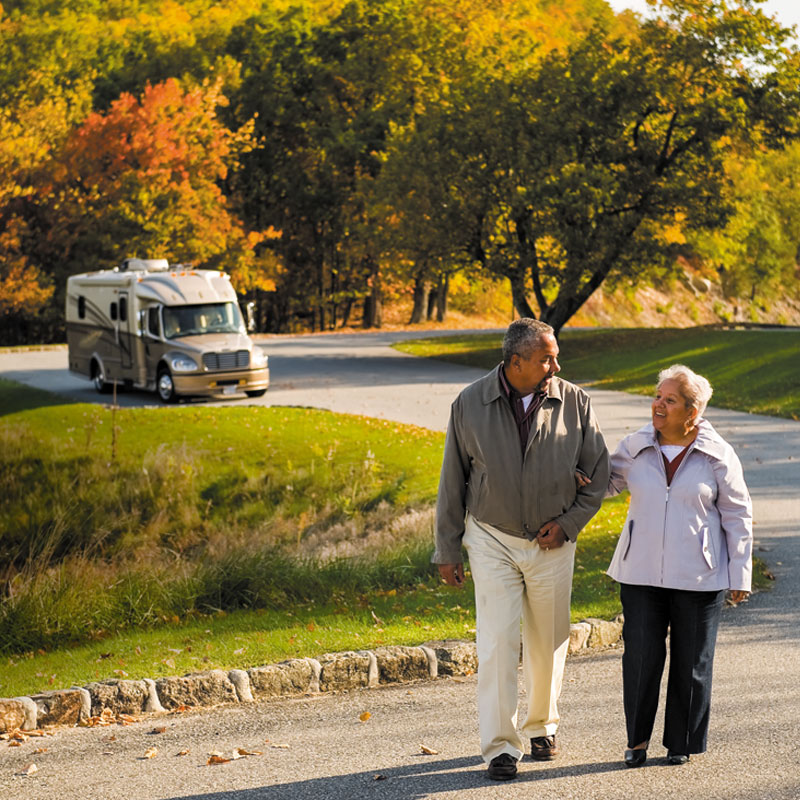
By meandering along Interstate 81, the Skyline Drive, and the Blue Ridge Parkway, travelers can fill their senses with fall foliage, bluegrass music, and some down-home cooking.
By Josephine Matyas, F468364
October 2021
The docent slips on white curator’s gloves and looks very earnest: “Patsy Cline was a firecracker, a real pistol.” An hour later, the guide with the Patsy Cline Historic House in Winchester, Virginia, has recounted more fascinating stories of the singer’s life than I ever thought possible. In truth, before visiting this part of Virginia, the sum total of my Patsy Cline knowledge was that she had a hit with “Crazy,” the ballad penned by newcomer Willie Nelson.
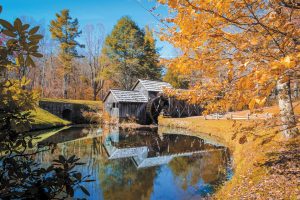
Mabry Mill, situated along the Blue Ridge Parkway.
This part of the Old Dominion, as the state is known, is full of hidden gems and surprises — an authentic destination for history buffs, music fans, and RV road trippers. By following Interstate 81 (with jogs along smaller roadways), we mapped a route from the city of Winchester in the north, near the West Virginia border, down to Bristol in the southwest tip along the Tennessee line. The direct route between these towns via the interstate covers 314 miles. Admittedly, this only scratches the surface of what’s available, but it’s RV-friendly and includes more than enough to fill a week: through Shenandoah National Park; a world-class autumn drive along the Blue Ridge Parkway; and breaks for museums, cultural centers, and lots of music.
Stop 1: Patsy Cline Historic House, Winchester
Even for those not drawn to country music, a visit to Patsy Cline’s childhood home “on the wrong side of the tracks” is a worthwhile stop.
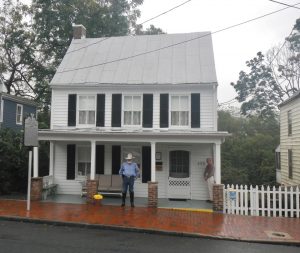
The childhood home of singer Patsy Cline in Winchester.
The small white home is filled with donated furnishings and mementos from the country singer’s life and reflects the strong work ethic of the family. As a teenager, Cline worked two or three jobs — anything to bring in money to help the family — and after work she would audition and sing, anytime and anywhere.
Items on display include her cherished collection of salt and pepper shakers, her favorite pink chenille bedspread, a pillowcase made from an old feed sack, and the box containing her fancy stage gloves.
“She was all-natural talent,” explained the docent, “no formal voice training at all.” When recording “Crazy,” Cline did the song in one take, cementing it as one of the top jukebox hits of all time. Hers was a talent lost all too early — in 1963, Patsy Cline died in a plane crash at age 30.
Travel note: To get from Winchester to the next stop, Monticello, take the spectacular Skyline Drive through Shenandoah National Park, an outdoors mecca with trails and 69 peaks with elevations of more than 3,000 feet. RVs can navigate the drive, but be prepared to slow down and be aware of some restrictions (such as low tunnels). In the fall months, the colors are spectacular — but be careful of wet, leaf-slick roads. The park’s website has detailed information.
Stop 2: Monticello, Charlottesville
A man with a mania for measurement and a self-described “bibliomaniac,” President Thomas Jefferson started clearing the land for Monticello when he was 25 years old, launching an ongoing construction project that spanned decades. He once explained, “Architecture is my delight, and putting up and pulling down one of my favorite amusements.”
Monticello provides a window into the life and thoughts of Jefferson, the third president of the new United States, who served America for almost five decades in many capacities. His initial goal was to build a simple two-story, eight-room house, but Monticello grew to 33 rooms spread over 11,000 square feet of living space. The hilltop property has 360-degree views over the surrounding mountains and is especially beautiful in autumn, when there are dramatic splashes of reds, oranges, and yellows.
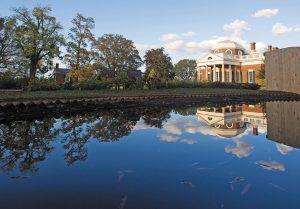
Monticello, Thomas Jefferson’s home in Charlottesville.
Jefferson grew up in the Age of Enlightenment and was fascinated by paleontology, archaeology, botany, astronomy, and meteorology. His approach was one of rational thought and science. This passion for the natural sciences is displayed on the walls of the two-story front foyer: framed portraits, models, engraved maps, fossils, bones, animal hides, tools, and American Indian artifacts.
Two hundred years ago, timepieces of any kind were rare, but Jefferson was fascinated by the tracking of time and had a clock in every room of the house. Above the front door, a large clock is recessed in the brickwork, marking the time of day and the day of the week.
In addition to clocks, the study, bedroom, and parlor are filled with telescopes, scales, weather instruments, compasses, and barometers. Jefferson was a meticulous record keeper, believing it was important to preserve information to gain a scientific understanding of the world through observation and study.
In addition to his terms as president, Jefferson is known for several other milestones: He drafted the 1776 Declaration of Independence, regarded as the charter of American liberties, and completed the Louisiana Purchase, which doubled the size of the nation.
Almost a century and a half after Jefferson’s death, President John F. Kennedy addressed the audience at a dinner to honor Nobel Prize winners with these words: “I think this is the most extraordinary collection of talent, of human knowledge, that has ever been gathered together at the White House, with the possible exception of when Thomas Jefferson dined alone.”
Travel note: The Skyline Drive through Shenandoah National Park connects to the northern reach of the Blue Ridge Parkway.
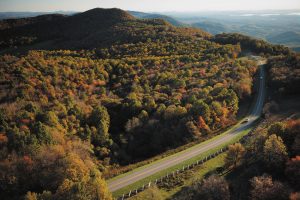
The Blue Ridge Parkway offers drivers a scenic alternative through Virginia’s rolling hills.
Stop 3: Blue Ridge Parkway
The misty blue hills beckon; the road twists and turns along the spine of a billion-year-old mountain range; and in the fall months, the beauty of the drive is magnified tenfold by the blaze of autumn leaves. They call the Blue Ridge Parkway “America’s Favorite Drive,” a roadway of mountain vistas, history, and recreation.
Tracing the Blue Ridge and Great Smoky Mountains chains, the 469-mile ridgetop route is known for its unspoiled setting and its easy access to wildlife and nature. There are countless scenic overlooks, campgrounds, and not a single stop sign. Busy in the fall, the parkway is famous for its splash of autumn colors. Stop for homemade blackberry cobbler at the historic Mabry Mill (milepost 176).
Eight National Park Service campgrounds are located along the parkway. None have hookups, although most can accommodate larger-size RVs. Many neighboring communities have private campgrounds with full RV hookups and amenities. Especially in the fall, it’s a good idea to make campsite reservations. In addition, check driving routes before heading out to ensure a safe match for driving conditions and RV size. The website www.blueridgeparkway.org lists all 26 tunnels and their maximum height.
Stop 4: The Crooked Road
The Crooked Road offers a deep dive into the heartland of America’s traditional music. The 330-mile driving trail follows two-lane highways, showcasing music evolved from the cultures of the people who settled there: the Scots-Irish, Anabaptist Germans, and African-Americans.
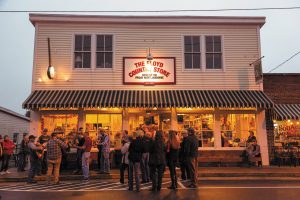
In Floyd, music spills out onto the streets each Friday.
Music provides the accent of history and culture along this heritage music route. Old-time music and bluegrass are so baked into the customs that they say you can tell which town a player comes from by the style of play. There is no shortage of highlights, and the biggest challenge could be picking from the lot. Here are a few suggestions:
Friday is the day of the week to stop at the century-old Floyd Country Store, in the small artisan town of Floyd just off the Blue Ridge Parkway, along U.S. Highway 221. Back after a pandemic closure, the owners push aside the shop displays to clear space for the historic Friday Night Jamboree, a community dance floor filler and one of the best places in the U.S. to hear authentic bluegrass music. The overflow crowd spills onto the sidewalk, and local musicians set up in alcoves along the main street. And the music doesn’t stop with Friday evenings: Other days feature concerts, dances, and old-time and bluegrass jams, as well as The Floyd Radio Show, an old-timey variety show.
Floyd is an audio education — a grassroots, immersive experience. The small town of 724 residents is also home to County Sales, where floor-to-ceiling wooden shelves are packed with what the owners claim is “the world’s largest selection of old-time and bluegrass music.” Just around the corner is the Blue Ridge Diner, a local favorite where the breakfast menu leans toward authentic Southern comfort food such as buttermilk biscuits and made-from-scratch sausage gravy.
Near Abingdon, the Southwest Virginia Cultural Center & Marketplace houses a visitors center and a collection of art created by the many talented artisans of the region. A handcrafted piece may be the perfect memento to tuck away in your RV. It’s also home base to The Crooked Road: Virginia’s Heritage Music Trail, where visitors can meet and listen to authentic roots musicians, and browse the sale racks of local old-time, bluegrass, and gospel music.
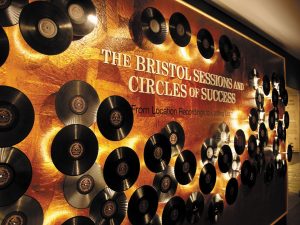
The Birthplace of Country Music Museum in Bristol.
Stop 5: Bristol
Bristol is a small city that seems to have it all, including an iconic electrified sign atop a main street that is divided by the state lines of Virginia and Tennessee.
In the heart of downtown, The Birthplace of Country Music Museum is a Smithsonian-affiliate facility that tells the story of the influential 1927 Bristol Sessions by the Victor Talking Machine Company, which brought country music into the living rooms of the nation. The Bristol Sessions were the first recordings of the music of the mountains, creating an archive of Americana nicknamed the “Big Bang of Country Music”: the moment when technology, talent, luck, and circumstance captured what would become the quintessentially American blend of gospel, folk, and country music. The immersive, fascinating displays are a mix of video, touchscreen, audio clips, and history that manage to blend state-of-the-art displays with a down-home feel.
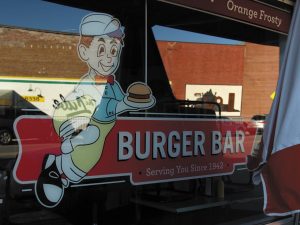
Bristol’s Burger Bar is a trip back to life in the 1950s.
To stay fueled, we always stop at the Burger Bar, the classic diner that is reputed to be the last place country legend Hank Williams was seen alive before suffering a heart attack on his way to a 1952 New Year’s Eve gig. Dishes are named after the singer’s best-known songs (try “Hey Good Lookin’” or “Your Cheatin’ Heart”) and the décor is frozen circa 1950s. And we never, ever leave town without stocking up on scratch-made cinnamon buns and doughnuts, the house specialty, from Blackbird Bakery.
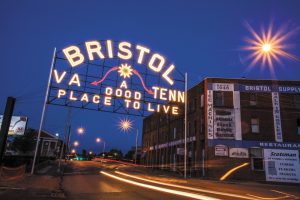
Bristol’s main street doubles as the state line with Tennessee.
Just outside town, the city-operated Sugar Hollow Campground has 75 beautifully wooded sites that can accommodate RVs. Most sites have electric hookups with easy access to water. Other amenities include comfort stations, Wi-Fi and cable hookups, and a dump station.
Stop 6: The Carter Family Fold
In the hills above Bristol, about 21 miles northwest near the village of Hiltons, is The Carter Family Fold, the spiritual and physical home of the Carter Family — the “First Family of Country Music.” The “Poor Valley” spread is also the location of A.P. Carter’s dry goods store, which has been transformed into a small museum of family musical history.
No stop here is complete without watching a performance at the Carter Family Memorial Museum Center, a modern 842-seat performance auditorium cut into the side of the hill, where they’ve hosted country music troubadours since opening in 1976.
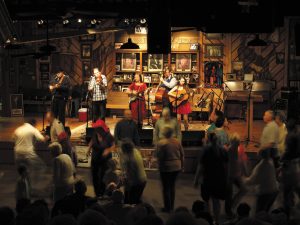
In nearby Hiltons, the Carter Family Fold honors its “First Family.”
The music of the Carter Family was “like water rippling in a sweet, clear spring off Clinch Mountain,” enthused Johnny Cash, who married Maybelle Carter’s daughter June and performed for the last time on this stage in July 2003, a few months before his death.
On a Saturday night, the cars and pickups arrive, park in a nearby field, and pack the seats. It’s old-time music and bluegrass only, played on authentic instruments — fiddle, guitars, mandolins, banjo, and bass — and flatfooting on the hardwood down front.
Like the rest of this Virginia drive . . . it’s authentic.
More Info
Visit Virginia
www.virginia.org
This website offers information about places to go, things to do, campgrounds, and more. A downloadable visitors guide also is available.