
If you’re easily affected by poison ivy, poison oak, and poison sumac, you know the allergic reaction may not be just a “little rash.” Know what to look for, how to avoid it, and how to treat it if it gets you.
By Ann Bush
November 2021
During my road trips, I can always count on collecting several things: A few extra pounds from sampling ice cream at every town’s special sweet shop. A nice suntan. A new folder bursting with brochures. A colorful baseball cap. And a poison ivy rash.
No matter how hard I try, I end up with a swelling, itching, red rash, usually on my legs or hands. Hiking is my favorite outdoor activity, looking for birds usually chirping in the highest tree. With binoculars in hand, I venture off the trail, looking up to get a better view without looking down to see what is in my path.
Much to my chagrin, poison ivy grows in every U.S. state except for Hawaii and Alaska. Touching or merely brushing against the ivy that sometimes looks like a bush can result in a painful or uncomfortable few days or, in my case, weeks. In addition to poison ivy, several other poisonous plants sit silently in the forest, just waiting for me to stroll by.
Poisonous plants fall into the plant genus Toxicodendron; the medical reaction they cause is known as Toxicodendron dermatitis. Five plants fall into this group: eastern poison ivy, western poison ivy, eastern poison oak, western poison oak, and poison sumac. All contain the same rash-inducing oil called urushiol (yoo-ROO-shee-all), which is on the leaves as well as in the plant’s roots and stems. Other plants that contain this oil include Japanese lacquer trees, mango rinds, and cashew shells.
People break out in a rash when urushiol touches the skin, even if the oil is transferred indirectly from clothing, a tool, or a pet. Urushiol quickly penetrates the skin at the mere touch of the oil, often leaving a red mark at the place of contact.
Symptoms usually appear within 24 to 72 hours after exposure. Scratching the itchy area doesn’t cause it to spread but can prolong healing and cause a secondary infection. The rash itself is not contagious; however, if the oil is still on your clothing, a second person could develop a rash if they touch that part of the garment.
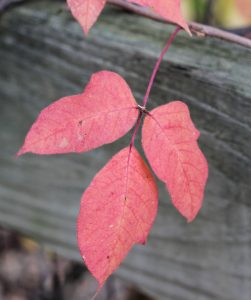
Poison ivy leaves can turn red in spring and in fall.
Sensitivity to poison ivy, poison oak, and poison sumac varies from person to person, and from plant to plant. Some people may develop only a mild reaction, while others are seriously allergic to these plants. Most symptoms include red streaks or patches, itching, swelling, and a rash that turns into blisters and inflammation.
Of the 15 species of poison ivy, oak, and sumac recognized in the Western Hemisphere and eastern Asia, five occur naturally in North America. Most animals are not affected by them, and birds eat the berries produced in the fall. American Indians and early pioneers used poison ivy for dyes and medicines.
To avoid contact with these plants, become more knowledgeable about them.
Poison Ivy
When I was young and on my first camping trip, my Campfire Girls leader taught us this rhyme: “Leaves of three, let them be.” But look around while in a thick forest, and you’ll see a lot of plants with only three leaves. Also confusing is that poison ivy is not always a vine, which I learned the hard way.
Poison ivy has two varieties in the United States. Western poison ivy is a low-growing shrub found widely across the western states, Great Plains, and Northeast. Eastern poison ivy is the real monster of the two; it grows on the ground, climbs as a vine, and sometimes appears as a shrub. Found on nearly every roadside, path, pond, stream, and beach from the Midwest to the East Coast, it is hard to avoid.
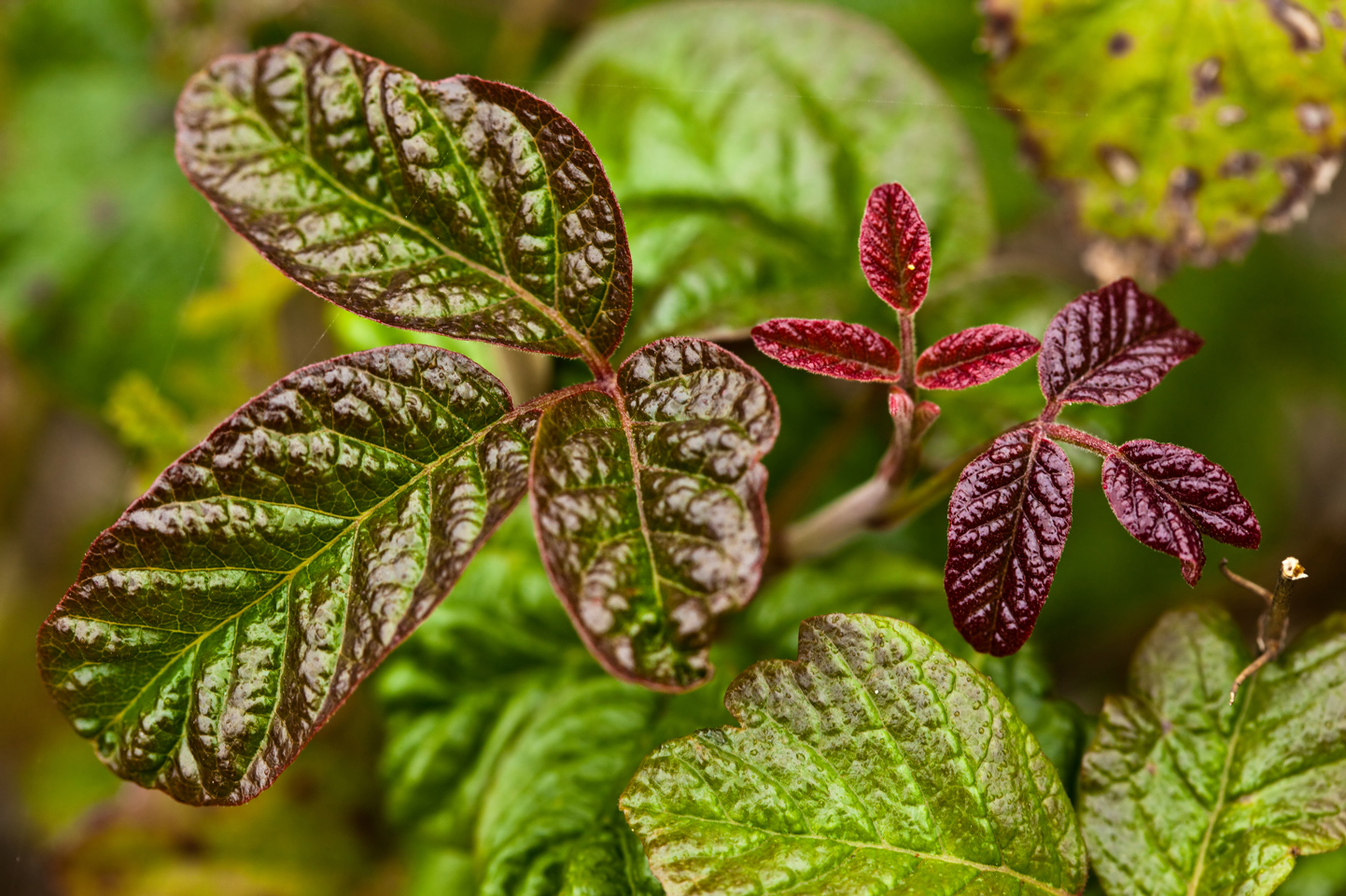
Regardless of the variety, poison ivy has leaves that grow in groups of three, and the color is solid — no streaks or spotting. The middle leaf has a longer stem than the two side leaves, and there may be small white or yellow flowers attached. The stem looks like it has tiny hairs growing out of it. Some people think the leaf resembles a child’s mitten. In the winter, there may be just a vine, or a vine with white berries. In the spring, young leaves may be yellow-green, then turn red and darken to stay green all summer. They change back to red or orange in autumn.
Poison Oak
Most commonly found in the southern and western United States, this vine has leaves of three, five, or seven, and sometimes nine, but the leaves are larger and more rounded, similar to an oak tree leaf. The leaves have a textured, hairy surface. Sometimes the vines do not crawl up trees but reach out from a sturdy main stem or follow another plant. Leaf color varies from hints of red when the plants are young to green in the summer, and to shiny red in the fall. Pacific poison oak leaves are shiny, which proves that these plants vary according to their environment. A quick study of the poisonous plants in your destination should be done for proper identification.
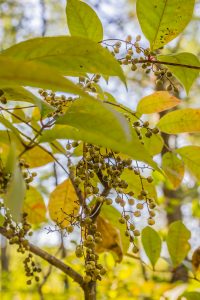
Unlike other species of sumacs, poison sumac is highly toxic; it can be identified by hanging clusters of berries.
Poison Sumac
Considered one of the most toxic plants for humans, poison sumac is also much rarer than the others mentioned above. It grows only in super wet areas, such as bogs or swamps. The plant starts out as a bush but can grow into a tree. It has red or brown stems that produce clusters of about seven to 10 leaves each. The leaves grow in pairs opposite one another, with one solo leaf at the tip of the stem. Leaves are green in the spring and summer, then change color in the autumn. The leaves could have black or brown spots. Clusters of white berries may hang from the branches during the winter, which birds eat unharmed.
Prevention Is Best
To prevent your morning nature hike from ending up with a trip to the doctor, the best advice is to first talk with the local park ranger or campground RV hosts to learn of the plants’ presence around your campsite. If signs are posted asking visitors to stay on the trails, it is usually for this very good reason.
My favorite time to travel is in the fall, when colorful leaves are falling all around me. However, this makes locating and properly identifying poisonous plants even harder. Even if the plant has no leaves, the vine or stems are full of urushiol oil, which can rub off on a shoe or piece of clothing and later transfer to your hands, which might contact just about any place on your body.
Cover your skin as much as possible when hiking, camping, or working in the woods and around shrubs. Wear long sleeves, long pants, gloves, socks, and good shoes. But remember, you can get a rash from the oil that is on clothing or a pet, so remove all clothing as soon as you enter your RV, or place it in a plastic bag until the garments can be washed. Using mild soap and lukewarm water, wash all clothes, shoes, socks, tools, pets, and outdoor equipment that may have become contaminated as soon as possible after contact so as not to spread the oil to other parts of your body.
If you plan to work or play outside, within or near a forest, ask your pharmacist about over-the-counter skin products that contain a barrier such as bentoquatam, which can help protect skin from urushiol.
Removing Poisonous Plants
Poisonous plants should never be mowed, pulled, or chopped, because their irritating oils can spread on clothes or pets and linger for a while. Never cut plants around your RV and throw them into the campfire. Burning these plants is not recommended, as the oil can become airborne, penetrating the eyes, skin, nose, throat, or lungs. If the rash begins to form in the lungs, it could be fatal.
If you spot a poisonous plant growing near your RV, you have two options. One, wear thick or rubber gloves, long sleeves, and pants and carefully cut the plant. Place plant pieces into a plastic bag for disposal. Wash cutting tools carefully and thoroughly, including gloves. Two, cover the area with a plastic bag. Just before you leave the site, carefully gather the bag, keeping all areas that touched the plant on the inside, and dispose.
Killing the noxious plants with a spray might work, but the plant won’t die overnight. To make a nontoxic poisonous-plant-killer spray, combine 1 cup of salt with 1 gallon of vinegar in a pot and heat to dissolve the salt. Allow the liquid to cool; then add 8 drops of liquid dish soap and pour into a spray bottle. This mixture will kill all plants, so be careful where you spray.
If you have a goat or cow handy, they love to eat the plants without side effects. (Seriously; landowners have used goats to munch large portions of the plants on their property.)
Climate Change Effects
To my dismay, it may get worse. Dr. Jacqueline Mohan of the University of Georgia and researchers from Duke University have studied the impacts of enhanced carbon dioxide levels on poisonous plants. They found that these plants thrive on carbon dioxide. After exposure to this greenhouse gas, poison ivy produced increased levels of the urushiol oil at higher concentrations. As trees are lost, plants will remain to carry the burden of removing excess carbon dioxide from the air. These scientists conclude that poisonous plants will become more widespread, aggressive, and toxic in the future.
But don’t let this news prevent you from enjoying the great outdoors. Keep an eye out for these pesky plants, and know what to do if you accidentally encounter them.
Treatment
According to the Stanford University Children’s Health Center, 85 percent ofthe U.S. population is allergic to poison ivy, oak, and sumac. Since all three plants contain urushiol, the treatment is essentially the same. Self-care for a mild rash includes the following:
- A topical corticosteroid cream can be rubbed gently on the rash; stronger creams may be prescribed by a doctor.
- Calamine lotion eases the itching; however, avoid skin products that contain anesthetics or antihistamines, which can cause their own allergic reaction.
- A cold shower or mixture of baking soda and water applied to the area might help relieve the itch.
- When blisters appear, a cool compress may provide temporary relief.
See a doctor, dermatologist, or other medical professional immediately in any of these scenarios:
- The rash is near the eyes, lips, throat, or genitals.
- A fever develops, and the rash worsens.
- The rash is over large areas of the body.
- The rash lasts longer than a week to 10 days.
- The blisters become infected with pus.
- Breathing becomes difficult, or severe coughing occurs soon after exposure.