
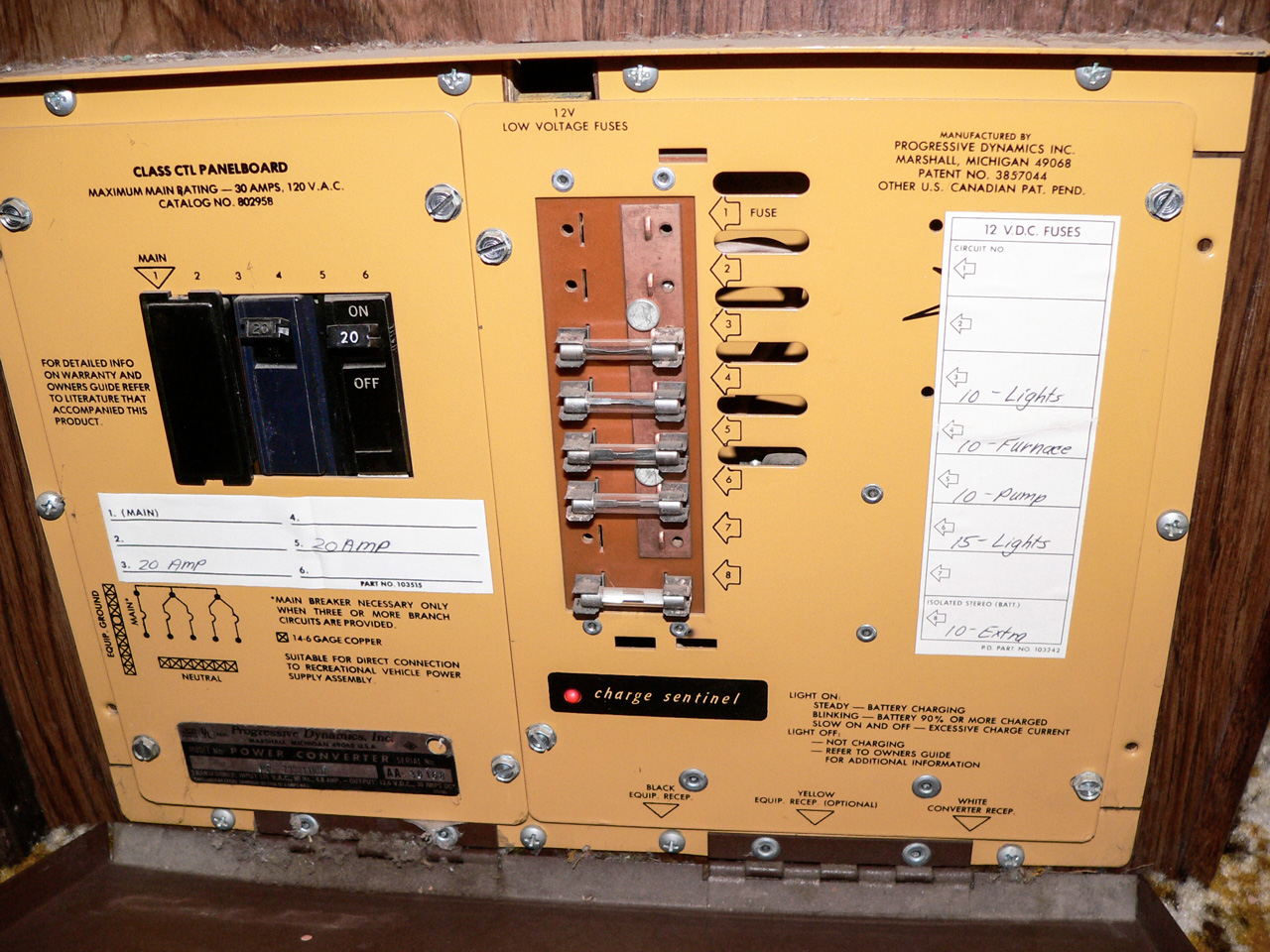
Exploring the differences between these components, which are integral to RV electrical systems.
By Steve Froese, F276276
February 2022
By incorporating propane and 12-volt-DC and 120-volt-AC electrical systems, RVs can provide all the comforts of home. In most RVs, the onboard propane system is used as an energy source for the refrigerator, furnace, and water heater. Some modern RVs eliminate the propane system partially, or even entirely, instead relying on regular residential appliances. This creates even more of an in-home environment in your RV. In terms of the electrical system, the combination of shore and battery power allows RVers to operate standard electrical appliances. In this month’s column, I will walk through the basics of how RV electricity works and specifically delve into the differences between converters and inverters.
Let’s first examine the low-voltage system. The battery system in an RV allows occupants to use amenities such as lights and also powers the control logic in appliances, among other things. In its simplest form, low-voltage direct current (DC) power is provided by the onboard batteries.
When it comes to the 120-volt alternating current (AC) requirements in an RV, such as the air conditioner, AC receptacles, microwave, washer/dryer, refrigerator, water heater elements, and so forth, I’m sure all RV owners are familiar with the concept of shore power. Simply put, the shore power cord draws electricity from the park or other outside receptacle and carries it into the RV for use by the appliances. An onboard generator also can supply 120-volt-AC power.
Both the AC and the DC voltage requirements in an RV need to be properly distributed. The power needs to be split into discrete circuits (for instance, each roof air conditioner requires its own 20-amp circuit), and each circuit needs to be protected by a fuse or a circuit breaker. This applies to both 12-volt and 120-volt circuits. Circuit distribution is one of the three main functions of the RV converter.
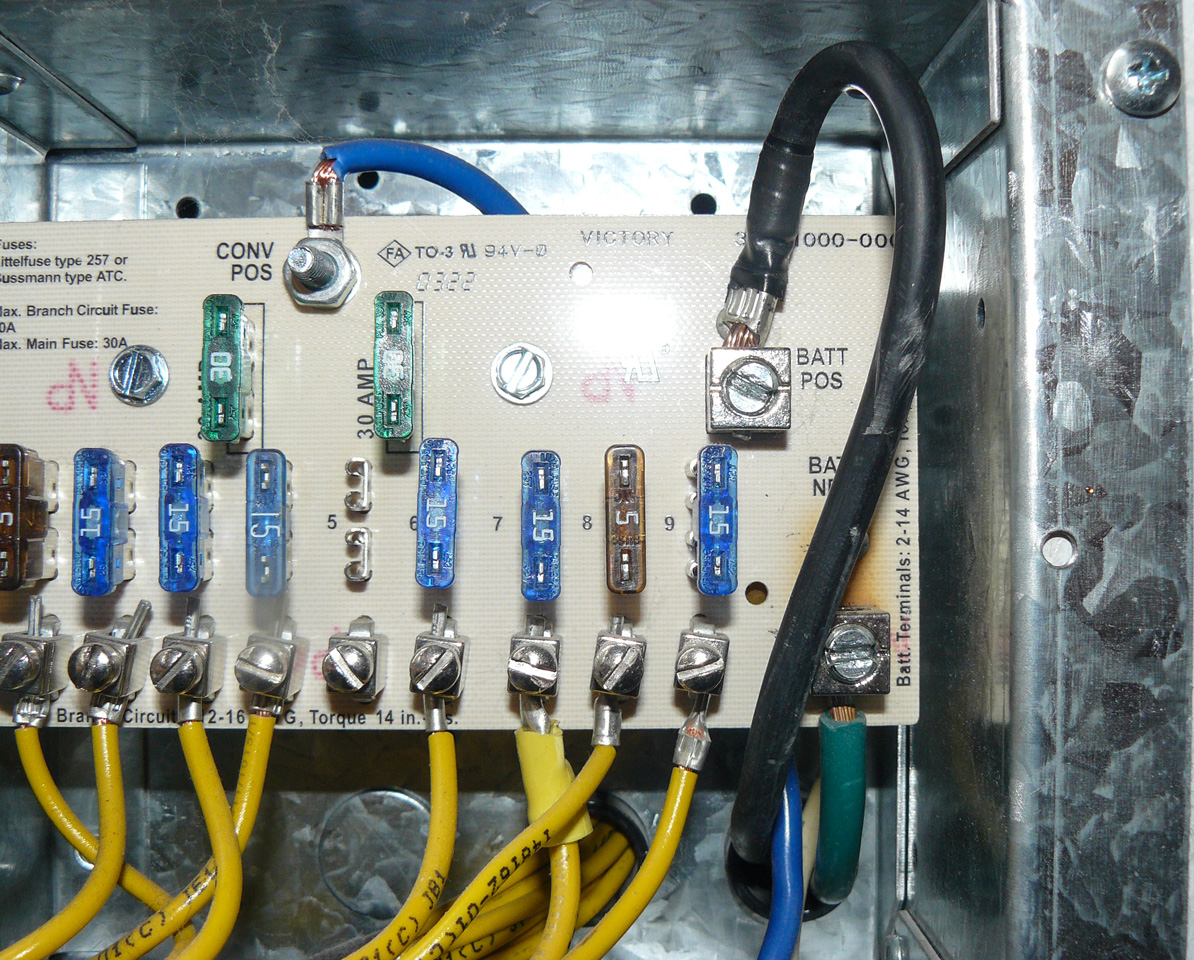
The converter usually is where you find AC circuit breakers and 12-volt fuses.
The converter takes the incoming battery and 120-volt-AC power and distributes it into several different AC and DC branch circuits. The converter is where you normally find both your AC circuit breakers and 12-volt fuses.
The second function of the converter is to provide a method for charging the RV house batteries. Using shore or generator power, the converter “converts” (hence the name) the AC voltage into low-voltage DC to charge the batteries. The converter uses this same functionality to provide low-voltage DC power throughout the RV whenever shore or generator power is available. That means the batteries are not being discharged if there is 120-volt-AC power available to the RV.
So, the converter serves three important functions in an RV: to distribute power to individual branch circuits (as well as circuit over-current protection); to provide battery charging; and to create 12 volts DC throughout the vehicle whenever 120 volts AC is available.
However, a significant limitation exists with RVs that utilize converters: No 120 volts AC is available without shore power or a generator. So, without an outside source of AC electricity, the AC loads can’t function. That is when inverters come in handy.
While a converter gets its name from the fact that it converts 120 volts AC into 12 volts DC, the inverter is so named for its ability to invert 12 volts DC to 120 volts AC. Therefore, it works the opposite way a converter does; it changes the low-voltage direct current into 120-volt alternating current. Inverters originally were found mainly in larger, high-end motorhomes and fifth-wheels, but they increasingly are being incorporated in less-expensive units.
Having an inverter installed in an RV eliminates the need for an external source of AC power. Drawing from the RV house batteries, the inverter creates 120-volts-AC electricity that can be used to power receptacles, microwaves, and other small to medium loads. Inverters do have a limitation in that they can’t be used to power large loads such as air conditioners, since the current requirement would burn out the inverter and also drain the battery bank in a few minutes.
Recall that I mentioned how some RVs now are available with residential appliances instead of conventional propane-powered RV units? This is made possible by providing dedicated inverters for the residential refrigerators. So, many RVs that utilize large residential fridges have more than one inverter: one to power only the fridge and another one (or more) for the rest of the RV.
Several types of inverters are available. There are “regular” inverters that still require some form of separate battery-charging module. The disadvantage of inverters is that they can consume battery power at a high rate. Watt’s law states that power in watts (W) is equal to volts (V) times amps (A).
Let’s take an example of a 1,200-watt microwave oven. Since the microwave plugs into a standard receptacle, we know it requires 120 volts AC. Using Watt’s rearranged to solve for A, we get A=W/V = 1,200/120 = 10A. So, the microwave oven nominally consumes 10 amps of power at 120 volts AC.
With an inverter, we need to generate the same 1,200 watts using 12 volts DC when thinking about the battery side of the inverter. Therefore, the current draw on the batteries is 100 amps. Even though microwave ovens are considered “transient” loads, meaning they are not in constant use, this example still demonstrates the high potential battery load caused by inverter use. Successful off-grid camping using inverter-only power requires as many batteries as possible, which mainly is limited by cost and physical space in the RV.
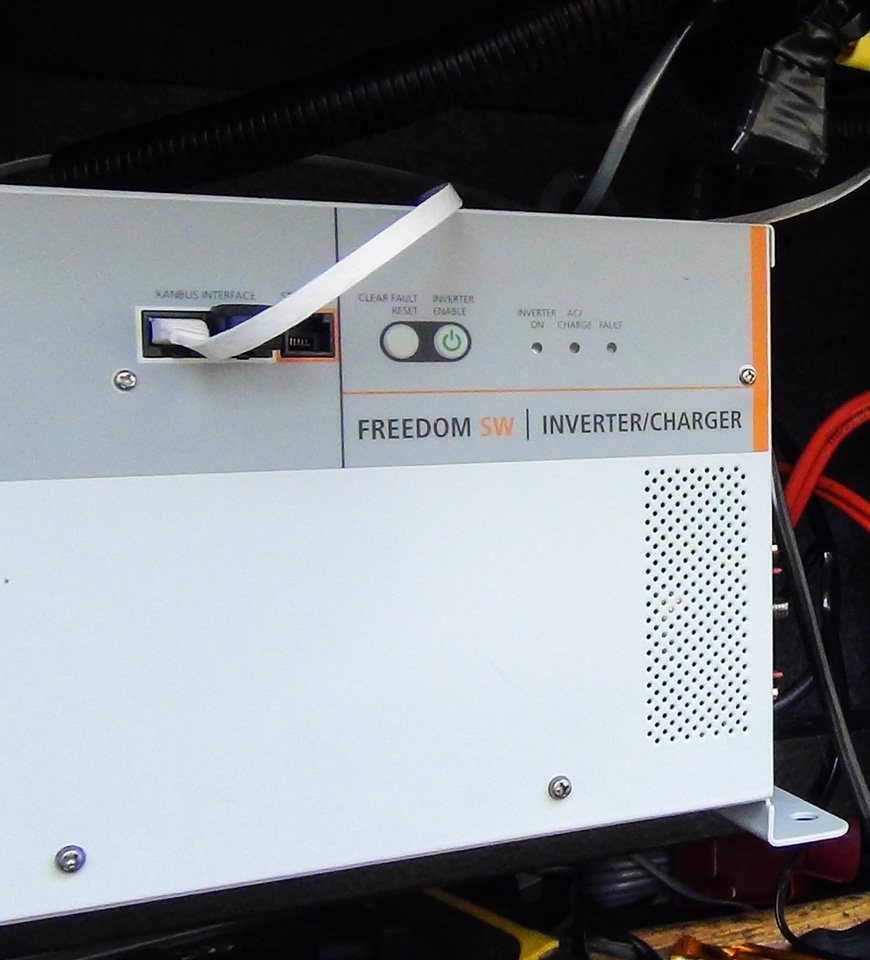
An inverter-charger inverts 12 volts DC to 120 volts AC and also charges batteries.
The most common type of inverter used in RVs is the inverter-charger. These inverters also provide battery charging by reversing the current flow when the RV is plugged into shore power or has a generator running. Without an external power source, the inverter current flow is from the batteries to the AC appliances. Whenever an external 120-volt source is applied, the current flow changes to move from the AC side through to the batteries, providing a charge current. Inverter-chargers can provide a very high charging current, often upward of 100 amps, whereas most converters supply a fraction of this, making inverter-chargers a very good option for RV power requirements.
Finally, inverters are available in square wave, modified sine wave, and pure sine wave models, with the pure sine wave models being the most expensive. While “naturally” generated AC voltage is always pure sine wave, given the nature of how inverters work, the basic waveform output is a square wave. Most modern inverters create at least a modified sine wave as a result of improved electronic filtering. Modern digital electronics such as laptop computers, tablets, smartphone chargers, and other devices can be sensitive to square wave, and they can overheat or be damaged unless a pure sine wave inverter is used. The good news is that pure sine wave inverters are becoming less expensive.
So, while many RV manufacturers continue to sell units with converters as stock, more makes and models are being made available with inverters or inverter-chargers. And these systems generally are fairly easy to install as an after-market product, but remember to incorporate as many batteries as you can. I also would recommend solar panels to help keep your batteries charged in the absence of shore or generator power.
The intent of this article was not to delve into the technical aspects of converters and inverters but instead to help readers understand the important differences between converters and inverters.