
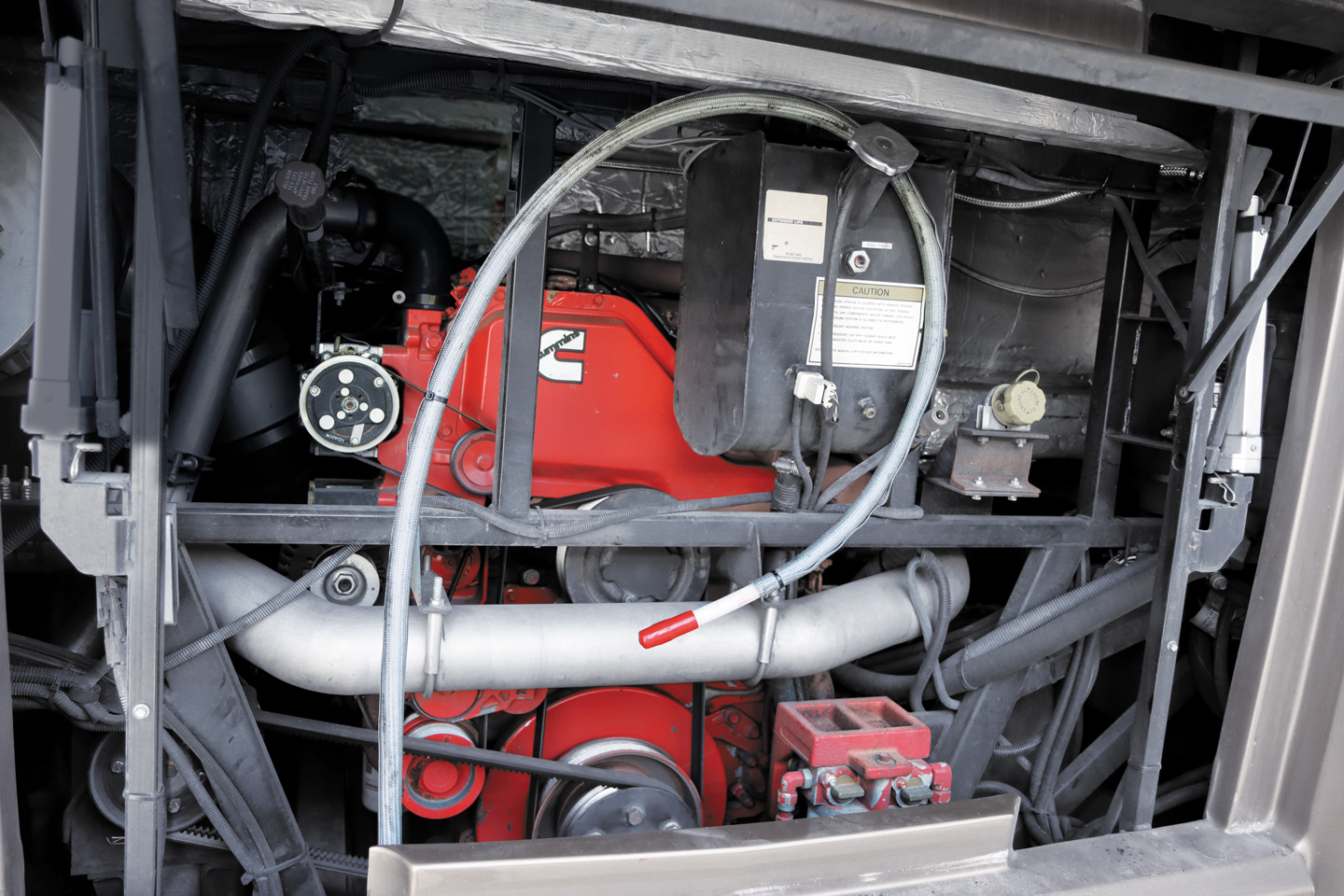
Proteng’s THIA stand-alone fire-suppression system for RVs is effective and easy to install.
By Mark Quasius, F333630
February 2022
Fire safety is always a hot topic — pun intended, but nevertheless true. Whenever an RV fire flares up, you have very little time to either extinguish it or flee before the RV becomes engulfed in flames. RVs are filled with fiberglass, wood, carpet, fabrics, and other materials that quickly become consumed once a fire starts. According to the National Fire Protection Association, about 20,000 RV fires occur every year, which is approximately one every 26 minutes, and a large percentage of those begin with the electrical system. Hot wiring and sparks easily ignite surrounding materials. Engine compartments and generators are common starting spots, although fires also can begin near electrical transfer switches, hydronic heating systems, breaker panels, and battery banks. Absorption-style RV refrigerators are another significant concern, especially as they age.
The key to extinguishing any fire is a quick response with an extinguishing agent. Manually applied systems often fail, though, because the fire is generally well established before the occupants — assuming they are even present — notice the fire. Automatic extinguishers, such as systems that utilize aqueous film forming foam (AFFF), eliminate that lag, but most are limited to the engine compartment or behind an absorption-style refrigerator.
I decided to upgrade my existing engine bay’s AFFF system after researching a new product available for RVs: Proteng’s THIA system. Proteng created this system by working with race cars, whose high-output engines create plenty of heat and the potential for fire, especially in a crash. Since then, the system has proven to be popular among owners and operators of boats, airplanes, buses, and other equipment, and more recently it was introduced for RVs.
THIA stands for Tube + Heat = Instant Action. The system consists of a polyamide tube (a synthetic polymer) that is filled with FM-200 fire retardant and sealed using hydraulically crimped brass ends. FM-200 is a state-of-the-art substance that eliminates many of the drawbacks of other retardants. Unlike dry chemical or foam retardants, it leaves no residue, is nontoxic, and is safe to use on equipment without causing any collateral damage.
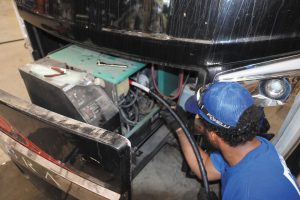
A 3-foot-long Proteng tube inserted into the Cummins Onan generator.
Previous automatic systems commonly utilized halon gas to extinguish the flames, but halon had its issues: It displaced oxygen from the air, was toxic, and had extremely high potential for ozone depletion. As such, production of halon ceased under the 1994 Clean Air Act, although it is still legal to use existing halon extinguishers. FM-200 is also a clean-agent gas, but it is not toxic, and rather than displacing oxygen, it functions by cooling the fire’s fuel to a temperature lower than its flash point. Keep in mind that three things are needed to maintain a fire — fuel, oxygen, and heat. Removing any one of these elements stops the fire.
With the Proteng system, tubes are placed in strategic locations throughout the RV. These tubes don’t require bulky valves, hoses, or wires, which makes them ideal as stand-alone units requiring minimal installation.
Each device is calculated to protect a volume of air space and custom fit for each area. They are available in two grades, standard and heavy duty. The tube chosen for installation in a particular area is based on the average ambient air temperature. The heavy-duty tubes are wrapped with a protective mesh shield for longevity, as they generally are placed in hard-to-access locations such as engine compartments and generator bays.
At rest, the FM-200 exists in a liquid form that is pressurized to 72 psi, but as the tube heats up, the pressure builds up. The pressure at which the system activates varies but averages around 300 psi. When the tube ruptures, it releases the expanding FM-200, which is expelled at 1.6 degrees Fahrenheit, thus rapidly cooling the fire’s fuel and extinguishing the flame. The tube will rupture at the hottest point on the tube, providing maximum fire suppression where it is needed the most.
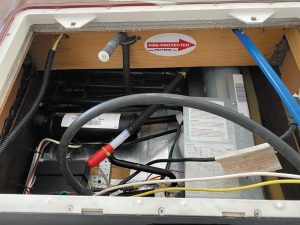
A Proteng unit was installed behind this absorption-style RV refrigerator to add another layer of protection.
We took our Entegra Cornerstone motorhome to National Indoor RV Centers in Lewisville, Texas, just outside of Dallas, to have the Proteng system installed. A tech began by checking the RV for any potential fire risks and measuring for the correct THIA tube length. After just a few minutes, he returned with a cart full of tubes. His first step was to remove the two breaker panels in the overhead cabinet on the left side of the cockpit. A small THIA tube was placed behind the breaker panels and fastened with high-heat cable ties.
Next, he went to the engine compartment. The tube chosen for this coach, with its 600-horsepower engine, was a heavy-duty version measuring 21 feet long. He began installing the tube in the chassis battery compartment. From there, it snaked past the DEF tank and crossed the bell housing to the driver’s side before turning back to the rear of the coach. It wrapped back along the curb side of the engine to the starter motor, creating a large loop that passed by every electrical component or potential fire risk. The long length provided a large enough supply of FM-200 to adequately extinguish even the largest fire in the area.
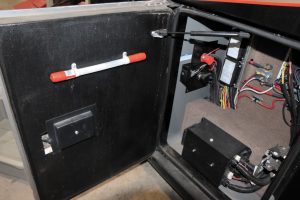
The installation technician added a small Proteng THIA tube to the front electrical compartment.
One other advantage to the polyamide tube is that it ruptures at the hottest point. Unlike a traditional system with one or two sprinkler heads, this gives the tube unlimited locations to dispense the FM-200 gas as needed rather than in a general spot at the top of the compartment.
Next, a small tube was installed at the front-most compartment, where a number of electrical components are located. Another tube was fitted in the bay that contains the eight house batteries. Normally, the tube would be mounted above the batteries, but this bay has two stacks of four batteries, and space is pretty tight; therefore, the tube was mounted in a U-shape to the inside of the bay door to cover both layers of batteries. Another tube was placed in the compartment where the electrical transfer switch is located. This is also where the Aqua-Hot water heater is installed, so a larger tube was mounted above those components.
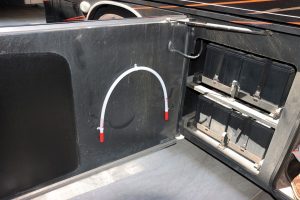
The motorhome’s eight house batteries were protected by a 3-foot-long THIA tube.
A pair of Magnum inverters are mounted on a tray between the frame rails, above the front pass-through storage bay, so another tube was inserted above the inverters to properly protect them. Lastly, a second heavy-duty tube was installed inside the generator bay.
That completed the system on our coach. We have a residential refrigerator that is tucked into a cavity in the slideout, so we did not equip that area with an extinguisher. However, if we had an absorption-style RV refrigerator, we would have placed a tube behind the fridge.
Proteng for RVs is sold exclusively through National Indoor RV Centers, and FMCA members receive a 10 percent discount on Proteng products. The systems are backed with a four-year warranty. Prices vary from $159 to $1,399 depending on the size of the system.
More Info
To learn more about the Proteng THIA fire-suppression system, visit www.fmca.com/proteng.