
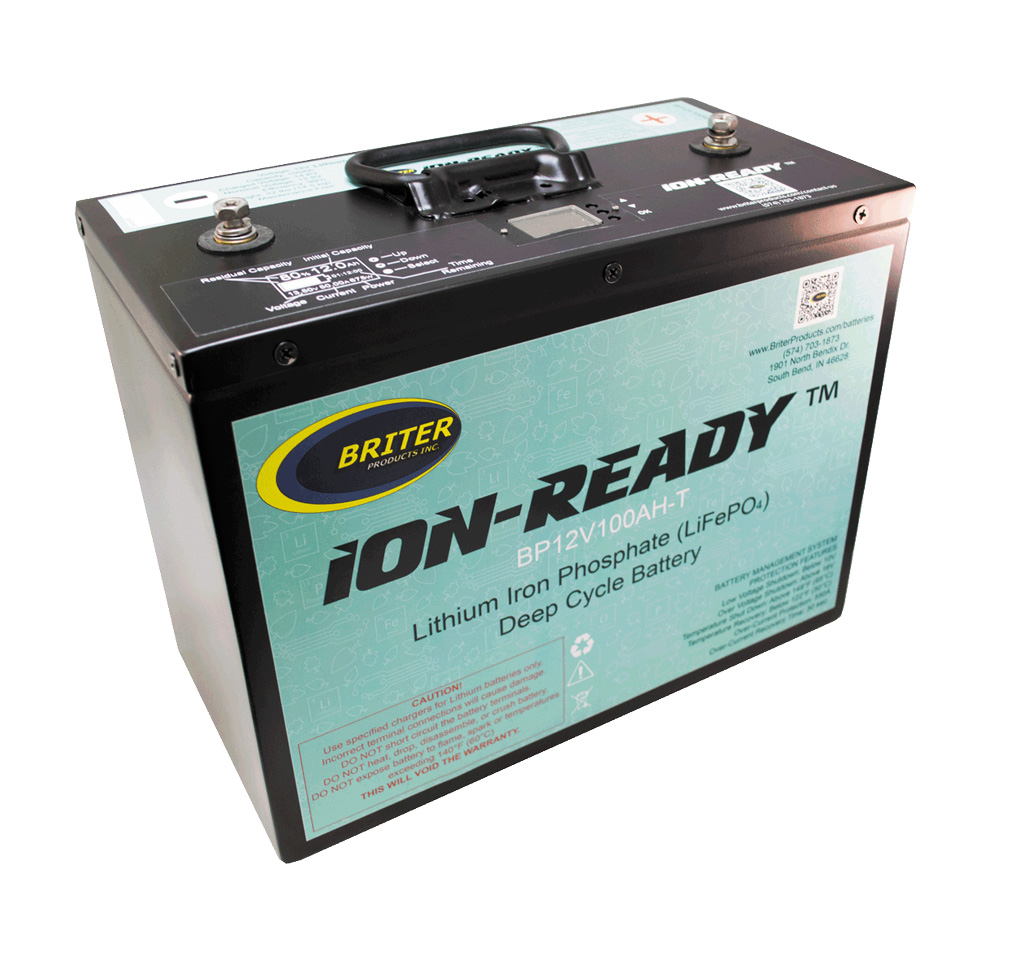
The basics of lithium-ion batteries and their properties.
By Steve Froese, F276276
May 2022
I am often asked about lithium batteries for RVs. In fact, that may be the question I’m asked most frequently. So, this month I decided to cover the basics about lithium. Some of the material may be known to the reader, while other information may be new.
Lithium batteries have been around for some time and are commonly used in cellular phones, laptop computers, and electric cars, among other things. But they are relatively new to the RV world. While lithium batteries generally are a good choice for RVs, most dealership sales and service staff are not properly informed about them. At the last dealership where I worked, I had so many questions from sales personnel that I created a lithium “cheat sheet” to aid them in informing interested customers. I also had to properly educate the service staff, as they knew virtually nothing about this important technology. The intent of this article is to educate RV owners so they’ll be less prone to misinformation.
A few different chemical compositions are used for lithium batteries, but the one most suitable for vehicle use is a type of lithium-ion battery known as lithium iron phosphate (LiFePO4) or lithium ferrous phosphate (LFP).
The first thing that happens to most people when introduced to lithium batteries is sticker shock. A high-quality lithium-iron-phosphate battery costs approximately $1,500, much more than the few hundred for a sealed lead-acid battery. However, this price difference is justified when considering the benefits of the technology and the overall cost of ownership over the many years these batteries can last.
Maintenance
Lithium-ion batteries are virtually maintenance-free. Since they do not use any free electrolyte, there is no need to monitor the fluid level or worry about corrosion.
Depth Of Discharge
Depth of discharge (DoD) refers to the percentage of a battery’s energy that has been depleted compared to its overall capacity. For example, a 100-amp-hour (Ah) battery that has been discharged down to 50 Ah has had a 50 percent DoD. Each discharge and charge event of a battery is referred to as a cycle. The normal maximum “working” DoD for a lead-acid deep-cycle battery is about 50 percent. Many RV owners are not aware that if a lead-acid deep-cycle battery is regularly discharged below 50 percent, its lifespan is significantly reduced. Another way to look at this is if you have a 100-Ah deep-cycle battery, you only have
50 Ah of useable capacity, because you cannot safely discharge the battery lower than that.
Conversely, many lithium-iron-phosphate batteries can be constantly discharged down to 20 percent without any detrimental effect on the battery (Briter Products’ Ion-Ready battery is an example of a lithium-iron-phosphate battery that can be discharged 100 percent). Therefore, to maintain the same battery capacity in your RV, you need only around half the number of lithum-iron-phosphate batteries versus lead-acid batteries. A common lead-acid battery configuration in an RV incorporates four 6-volt batteries. This equates to a total capacity of approximately 440 Ah. The most common RV lithium-ion battery size is the group 27 with 100 Ah, but manufacturers will specify what group size meets the need of your vehicle. With two LiFePO4 batteries installed, you have almost the same useable capacity as four lead-acid batteries would supply. The same ratio applies for larger coaches with an original configuration of six 6-volt batteries; generally, three lithium-ion-phosphate batteries will do the job.
Life Expectancy
Lithium-ion batteries last much longer than lead-acid batteries, potentially up to 20 years or more under normal use, compared to about five to seven years for lead-acid batteries. While lead acid batteries have an average life expectancy of up to about 800 cycles at 50 percent DoD, lithium-ion can last up to 10,000 cycles, or 5,000 cycles at 80 percent efficiency.
Weight
A lithium-ion battery usually weighs about half as much as a lead-acid battery. Since you generally can swap out two lead-acid batteries for one LiFePO4 battery and keep the same capacity, the total weight of your lithium-iron-phosphate battery bank will be about one-quarter the weight of an equivalent lead-acid system. Another bonus is that it will take up half the physical space in the RV.
Peukert Effect
Peukert’s law states that the added internal battery resistance caused by a load uses up the available energy faster at high loads versus low ones, reducing the advertised amp-hour rating of the battery as the load increases. Because the internal resistance of lithium batteries is very low, they are barely affected by Peukert’s law. Therefore, the discharge rate of a lithium-iron-phosphate battery is much more linear than that of their lead-acid counterparts. This results in a longer run time per Ah, especially at high loads. This is usually most relevant for inverter use.
For example, by applying Ohm’s law, we know that current draw on the battery side of an inverter is twice that of the AC side. So, if you want to run a microwave oven at 12 amps, the draw on the battery is 120 amps while the microwave is running. With lead-acid batteries, this would have a nonlinear effect on the rate of discharge, whereas it does not with lithium-ion batteries.
Charging Requirements
Due to the vastly different chemical composition of a LiFePO4 battery compared to lead acid, lithium batteries have different charging requirements. While the onboard controllers (battery management systems) on lithium batteries do allow regular charging systems to be used, it is not ideal and tends to reduce the lifespan of the battery bank and other electrical components. Therefore, lithium-compatible charging systems are highly recommended. Lithium-compatible charge modules are available for most makes and models of converter-chargers and are a swap-out replacement. I highly recommend purchasing one of these if you upgrade to lithium-iron-phosphate batteries.
The same considerations must be made for solar, inverter-chargers, and engine charging (in the case of motorhomes). For the first two scenarios, you must ensure that both the solar controller and the inverter-charger are lithium compatible and set to the correct battery type. Every charge source in the RV must support lithium batteries to maximize the lifespan of the LiFePO4 bank.
In terms of alternator charging, devices such as a DC/DC converter or solid-state battery isolation systems are required to isolate the engine and house batteries from the alternator and each other, protecting both banks from damage. The battery isolation system is like that used with lead-acid battery banks but must be lithium compatible; DC/DC converters are also a satisfactory solution.
If you decide to have lithium-iron-phosphate batteries installed in your RV, make sure you do not simply swap out the lead-acid batteries with lithium. Do your research on charging requirements and be sure to make the appropriate upgrades. Many dealerships are not yet fully educated in lithium technology, so if you are having a dealership do the work for you, ask the right questions and make sure all the correct additional components are added to the bill. Understand the components of your existing charging system so you know what elements, if any, are already lithium-ready. Many technicians are unaware of the specific alternator isolation requirements.
Temperature
Because of their chemistry, LiFePO4 batteries lose the ability to charge if their core temperature falls too far below freezing. The digital readout on Briter Products’ lithium batteries (a feature unique to Briter) results in heat generation from the consumption of energy. Therefore, the battery core temperature will always be higher than the ambient temperature. The exact temperature is manufacturer dependent, so be sure to check the specifications. Unless you enjoy winter RVing at extremely low temperatures, this should not be an issue. Even if the batteries stop charging due to low temperatures, some batteries will start functioning normally again once the core temperature increases.
These are the main factors to consider when thinking about upgrading to lithium-ion battery technology. While the initial outlay of money is much higher than for lead-acid batteries, the overall cost of ownership is lower considering that the batteries could last the lifetime of your RV and beyond. Many different RV lithium-iron-phosphate batteries are available on the market, and the variations in price are due to trade-off choices in battery materials and manufacturing processes. This makes each lithium battery very different, analogous to different cars or computer systems. How frequently you use the RV is a consideration when it comes to your battery bank investment.
To help FMCA members purchase quality products, FMCA has partnered with Briter Products to offer a discount to members. Briter is a leading manufacturer of lithium batteries and offers a full-replacement five-year warranty. For more information, visit www.fmca.com/briter-battery.