

New to RVing? Need a refresher or some tips? Learn the basics of driving, backing, parking, and how your RV works — inside and out — with one or more on-site learning opportunities offered by the FMCA Academy.
By Linneah Deighton, Associate Editor
June 2022
RVing breathes life and ease into your travels, but that can all change if something breaks down. If you travel as a family or in pairs, having more than one person who can take the wheel can be incredibly beneficial, if not vital, during emergencies. Even if you know your RV inside and out, a refresher course never hurts. When you replace parts or get an entirely new RV, the maintenance requirements may also change. You might even be completely new to RVing and need a push in the right direction. Attending FMCA’s RV Basics and RV Driving School courses will help you be prepared for the best and the worst.
These educational sessions, presented by the FMCA Academy, are designed to supply valuable RV information in a fun, relaxed setting. Learn how they can help you improve your own RV knowledge.
What’s RV Basics?
The RV Basics workshop, led by knowledgeable RV owners, acquaints you with your RV and the various systems inside it. These classes benefit RVers of all experience levels, as the courses cover new technology and equipment used in the latest RV models. Because technology is constantly evolving, the RV Basics instructors will give you pertinent information about your motorized or towable RV.
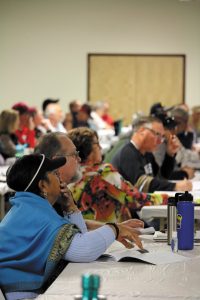
Spend time in a classroom environment with fellow RV Basics participants and learn about your vehicle’s key operational features.
How Is The Program Structured?
RV Basics classes span 21/2 days and begin just prior to the start of an FMCA international convention. Class participants receive two complimentary nights of camping; they are parked in the area they have chosen with their convention registration (electric, full generator, etc.) and remain there for the duration of the event. For those who choose to attend only the RV Basics workshop, free car parking is available.
Lessons are structured around 10 different subjects. These courses address common misconceptions, do’s and don’ts, and basic preliminary information that is important to fully understand an RV’s various functions. The program covers these topics:
*Electricity: This session outlines the basics of 120-volt-AC and 12-volt-DC systems, terms to know, electrical power sources, safety, hazard identification, maintenance, energy management, and surge protection.
*Propane: The propane system lesson covers topics that range from what it is and how it works in your RV to simple maintenance and safety.
*Plumbing: Water and liquids are fairly easy topics to understand, but this session discusses how RV plumbing systems operate and addresses common misconceptions.
*RV appliances: These are very different from home appliances, as some use electricity (AC and/or DC) and others use propane — or a combination. This class explains the key differences of RV air conditioners, refrigerators, furnaces, water heaters, stoves/ovens/microwaves, fireplaces, washers/dryers, vacuums, and dishwashers, as well as their proper usage.
*Tire safety and brakes: This discussion addresses RV weight terms, tire types and designations, braking types and components, operation, maintenance, and recommended procedures to maximize safety and tire longevity.
*Leveling, undercarriage, suspension, and control: This lesson allows you to get an up-close look at the different components and what issues can arise (and how to fix them).
*“Preflight” and personal safety: This discussion reviews what safety measures should be taken before heading out on the road in an RV.
*Introduction to towing: This session is intended to improve and expand upon your towing knowledge, including everything from flat towing to auxiliary braking systems. The discussion covers towing travel trailers and fifth-wheels, as well as various methods of towing a vehicle behind a motorhome.
*Boondocking: RVers receive information on how to camp “off grid,” or stay overnight independently at locations with limited or no resources.
*Fire safety: Toward the end of the course, you will review what you have learned and receive extensive information on how to incorporate fire safety into the mix, including the use of various alarms and fire extinguishers.
How Do I Benefit?
Besides learning the ins and outs of RV components and operation at an RV Basics workshop, you will be better equipped to handle emergencies and conduct your own basic maintenance. Perhaps one of the most important takeaways is how to spot hazardous situations and act accordingly. And an added bonus: You may even qualify for an insurance discount upon completing the RV Basics course.
What’s The RV Driving School?
Established in 1991, the RV Driving School has taught thousands of RVers how to handle their vehicles safely and confidently. In partnership with FMCA, the company offers its on-site RV driving and RV backing programs before the association’s international conventions.
The RV Driving School is owned by George W. Mayleben and his wife, Valerie, who were RV full-timers for 10 years. George is certified by the state of Minnesota as a Safe Driving Instructor, has an extensive background in automotive safety, and has been a lead presenter at trade shows in Washington, D.C. In addition to providing RV driving instruction, he has taught people how to drive and back up semi-trucks, buses, and dump trucks.
Lessons are tailored to each student’s specific needs and vehicle, so instructors assess expectations and alter the lesson accordingly. Aside from the on-site sessions scheduled in conjunction with FMCA conventions, the RV Driving School offers classes at various locations across the United States.
How Is The Program Structured?
The RV Driving Class and the RV Backing Class take place before an FMCA convention begins. Participants receive one or two days of general no-hookup parking; after completing the course(s), they are moved to their convention parking location.
These lessons include classroom learning as well as time spent driving your own personal vehicle with an instructor riding along in the passenger seat. The lessons are not considered to be technical in nature but deal with the more practical aspects of driving your vehicle safely. Students range from novices who have just purchased a motorhome or towable RV to full-time RVers who may have changed to a different vehicle.
The RV Driving Class takes place over two days: four hours of classroom instruction on day one and four hours of hands-on driving on day two. The RV Backing Class is held all on one day, with two hours of classroom training and 3.5 hours of individual backing practice.
The RV Driving Class covers these topics:
*Backing and parking.
*Mirror adjustment.
*Transmission and engine operation.
*Turns, swing outs, and curb climbing.
*Situational awareness and lane positioning.
*Proper road separation (forward, sides, and rear).
*Over-the-road driving.
*RV operational instruction.
*Learning your RV’s dimensions.
*RV tires (pressure and age).
Even if you feel comfortable driving your RV, backing it up is a different story. The RV Backing Class helps drivers learn how to back up their own RV and maneuver around various obstacles. These topics are covered:
Right-angle backing.
*Left-angle backing.
*90-degree backing.
*Parallel parking.
*Straight-line backing.
*Mirror adjustment and use.
*Turns, swing outs, and curb climbing.
*Situational awareness.
How Do I Benefit?
There are many benefits to attending RV Driving School classes. You will learn and improve upon your ability to drive, park, and maneuver your RV; become a more safe and confident driver; and be prepared for situations should your driving partner be unable to drive. In addition, you may qualify for an insurance discount upon completion of the course. Driving is a skill and, just like any other skill, has to be maintained and practiced. Don’t learn how to drive an RV during a crisis — learn before something bad happens.
More Info
The RV Basics and RV Driving/RV Backing classes will be presented before FMCA’s 105th International Convention and RV Expo in Lincoln, Nebraska. Each course is offered for an additional fee; registration in advance is required.
RV Basics
Offered August 21 to 23, 2022. Runs 9:00 a.m. to 4:00 p.m. on days 1 and 2; 9:00 a.m. to noon on day 3. Fee: $250 per individual; $400 per couple. www.fmca.com/academy
RV Driving Class
Two-day class times available from August 17 through August 22. Includes four hours of classroom training on day 1 and four hours of behind-the-wheel training on day 2. Fee: $495 per person. www.fmca.com/rv-driving-school
RV Backing Class
One-day class times available from August 18 through August 20. Includes two hours of classroom training and 3.5 hours of behind-the-wheel backing practice. Fee: $249 per couple. The pilot is taught to maneuver the RV; the copilot learns how to guide/direct the RV into the proper position. www.fmca.com/rv-driving-school