
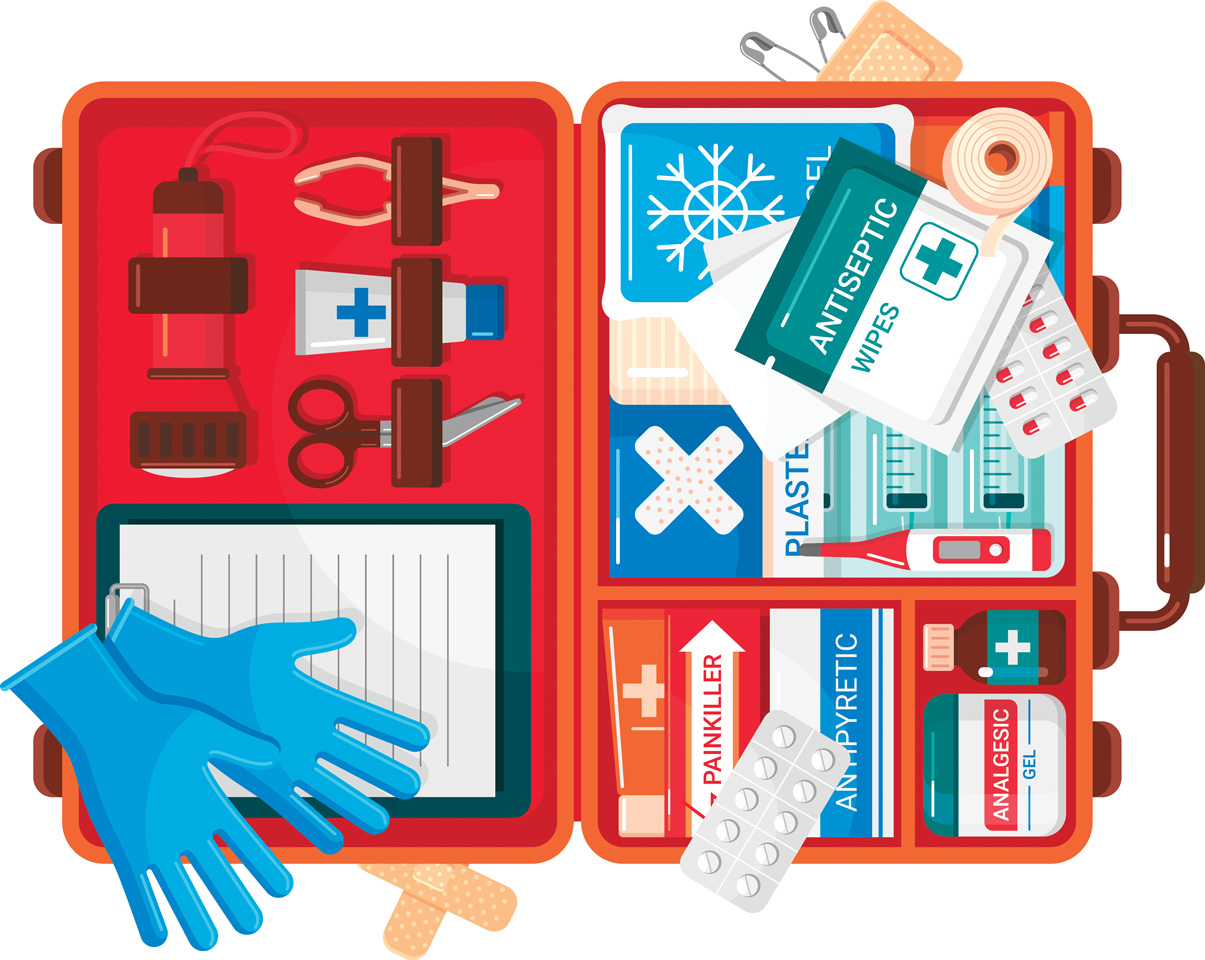
Tips for what to include so that you are prepared to render assistance during your RV travels.
By Randy Davis, F471978
October 2022
What should our RV first-aid kits contain? Well, the answer depends on what you want to be prepared for, what you are trained to use, your medical needs and those of your family, and your available space. A simple first-aid kit can contain a couple of handkerchiefs, a multitool, a small flashlight, a pair of nitrile gloves, and a breathing-barrier device like I carry all the time.
But your kit could range up to multiple bags of equipment and supplies, similar to the ones I carried on an ambulance for 40 years as an EMT/paramedic. Of course, you do not need to carry everything an ambulance does. However, the supplies you take along should offer protection for the first-aid provider, help you to keep a critical victim alive, serve to reduce further injury, and also include items for treating minor cuts and problems. You may also want to carry specific things for your or your family members’ special medical needs, such as an EpiPen, medications, or devices.

SAM (structural aluminum malleable) Splints immobilize injuries during emergencies.
Container
First of all, you will need a water-resistant, organized, easily carried, and readily identifiable container that is large enough to accommodate all your supplies. Commercially available first-aid kits usually come in containers that meet the above criteria. If you are making your own first-aid kit, you can use an old purse to keep everything in. I would recommend marking it on the outside with tape labeled “First Aid.” If you need more room, I suggest using an under-the-seat travel bag or a tackle box.
Personal Protection Equipment (PPE)
You need at least two pairs of nitrile gloves; extra-large should fit everyone. If you want more PPE options, include a pair of safety goggles and a surgical mask — the masks you used for the COVID-19 pandemic will work just fine for this. Also include a small container of hand sanitizer or alcohol for hygienic purposes.
Breathing Assistance
You can carry, as I do, a small disposable barrier device that attaches to a keychain so it’s readily available. Often called a CPR barrier, face shield, or CPR mask, this is a piece of plastic with a tube in it that helps to protect you if you need to perform mouth-to-mouth breathing for somebody.
I also carry a turkey baster in our first-aid kits. It can be used to suction and clear a patient’s airway of vomit or blood. If you have small children or infants, you can use a bulb syringe instead.
Bleeding Control
Sterile 4-inch-by-4-inch pads can be used as a dressing for wounds, but a sanitary napkin can be a good substitute for this. If the bleeding in an extremity is severe, you should use a commercially available tourniquet to help stop blood loss.
You still need bandage material to hold the dressing in place, such as 4-inch-wide gauze wrap. But if you are pressed for space, 4-inch elastic bandages will do the trick and do double duty for breaks and sprains. You can make bandages from clean sheets that you cut into triangles — these are also useful for breaks and sprains and can be used as a sling or a tourniquet. To hold dressings in place, or for breaks or sprains, 3-inch or 4-inch medical tape can be used.
Blood-stopping powder or gauze pads are available commercially for severe bleeding that does not respond to direct pressure or is in an area of the body where you cannot use a tourniquet.
Breaks And Sprains
Anything that will pad and reduce movement of a break or sprain is fair game for first aid. However, one item specific for breaks and sprains is a commercial product called a “SAM Splint.” It consists of flexible aluminum covered with foam. You can apply it to an extremity at any angle. You can also use a pillow to secure and cushion limbs that are suspected to be broken.
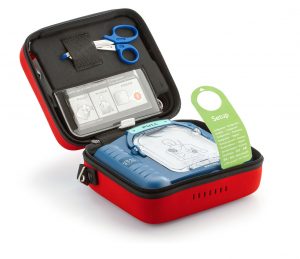
An automated external defibrillator (AED) is used to help victims of sudden cardiac arrest.
Heart Attacks
The best thing you can carry for heart attacks is low-dose aspirin (81 mg). Two to four tablets given to a patient exhibiting signs and symptoms of a heart attack can make a big difference in the outcome. However, do not give aspirin to patients exhibiting symptoms of a stroke. Not all strokes are caused by blood clots. Some are caused by ruptured blood vessels (hemorrhagic strokes), and for those patients, aspirin can increase bleeding and worsen the outcome.
See the “Breathing Assistance” section for devices that help with mouth-to-mouth breathing while performing CPR if the patient suffers from sudden cardiac arrest or a heart attack progresses to a cardiac arrest.
We always carry an automated external defibrillator (AED) for heart attack victims. However, they are very expensive. The AED, when used within the first few minutes of a cardiac arrest, can increase the chance of survival.
Burns
You can use the clean dressings mentioned in “Bleeding Control” to cover burns after putting clean, cool water on the area. A small bottle of normal saline solution — such as the kind you use to clean contact lenses or flush eyes with — can be carried in your first-aid kit to use on a burn. Saline is also useful for cleaning wounds or washing out debris to reduce infection.
A burn gel or spray containing lidocaine or benzocaine (it could be in an aloe-containing product) can be useful for treating pain from burns. However, DO NOT USE gels or sprays until you reduce the temperature of the burn with cool water. Never put an ointment or oil-based preparation on a burn, as grease will slow the heat release from the skin and potentially result in more damage.
Low Blood Sugar
Small packs of grape jelly can be given to those with suspected low blood sugar. If you or a family member is diabetic, you also can keep a tube of glucose handy — available over the counter from any pharmacy.
General Or Multiuse
Additional items for the first-aid kit may include adhesive bandages, butterfly bandages to help close a wound, scissors, tweezers, a flashlight, a first-aid book, alcohol wipes, moleskin (for foot blisters), or antibiotic cream (make sure the victim is not allergic to the antibiotic). Liquid bandage such as New-Skin brand can be used for blisters, cuts, and scrapes, not only on humans but also for the paws of your pet.
Remember to clearly mark your first-aid kit as well as the compartment where you keep it. Make sure everyone riding in your RV knows where the first-aid kit is located.
Randall J. (Randy) Davis is a nationally registered paramedic licensed in Missouri and Kentucky. His EMS career has spanned more than 40 years, first as an EMT in 1979, then as a paramedic beginning in 1981. He has presented numerous life-support classes for the American Heart Association, the American Academy of Pediatrics, and other nationally accredited education programs.