

This facility in Pocatello, Idaho, is dedicated to sharing the value of “clean” and raising awareness of how it impacts people, places, and the planet.
By Richard Bauman
October 2022
A Museum of Clean? What kind of place would that be and what would it display? Bars of soap, buckets of sudsy water, or tubs full of old mops? It turns out there’s more to the concept of clean than soaps and suds.
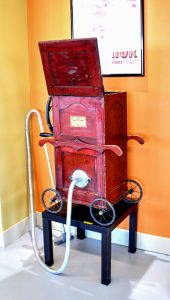
The museum features antiques like the Dustaw vacuum cleaner.
The Museum of Clean in Pocatello, Idaho, contains all sorts of historical machines and other items used for cleaning. The museum is more about the concept of cleanliness than it is about the physical objects, although they certainly help to convey the philosophy behind it. The facility promotes the history and value of clean – from clean floors and sheets to clean air and water.
Don Aslett is the founder of the museum. His fascination with the concept of clean started as a child, when he noted that his family home and their clothes, food, and yard were always fresh. He concluded that taking care of things seemed to make life better. He went on to start a cleaning business as a way of paying his way through college, and he built that business into a lifetime profession.
He opened the Museum of Clean in 2011 in a six-story warehouse. Refurbished to three floors and approximately 74,000 square feet, it displays 6,000 historical cleaning artifacts. It also boasts an art gallery and an indoor garden. The facility was designed to be low-maintenance and environmentally friendly. It cost $6 million to establish the museum and took six years to assemble its collections. The museum educates the public about the value of cleaning and how it can help people, their property, and the planet.
The museum is filled with fun, historical exhibits featuring successful cleaning products, not-so-successful cleaning products, and a few fictitious things. The artifacts range from simple brooms, buckets, rags, and mops all the way to washing machines and vacuum cleaners. No less than 500 different models of pre-electric vacuum cleaners are on display, making it perhaps the largest collection of vacuums in the world. Many of these vacuums were purchased with their original patents and brochures. The Museum of Clean currently has a Daniel Hess carpet sweeper from 1860, billed as the world’s first vacuum cleaner and the only one in existence.
The exhibits are not crammed together, even with many containing numerous items. Because the museum is spacious, you never feel crowded or the urge to hurry from one area to another to see these antiques.
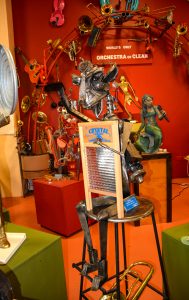
Artistic exhibits include the World’s Only Orchestra of Clean.
The largest stand-alone exhibit is the world’s first commercial vacuum cleaner. Patented in 1901 by Hubert Booth, a British engineer, “Puffing Billy” is a monstrous device that stands 10 feet tall, is painted red, and sports yellow wheels. It was meant to be horse-drawn and taken from house to house, and it looks like something you would expect to see in a circus parade. A framed banner atop the wagon proclaims: “Our Heritage: ‘World’s First Powered Vacuum.’” The rolled-up canvas cover on the wagon’s right side reveals the inner workings of the machine. For all its size and glitz, it is a simple device consisting of a motor, a vacuum pump, hoses, and a debris collector.
The World’s Only Orchestra of Clean, another exhibit, is a fun group of “musical instruments” made from cleaning devices. Captain Seedro Wooley, a sculpture made from cleaning products, “plays” the Crystal Cascade washboard. One sculptured musician holds trash-can lids as though they were cymbals. On the wall is a collection of instruments — some actual musical instruments plus creations from cleaning devices. And conducting this motley crew, squeegee in hand, is “The Maestro” sculpture. You can only wonder what sort of melodies this concert concoction might play.
The Vacuum Village is one of many vacuum cleaner displays depicting forerunners of the modern vacuum. Although many of them resemble modern models, they lack one thing: power cords. From 1875 to 1911, hand-pumped vacuums were typically used to suck dirt and dust from rugs.
In his book Is There Life After Housework? (one of the 40 books he has written about cleaning), Aslett recommends cleaning something the moment you notice it needs attention. If a bit of trash is lying about, pick it up and throw it away; do not wait until later. “Procrastination never makes things simpler (or easier),” Aslett says.
Though cleaning is typically a serious subject, humor still prevails in the museum. For example, there is a large, framed photo and spoof story about the Bavarian mop hound. The dog’s fur is long, white, and resembles strands of a floor mop. According to the accompanying text, “Bavarians were notoriously bad moppers” and thus began breeding mop hounds. The dog’s “instinctual propensity to slide its belly on the floor (in an aggressive back and forth motion) as well as rub its body against walls (in an unrelenting up and down motion) resulted in a very clean Bavarian, indeed.”
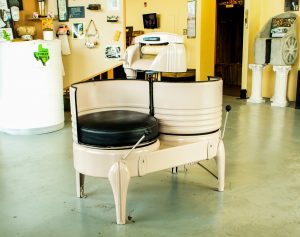
When a washing machine’s cleaning days are over, it might get turned into an interesting piece of furniture.
The duster display has a few dozen hand dusters, both modern and antiques. The accompanying sign states: “Dusters — typically rearrange dust rather than remove it.”
You will also come across a whimsical sign created by Dr. Corey Schou, an Idaho State University professor, about the museum’s home city: “No one comes to Pocatello unless lost on their way to Yellowstone or coming to the Museum of Clean.”
Some people have converted cleaning items into furniture oddities and works of art. There is an Easy Wash machine loveseat — its gleaming whitewash and rinse tub have been cut in half and positioned to face in opposite directions on the machine’s base, separated by the clothing wringer. Plush cushions provide comfortable seating.
Most people see household plants as decorations, but the Garden of Clean exhibit displays more than 20 plants that help clean the air of airborne toxins such as formaldehyde, xylene, and benzene — all of which are commonly found in household air.
Several interactive exhibits are geared toward children. Some of them teach kids about recycling, sweeping, how to clean their room, and how to make beds. Practical and fun! In addition to recycling, the museum offers information about eliminating and reducing waste.
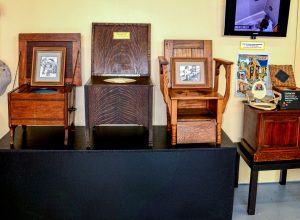
The “Toilet Zone” includes child-size toilet training chairs from the late 19th and early 20th centuries.
The Toilet Zone has dozens of examples of early commodes, including latrines used by the military and antique toilets for younger children. Displays include examples of portable toilets and accessories, too. One especially pristine and captivating model was used by Elisabeth of Bavaria, a princess in the mid-1800s. She traveled extensively, and her private privy always went with her. Contained in a wooden furniture-like chest is a porcelain bowl with a bucket and flushing mechanism.
Throughout the museum are framed copies of colored print ads for various cleaning products such as soaps, washing machines, and vacuum cleaners. For example, a full-page ad from the 1940s declares: “You’ll be happier with a Hoover.” Another praises the economical cleaning properties of the Old Dutch Cleanser, depicting the cleaning powder drifting from an upside-down can with the words, “A Little Goes A Long Way.”
The Museum of Clean is educational, instructional, interesting, and entertaining. After visiting this museum, we certainly came away with more knowledge, appreciation, and consideration for how cleanliness affects all aspects of our lives. I think my wife, Donna, best summed up the museum when she said, “It’s more like an encyclopedia of clean rather than a museum.”
The Museum of Clean is located at 711 S. 2nd Ave. in Pocatello, Idaho. It is well worth visiting when you are in the area or on the way to Yellowstone National Park. It has excellent access for individuals with disabilities and is open Tuesday through Saturday, from 10:00 a.m. to 5:00 p.m. Plenty of parking is available for cars and RVs. For additional information, call (208) 236-6906 or visit www.museumofclean.com.