
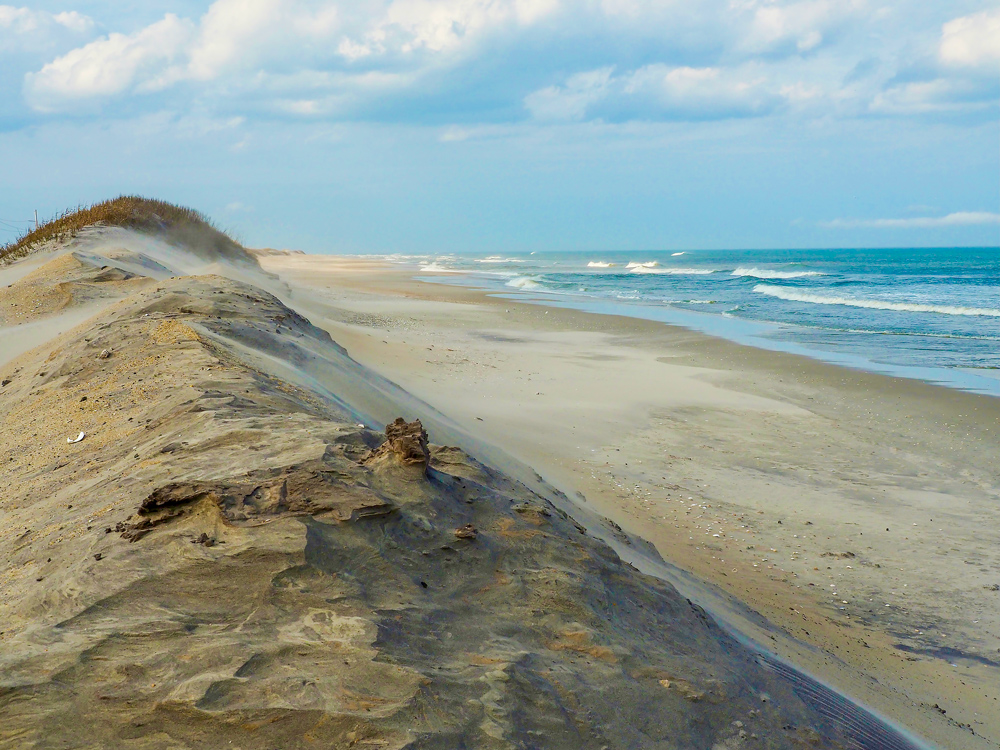
Where wind and water meet dunes of sand.
By Josephine Matyas, F468364
October 2022
The weather in the Outer Banks of North Carolina is nothing if not changeable. At sunrise, my cellphone rang to let me know that early-morning bird-watching along the coastline was off — too foggy — but we’d head inland to look for wildlife. Guides in this area know how to look out the window and pivot.
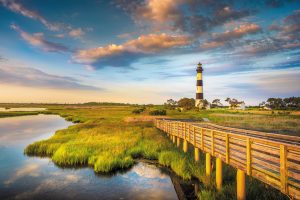
Bodie Island Lighthouse celebrates its 150th anniversary on October 1.Bodie Island Lighthouse celebrates its 150th anniversary on October 1.
The Outer Banks — affectionately abbreviated as OBX — is a 130-mile strip of barrier islands known for windswept dunes and beaches, tall lighthouses, the history of powered flight, shipwrecks, and spectacular birding. Coastal North Carolina Highway 12 is an RV-friendly route that allows for a more leisurely pace than zinging along the transport-packed interstate. A large part of the ribbon of narrow coastline is protected as Cape Hatteras National Seashore.
Wildlife Shelter
Jonathan Cooley, a professional birding guide with Native Birding Tours, keeps one eye on the day’s weather and knows the best spots to suit the conditions.
“I like showing people the diversity of wildlife here in the Outer Banks,” he said. “We’re right on the Atlantic Flyway, and more than 420 species of birds are found in this region. And birding is easily accessible — you can bird just about anywhere with minimal equipment.”
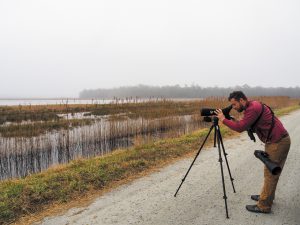
The diverse ecosystem allows many opportunities to view and photograph local wildlife, especially different bird species.
We moved slightly inland from the foggy shoreline and drove through Alligator River National Wildlife Refuge, known for its population of black bears and endangered red wolves. The refuge’s wetlands turned out to be a fantastic birding site as well. In the space of a few hours, I ticked dozens of species off my checklist, including tundra swan, Carolina chickadee, belted kingfisher, and American kestrel. In the shallow waterways crisscrossing the refuge, we spotted a sleek river otter and several species of aquatic turtles stretching toward slivers of sun as the clouds broke.
“A lot of birding is by ear,” Jonathan explained. “You can hear them calling before you see them.” He recommends using the Merlin Bird ID app, which is loaded with bird sounds and calls, identification photos, and a checklist of behaviors.
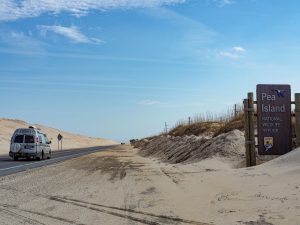
The sandy beaches of Pea Island National Wildlife Refuge are home to many endangered species.
Once the fog lifted, we drove back to the coastline for several hours of birding at Pea Island National Wildlife Refuge, located at almost exactly the halfway point on the Outer Banks. Before heading along the North Pond Wildlife Trail, we clambered to the top of the sand dunes and used the spotting scope to view waterfowl bobbing on the saltwater.
Jonathan was enthusiastic about the year-round birding possibilities. “Getting 50 to 60 species on any given day is doable, especially if you have a guide. The fall — especially October — is the best time for diversity, and you could spot 100 species in a single day. You have some waterfowl coming in, breeding birds are around, and migrating birds are passing through. This is a prime birding location.”
From professional fliers, I turned my attention to the first flight attempts by people.
The History Of Flight
The town of Kill Devil Hills is renowned as the spot where humans first achieved powered flight, thanks to the tinkering of those bicycle-building Wright brothers — Orville and Wilbur. Bicycling was all the rage at the turn of the 20th century, and the brothers sensed a connection between the two-wheeler and the potential for flight; it was all about turning and control.
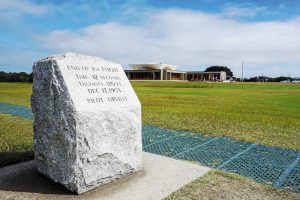
This marker commemorates the first successful airplane flight at the Wright Brothers National Memorial.
After several years of study and experimentation, the Wright brothers broke out the slide rule and calculated that if they made the wing just four inches longer, the aircraft would be stable. By tying in the warping of the wings with the use of a rudder, they designed something no one ever had: a power-driven, man-made machine that would fly.
A century ago, OBX was accessible only by boat and had very few residents. This guaranteed isolation and the reliable winds drew Orville and Wilbur Wright to fine-tune and test their homemade flying machines. On a blustery December 17 in 1903, the brothers changed history in mere seconds, cementing Kitty Hawk as the site of the first successful powered airplane flights. They piloted four successful flights, lasting from 12 seconds to 59 seconds. It’s a story beautifully told at the Wright Brothers National Memorial, located at the exact spot where the brothers took to the air.
The updated visitors center is filled with reproductions of the Wrights’ planes and the factors they studied to adjust lift, power, and control — and to turn dreams into reality. Outside, large stones pinpoint liftoffs and landings for each of the four flights. On the park grounds, the stone memorial at Big Kill Devil Hill marks the spot from which they launched the initial trials for their “soaring machines.”
A World Beneath The Surface
What could be more fascinating than peeking beneath the waves? To illustrate the watery side of the OBX environment, the North Carolina Aquarium at Roanoke Island has touch tanks with small rays and horseshoe crabs skittering about; enormous sea-water tanks filled with skates, rays, sharks, fish, and electric-looking jellyfish; and a sea turtle hospital.
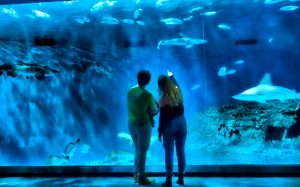
Visit the North Carolina Aquarium to see marine life up close.
In the colder months of winter and early spring, the Sea Turtle Assistance and Rehabilitation Center can house hundreds of cold-stunned reptiles. According to the aquarium’s sea turtle rehabilitation technician, “When the body temperature of a sea turtle hits 50 degrees, it’s considered to be cold stunned. There is a 24-hour hotline and special patrols who watch the beaches for turtles in distress. In this region, we see mainly greens and Kemp’s ridleys in the hospital. Over several weeks, we warm them up, and feed them before releasing them back into the ocean.”
Lighthouses And The Graveyard Of The Atlantic
The constant winds, the power of the ocean, and storm dynamics are ever so slowly shifting the sandy dunes westward. It’s a fact of life that local officials and road crews grapple with each season. Thousands of ships have sunk in the treacherous currents — often thanks to the shifting underwater sand bars, known as the Diamond Shoals. The collision of the Gulf Stream with the Labrador Current creates unpredictable weather patterns, and these storms — together with the changeable shoals — have sunk many ships in what has become known as the “Graveyard of the Atlantic.”
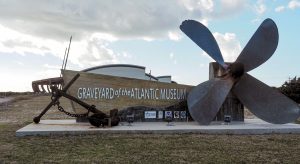
The Graveyard of the Atlantic Museum features items recovered from shipwrecks along the coast.
The Graveyard of the Atlantic Museum in Hatteras tells the tale of the more than 2,000 shipwrecks — including 90 vessels from World War II — that sank to the ocean floor along the barrier islands. The tricky shoals and navigational obstacles created an advantage for savvy pirates who sailed the coastline looking for ships loaded with goods that had run ashore.
It was this ghastly history that eventually led to the building of three lighthouses along the shoreline: Bodie, Hatteras, and Ocracoke. As a teenager, shipmate Alexander Hamilton made a frightening trip around pitch-black Cape Hatteras in stormy seas. Years later, after working his way up the job ladder to become the first Secretary of the Treasury for the United States, Hamilton made sure a lighthouse was built on that very spot. Today, at 198.49 feet from the bottom of the foundation to the top of the tower pinnacle, the Cape Hatteras Lighthouse is the tallest brick lighthouse in North America. Beach erosion and the ever-shifting coastline threatened the stability of the current lighthouse, and in 1999 it underwent “the move of the century.” Over the course of three weeks, it was lifted and moved 2,900 feet to safer ground.
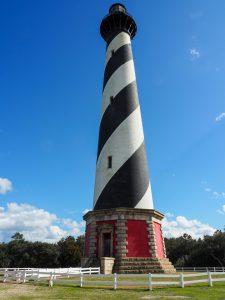
Cape Hatteras Lighthouse measures 198.49 feet high from the bottom of its foundation.
A climb to the top of the picturesque, black-and-white horizontal-striped Bodie Island Light Station gives a bird’s-eye view over the Cape Hatteras National Seashore, America’s first national seashore. The flashes of the Fresnel-lens light can be seen 19 miles away. The light was automated in 1932; prior to that, a team of lighthouse keepers carried barrels of oil up 10 flights of stairs, refueled the lantern, and lit the warning beacon.
The last of the trio of lighthouses is on quirky Ocracoke Island, accessible only by ferry (RV and vehicle combinations are limited to 65 feet; www.ncdot.gov/divisions/ferry). Ocracoke is a perfect snapshot of all that is remarkable about the Outer Banks: buying seafood right off the dock; grand sweeps of secluded beach; a great fishing hole called the Atlantic Ocean; unique artisan shops; friendly locals; and a jet-black nighttime sky that’s perfect for stargazing.
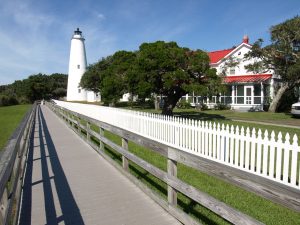
Ocracoke Lighthouse, built in 1823, is the oldest continuously in-service lighthouse in North Carolina.
Ocracoke’s historic lighthouse still flashes a warning to ships. Maritime history is thick here — this is the spot where the infamous pirate Blackbeard succumbed to no less than five bullet and 20 sword wounds before being beheaded. Legend has it that the pirate’s headless body swam seven times around the ship, but the locals doubt he could have managed more than two.
If You Go
The Outer Banks Visitors Bureau
(877) 629-4386
Camping
Spring and fall are the best times to visit — although September and October are at the tail end of hurricane season. Summertime has the largest crowds, so be sure to plan for campground reservations.
The Outer Banks are custom-made for RV travel, offering a wide selection of campgrounds with an array of amenities. My favorite was the dune-side Oregon Inlet Campground at Cape Hatteras National Seashore, with 107 sites (47 with electric hookups), running water, and showers throughout the property. A dump station is available for campers at a nearby marina. The maximum total vehicle length is 40 feet at all sites.
The Cape Hatteras/Outer Banks KOA Resort at Rodanthe has full-hookup, oceanfront sites and amenities such as a year-round pool, a hot tub, showers, a laundry, a dump station, and Wi-Fi.
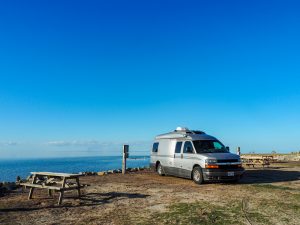
Frisco Woods Campground offers waterfront sites on Pamlico Sound.
To the south end of the Outer Banks at Pamlico Sound, Frisco Woods Campground has a wide range of sites, from primitive ones to pull-through and back-in sites with full hookups. The campground has propane service, Wi-Fi, showers, a laundry, a dump station, and a swimming pool.
Seafood Suggestions
Local seafood is a must. Look for local-catch fish filets and enormous, meaty shrimp at O’Neal’s Sea Harvest (a favorite with the locals). To eat in or take out, the shrimp burger at Sam & Omie’s is a Carolina favorite — more than a dozen lightly breaded and fried shrimp are piled on a bun and slathered with melted cheddar cheese, coleslaw, and tartar sauce. One of the oldest family restaurants on the barrier islands, this Nags Head legend began as a breakfast stop for early-morning fishermen.