
One of the best ways to deal with tire failure is to take the proper measures to prevent it from happening in the first place.
By Roger Marble, F399427
December 2022
As a retired tire engineer, I can offer suggestions that draw on my 40 years of experience in tire design, testing, evaluation, and quality assurance. This experience has been supplemented by 10 years of interaction with people in the RV community — answering questions, performing failed-tire inspections, reviewing tire issues, and even working as an expert witness on legal cases that involve tires and RV applications. Most of the information mentioned will apply to tires on RVs, vans, and pickup trucks. Some will be specific to travel trailers and fifth-wheel units, and it will be clearly identified.
If you ensure that your tires are properly inflated and not overloaded, you have done 90 percent or more of what you need to do to avoid problems. Take two simple steps: 1. Know the proper tire inflation pressure for your RV. 2. Ensure that your tires are always inflated to that level or higher.
First, some ground rules so we are all speaking a common language: tire inflation. Whenever we talk about inflation, we are referring to the psi (pounds per square inch) of a tire when it is “cold.” This does not mean it’s in some refrigerated garage or that special calculations need to be done to adjust the tire temperature to some “magic” laboratory standard. “Cold” is when the tire is the same temperature as the surrounding air, in the shade, and hasn’t been driven on or been in direct sunlight for the previous two to three hours. Some people check and adjust pressures in the morning, as this gives the tires plenty of time to match the ambient temperature. Tire covers, or even a piece of cardboard, can prevent the sun from warming up your tires.
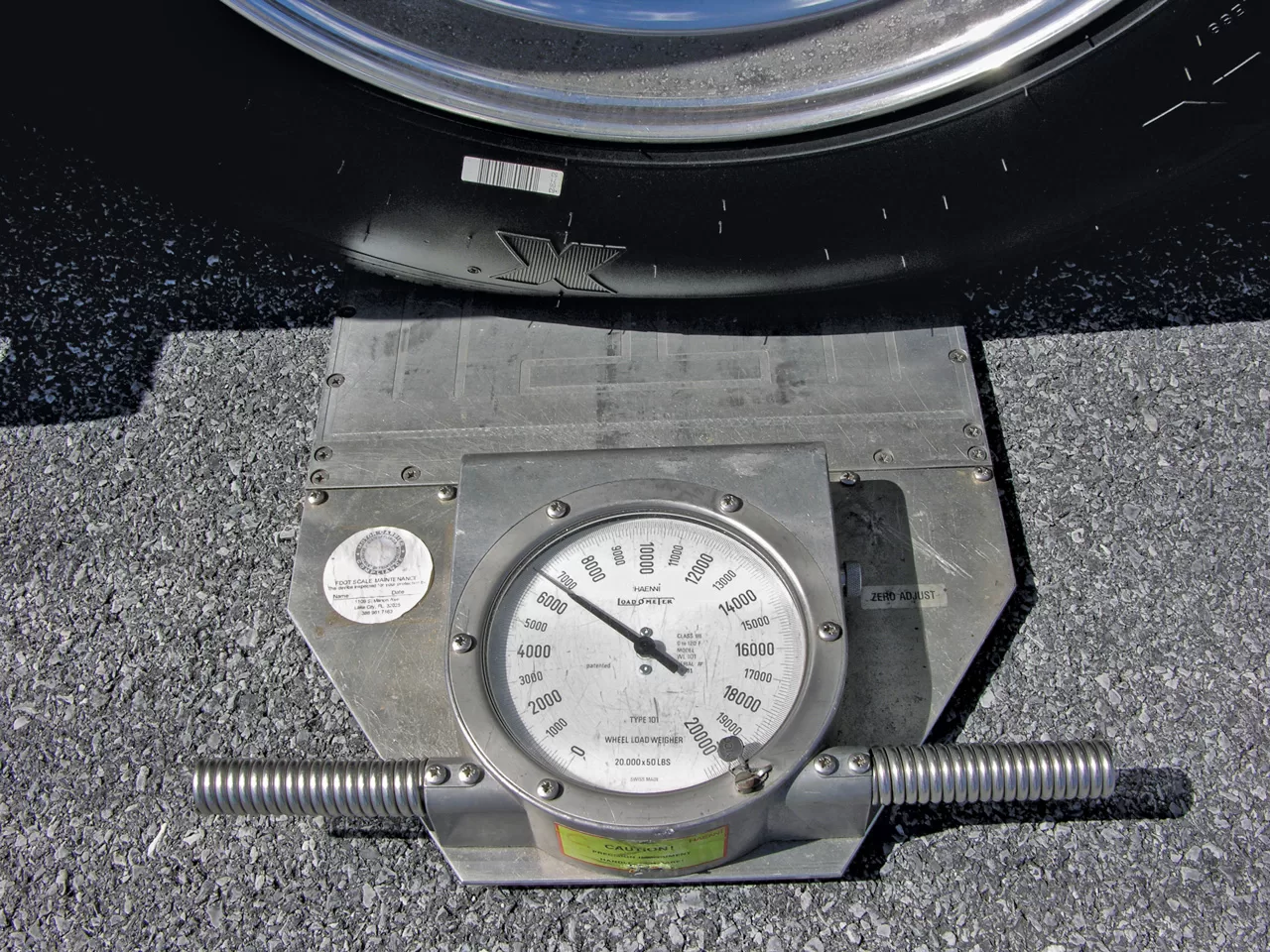
Talking about tire load refers to when the tires are loaded to the heaviest weight expected. When you are going to measure the tire load on a truck scale, the RV should contain all the clothes, tools, people, pets, and any extra stuff you carry around. This could include a full tank of fuel, propane, and water if that is how you travel. If you are getting your RV weighed by the RV Safety & Education Foundation (RVSEF) at an FMCA international convention or elsewhere, you will be asked about your loading. But if you are getting a reading from a truck stop scale or others, you will need to plan accordingly, or you may be misleading yourself regarding your tire loading.
Determining the proper minimum inflation for your RV tires takes a little effort, but you need only do it once unless the RV’s weight changes significantly. Examples of such changes could include adding a generator or residential refrigerator or refinishing the interior with granite countertops.
RVSEF offers RV weighing services by individual wheel position at FMCA international conventions and other events. Once the load being carried by each wheel position is known, RV owners are provided the minimum inflation pressure needed to carry that load. For more information, visit www.rvsafety.com.
If you will not be in a location where RVSEF weighs vehicles, another option is to do some research and find a large truck scale that has enough side clearance so that the tires from just one side of the RV can be positioned on the scale. Possibilities include moving and storage companies, feed stores, gravel pits, and truck stops. Be aware that in order to obtain an accurate weight reading, the RV should be as level as possible. At many truck stop scales, the adjacent area is sloped to allow water runoff and is not suited for single-side weighing. Here is a worksheet from Bridgestone that helps with the calculation: fifthwheelst.com/documents/BridgestoneWeighForm.pdf.
Each tire manufacturer provides load and inflation tables specific to their products to help you determine the minimum inflation pressure for your RV’s measured load. For links to the websites for many different brands of tires, visit my RV tire blog: www.rvtiresafety.net/2015/04/links-to-load-inflation-tables.html.
Simply look for your tire brand, find the table that has your tire size, and then look for the inflation level that carries your load or greater. You will probably notice that most companies have almost identical load capacity for the same size tire — this is the minimum cold inflation pressure for all the tires on that axle. Don’t be tempted to use a lower level of inflation if the numbers are close; always go up in inflation to equal or exceed the scale reading.
Let’s return for a moment to weighing the RV. If it will be a while before you can obtain individual wheel position weights, look for a truck stop scale where you can obtain the individual axle loads. Don’t assume that the weight is distributed equally on each side. To address side-to-side imbalance, I suggest you assume a weight split of 47 percent to 53 percent. Use the 53 percent number when consulting the load and inflation tables to arrive at a minimum cold inflation pressure for all tires on that axle. This should be only a short-term solution until you can obtain individual tire position loads.
All tires on each axle should be inflated to the same psi using the psi of the tire bearing the heaviest load on that axle. This ensures more uniform stopping and steering response.
We also need to address the advisability of having a margin of inflation over the minimum required to support the load. We all see day-to-day changes in the ambient temperature. If you are inflating your tires to the minimum required, you soon will discover that the pressure changes about 2 percent for every ambient temperature change of 10 degrees Fahrenheit. This can result in the need to add a few psi to maintain the minimum inflation. Some may ignore this minor pressure loss, but it means you are running the tires overloaded. While not much, it still can cause damage to the tire. Such damage is cumulative, and tires do not repair themselves. I recommend applying a margin of 10 percent above the minimum inflation to avoid the need to be “chasing” tire inflation as we travel. RV Industry Association (RVIA) changed its guidelines in 2017 and now requires a minimum margin of 10 percent extra load capacity over the gross axle weight rating (GAWR) on all RVs.
This is where I go a step further for trailers and fifth-wheels. These RVs suffer from special forces called “interply shear” when being towed. I covered this in a technical post at www.rvtiresafety.net/2018/09/warning-super-technical-post-tire.html. This is one of the contributors to shorter tire life for trailers versus motorhomes. One way to partially counteract the interply shear is with 15 percent higher inflation and/or lower loading. The FMCA online forums have a section on tires and weight, so you can find additional help by posting your questions and data there (https://community.fmca.com).

Advantage PressurePro’s FX tire pressure monitoring system works with smart devices to display real-time tire performance readings for motorhomes and towable RVs.
In recent years, a number of RV tire pressure monitoring systems (TPMS) have become available. Such systems monitor tire inflation as you’re driving and issue a warning if a tire is damaged by a nail or other object and loses air. I suggest finding a TPMS that has user-replaceable sensor batteries, a long-term warranty, and early warning of initial pressure loss. I also suggest selecting a system that can provide an early-morning pressure reading while you finish your coffee before you start driving. With this feature, you don’t have to use a digital pressure gauge to check the tires every day of travel. I suggest that you set the low-pressure warning level to 1 psi below the minimum found in the load tables. The high-pressure warning level can be 20 to 25 percent over your goal “cold” tire inflation level. The high temperature warning can be set at 158 to 165 degrees, as the low pressure that might alter the temperature will set off the warning before the temperature does. I have heard of some people getting a “high temperature” warning due to wheel bearing or brake problems.
So, there you have it. Have your RV weighed by individual wheel position when it’s fully loaded, or weigh it yourself. You can use a worksheet to calculate the actual loads on your tires, and then look up the recommended tire pressures. Check those pressures every travel day or monitor them with a TPMS. Follow this advice, and you’ll reduce your odds of experiencing a tire failure.