
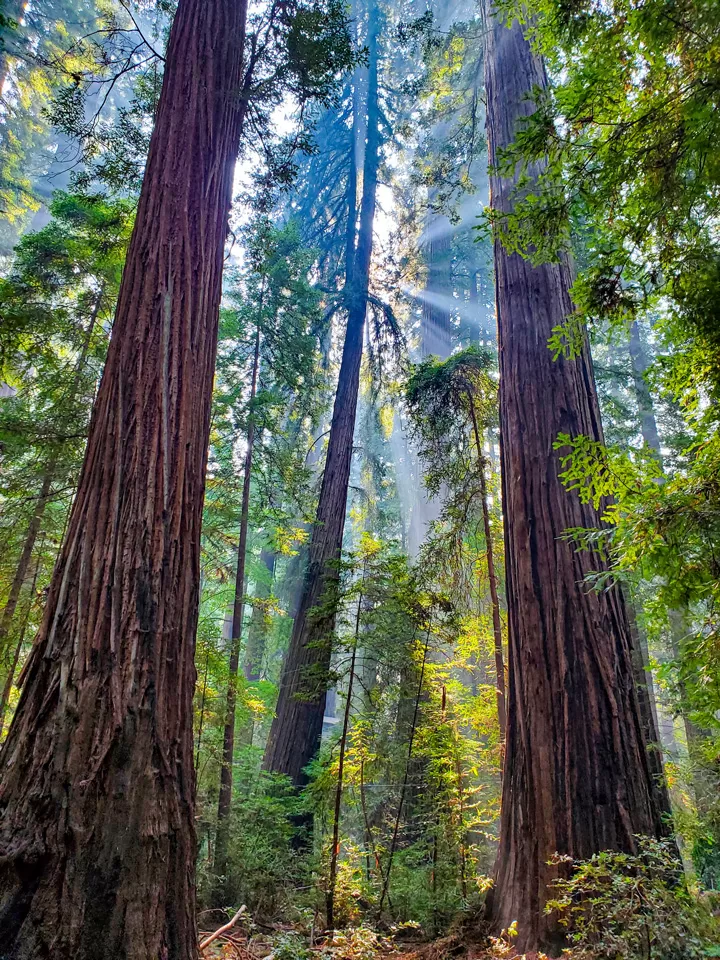
Richardson Grove State Park near Garberville, California, is home to a stand of stately old-growth coast redwood trees that reach skyward.
By Caryl Mallory, F473215
January 2023
When traveling along Highway 101 near Garberville, California, on the way to Eureka, 75 miles to the north, you suddenly find yourself slowing down on a narrow, two-lane roadway first built in 1915. Look around and you will discover that you are surrounded on both sides of the road by old-growth coast redwoods that tower more than 300 feet.
Highway 101 bisects Richardson Grove State Park seven miles south of Garberville. Established in 1922, this was one of California’s first redwood parks. It began with 120 acres and now encompasses 1,800. The park was named in honor of Friend Richardson, the 25th governor of California, who served from 1923 to 1927. It is believed that the park is home to the ninth-largest coast redwood tree in existence. The taller redwoods are easily struck by lightning, and so the coast redwood that claims the number-one spot keeps changing.
History
The first known inhabitants of the area were the Sinkyone people. They, and later the Wailaki, had villages at what is now Richardson Grove, with about five or six lodges they occupied during the winter months. The area served as a seasonal encampment for hunting, fishing, food gathering, and making beautiful baskets. The village name was pronounced “Kahs’-cho-so-ring-i-be.”
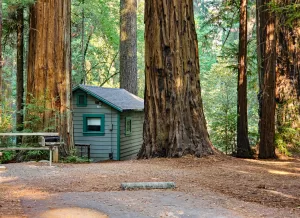
The author, once a park ranger, stayed in this cabin nestled in the redwoods.
The first recorded settler was a Kentuckian named Ruben Reed, who bought land there in the late 1860S. He married a widowed Wailaki woman, Nellie, whose former husband had drowned in the Eel River. Ruben’s brother and their widowed father homesteaded 160 acres that are now part of the park.
In the early 1900s, Canadian immigrants Henry and Ella Devoy purchased the Reeds’ land, which was much larger than the current park. The Devoys leased what is now park land — then called Henry Devoy Grove — to Ed Freeman, who built a cookhouse, some cabins, and platform tents. By 1920, Freeman also had constructed a store, a dining room, and about 15 newer cabins near the main lodge.
In 1922, the Save the Redwoods League became concerned about potential destruction of the trees by logging and highway construction and persuaded the state to acquire and preserve 120 acres of the redwood grove.
Between 1922 and 1932, Freeman, who played a role in naming the new park, operated it as a concession. The Civilian Conservation Corps (CCC) built a visitor center in 1931, followed by campgrounds, picnic facilities, trails, water systems, and rest rooms. Unfortunately, most of these facilities were damaged or destroyed in the floods of 1955 and 1964, when the South Fork of the Eel River overflowed. The original visitor center is all that remains.
The park has three campgrounds — Huckleberry, Madrone, and Oak Flat — with a total of approximately 160 campsites. The campsites, like those in many state and national parks, were built more for tent camping, but some can accommodate RVs. Some of the campsites are open only during the summer. Each site offers a picnic table, a food locker, and a fire ring. Coin-operated showers are available at nearby rest rooms. One large group camping site is available, as are cabins for rent.
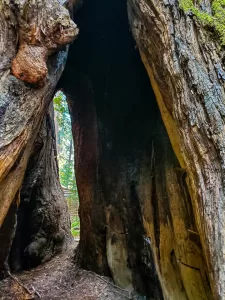
Visitors can walk through the “bat tree,” home to a colony of these winged creatures.
When I was a ranger at the park, I lived in one of those cabins and had people knocking at the door wanting to see their honeymoon spot. When I returned to visit in 2020, I discovered newly built cabins and noticed how much the trees had grown! Of course, it had been 41 years, and just one 40-year-old tree provides enough lumber to build a house. Think big!
Altogether, the park has nine miles of trails. Be sure to visit the east side of the highway, where you can walk in the midst of the tall and stately redwood grove and look for unusual trees. Among them is a “chandelier tree” with multiple trunks branching several feet above the ground. Walk through the “bat tree,” where a colony of Yuma myotis bats hang out. These small, brown bats feed on insects. This tree is near the gift shop and visitor center, which are open during the summer.
Speaking of bats, when I was a ranger, visitors found one lying on the ground in the middle of the day, and I was the one called to respond. As the creature looked at me — lying on its back and baring its teeth — a lady asked me whether I was going to give it artificial respiration! As I carefully slipped it into a plastic bag (all I had), I answered, “No,” and was praying that the bat didn’t bite through the bag, as it definitely was sick and maybe rabid!
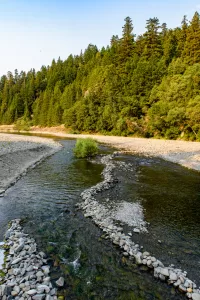
The South Fork of the Eel River is a great spot for catch-and-release fishing for salmon or steelhead in the winter.
To cool off during the summer, be sure to dip your toes into the South Fork of the Eel River, designated as a National Wild and Scenic River. In the winter, you can do some catch-and-release fishing for salmon or steelhead. A picnic area is close to the Eel River, and the trees are nearby.
One memory I have of the picnic area during my time as a ranger is of the maintenance crews complaining about those smart ravens! Each morning, the workers would find the garbage can lids off, and all the baby diapers removed from the cans. The ravens did this so they could get to the food scraps inside the cans. Diaper pickup was not a favorite chore for the crew!
So, if you’re motoring along Highway 101 and come to this stretch of highway within the majesty of Richardson Grove State Park, it might do your soul good to stop and truly appreciate the stunning coast redwoods and the beauty of the river that runs through them.
More Info
Richardson Grove State Park
1600 U.S. Highway 101, #8
Garberville, CA 95542-8700
(707) 247-3318
www.parks.ca.gov/?page_id=422