
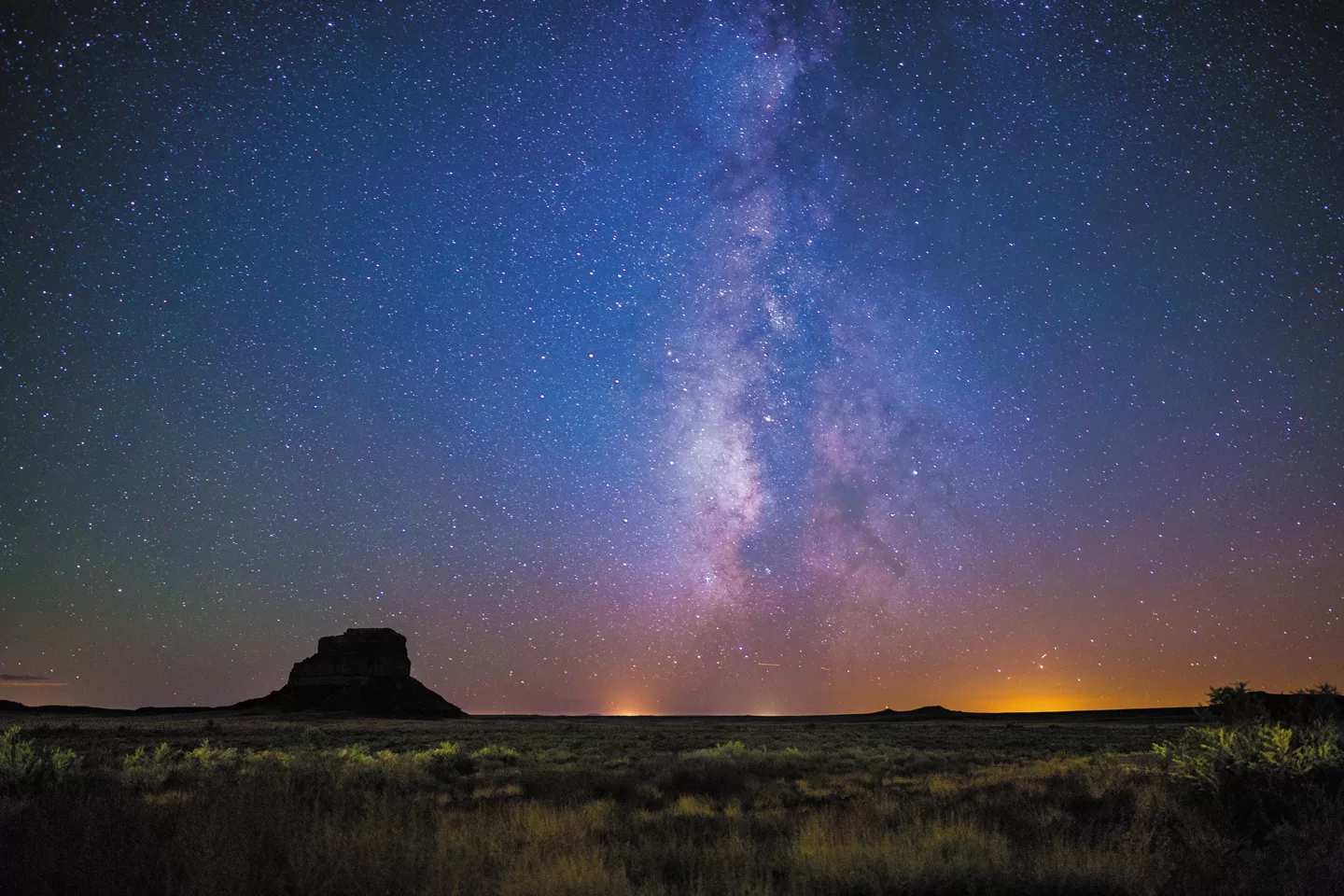
Celestial tourism has grown in popularity, and RVers have the ideal setup for visiting dark-sky locations and enjoying some awe-inspiring stargazing.
By Josephine Matyas, F468364
January 2023
There’s a boom of interest happening in celestial tourism — and what better way to experience a little stargazing than by RV, your “observatory on wheels.”
Over the years, we’ve piloted our Roadtrek Type B motorhome off the beaten path to some truly spectacular observation gems in Canada and the United States. Many are parklands recognized with “Dark Sky” status by several organizations dedicated to protecting the night skies, including the International Dark-Sky Association (www.darksky.org) and The Royal Astronomical Society of Canada (www.rasc.ca).
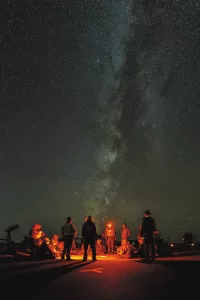
Rangers conduct a night program at Panorama Point in Arches National Park, Utah.
Finding an observation spot can be as simple as choosing a more out-of-the-way route, pulling over, and looking up to the heavens. One of our more memorable viewings was along Cedar Island Road, en route to the ferry between the North Carolina mainland and Ocracoke Island. We parked along the roadside, hopped out, and were treated to a jaw-dropping splash of stars dangling right to the horizon.
This growth in astronomy and celestial tourism has not gone unnoticed: Many parks and communities are adding interpretive programs and upgraded facilities with observation equipment. There’s no need to pack bulky telescopes in your RV; a pair of good-quality binoculars should do just fine. In many cases, the park programs have everything needed, from sky charts to telescopes to gigantic observatories. All you need to bring is curiosity and a sense of wonder.
Interested in some suggestions for viewing spots? Whittling down the list is challenging, but here are some standout places, along with a few additional stops to explore if you’ve got the time.
Southwestern/Western United States
The American Southwest/West is celebrated for its outstanding opportunities to observe the night skies. It all comes down to wide-open spaces, little light pollution, and higher elevations where the air is clean and dry.
Number one on our list is an out-of-the-way destination, Chaco Culture National Historical Park (www.nps.gov/chcu) in northwestern New Mexico. Thousands of years ago, all roads led to Chaco Canyon, the center of trade and ceremony for the Ancestral Pueblo peoples. These days, visitors negotiate a washboard road to experience the fragile and ancient cultural sites, and the arid landscape. The park’s rugged Gallo Campground is surrounded by petroglyphs, a cliff dwelling, and no-shade high-desert terrain. No firewood, fuel, food supplies, ice, or hookups are available in the park. The campground does have water and rest rooms with flush toilets, but no showers. A dump station is available. Most sites are open to RVs under 35 feet in length.
When the sun sets and things cool off, visitors head to the park’s Chaco Night Sky Program. This area is one of the darkest regions in North America — with so little urban light pollution that the sky is filled with quadruple the number of visible stars stretching right to the horizon. Every pinprick of light glimmers perfectly in the ink-black night. After being on hold during the pandemic, at press time programs were starting to be offered again, staff permitting. Visitors can check the status by calling the visitor center at (505) 786-7014.
The program provides an “archaeoastronomy” focus — the constancy of the night sky forges a special link between modern-day park visitors and the ancient Chacoans, who were close watchers of the sky and of the seasons. These observations provided them with the timing of ceremonies, planting, and harvesting — all central to their survival. The program combines interpretive talks, slide shows, and night-sky and solar observations. A permanent observatory, several telescopes, and advanced astronomy equipment are all part of the Night Sky Program. We found ourselves staying up through the wee hours to join the nightly stargazing ritual, and then showing up the next morning to participate in the tradition of sun watching through a solar telescope.
Kitt Peak National Observatory in Arizona houses the world’s largest collection of research telescopes.
The brilliant skies of Chaco Canyon are so unique that the park has designated the “night sky” a critical natural resource that must be protected, and in 2013 it was certified as an International Dark Sky Park by the International Dark-Sky Association.
More Southwest/West Astronomy Stops
Arches National Park, Utah. On a dark night, common binoculars may even reveal the rings of Saturn.
Big Bend National Park, Texas. The park claims the least light pollution of any other national park unit in the lower 48 states.
Chiricahua National Monument, Arizona. The best places to view the night sky are the Faraway Ranch and Echo Canyon parking lots.
Dead Horse Point State Park, Utah. Located on a high plateau, this park is one of the most active and accessible areas to stargaze in the Moab area.
Death Valley National Park, California. Get away from the mountains and choose a large, open area with some elevation to see the most stars.
Dinosaur National Monument, Colorado and Utah. Near the Split Mountain Campground, the park holds designated night-sky programs.
Gila National Forest, New Mexico. The Cosmic Campground International Dark Sky Sanctuary lies within the darkest category on the Clear Sky Chart light pollution map. The primitive campground is available on a first-come basis and offers four observation/telescope pads.
Great Basin National Park, Nevada. The park has a new Astronomy Amphitheater where rangers lead workshops about the night sky. The amphitheater is lit with red lights, which help to preserve night vision.
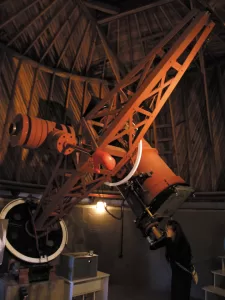
Lowell Observatory in Arizona houses the telescope used to discover Pluto in 1930.
Kitt Peak National Observatory, Arizona. Located 56 miles west of Tucson, the observatory houses the world’s largest collection of research telescopes. At press time, Kitt Peak was closed to the public because of the impact of a June 2022 fire that reached the site, so check www.visitkittpeak.org for updates before planning a visit.
Lowell Observatory, Arizona. Located in Flagstaff, the facility houses the original telescope used to discover Pluto in 1930.
Mesa Verde National Park, Colorado. Visitors can experience a night sky very similar to what the Ancestral Pueblo people saw a millennium ago.
Southeastern United States
RVers love the parks, oceanfront, and mountains of the southeastern states. Could there be anything more magical than settling down for the night under a blanket of stars and the dramatic streaks of meteors?
In our household, when we reminisce about memorable out-of-the-way travel, the hamlet of Edith, Georgia, often comes up. Not because there is anything spectacular about Edith — a community so small that no population number is listed — but because Edith marks the turnoff to a lonely drive into remote Stephen C. Foster State Park (www.gastateparks.org/stephencfoster), located deep in the wetlands of the Okefenokee National Wildlife Refuge.
One glance at the map and many travelers may second-guess whether the drive down a 17-mile, dead-end road is worth the effort. But if finding a truly dark nighttime sky surrounded by pristine nature is on your list, Stephen C. Foster State Park is the right place. During the daytime, the park operates guided boat tours through the dark waters of the moss-laced cypress swamp. Alligators, black bears, herons, and wood storks abound. Several easy boardwalk nature trails snake through the wet and dry lands of the park. The level campground has 65 sites with electric hookups that are well suited to motorhomes and travel trailers.
Isolated from communities, and in the middle of the Okefenokee Swamp, the park has minimal light pollution and boasts some of the darkest skies in the southeastern United States, which led to its certification as a Dark Sky Park by the International Dark-Sky Association. The park runs an astronomy program for visitors, using an 18-inch telescope. The best viewings depend on the weather and cloud cover; the cycles of the moon; and any other astronomical events, such as meteor showers.
More Southeast Astronomy Stops
Dr. Julian G. Bruce St. George Island State Park, Florida. Located on a barrier island on Florida’s Forgotten Coast, the park has a raised observation platform that provides a perfect perch for viewing the night sky.
Kissimmee Prairie Preserve State Park, Florida. Campers can reserve an astronomy pad site for ideal stargazing. Special restrictions exist for these sites. For instance, all lights must be red spectrum, and no campfires are allowed.
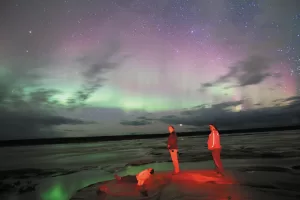
Wood Buffalo National Park in Canada’s Northwest Territories offers views of stars, constellations, and the northern lights.
Canada
From east to west, Canada is peppered with remote, wide-open spaces offering dark skies perfect for stargazing. With 13 dedicated dark-sky locations, the Parks Canada network protects more dark skies than any other agency or jurisdiction in the world. Included are Saskatchewan’s Grasslands National Park, the darkest Dark Sky Preserve in all of Canada. In August, expert astronomers take guests on nighttime sky “walks.” Also among them is the Northwest Territories’ Wood Buffalo National Park, the world’s largest Dark Sky Preserve. Here, campers enjoy a vast nighttime sky filled with constellations, especially during the Annual Dark Sky Festival in August.
Provincial parklands also have committed to protecting and preserving the natural nighttime environment.
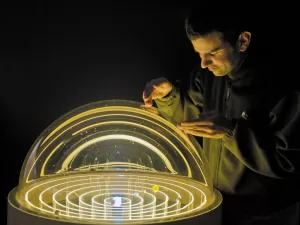
Mont-Mégantic Observatory in Quebec provides astronomy-related exhibits and programs.
In Quebec’s Eastern Townships —the rolling farmlands near the Vermont border described as a region of “New England charm with a Quebec flair” — the world’s first International Dark Sky Reserve, Mont-Mégantic, has long been welcoming visitors to experience astronomy nights. Centered on the Mont-Mégantic National Park and Observatory, the reserve offers outdoor telescopes, giant binoculars, and the telescope observatories (https://en.cieletoilemontMégantic.org/). The observatories at the park sit atop small mountains and are ringed by the dark forests of Quebec’s Eastern Townships. The mountaintop one is used mainly by researchers, but the smaller Popular Observatory is open year-round for public stargazing. There’s also an astronomy festival, and the annual Perseids meteor festival.
The park’s ASTROLab is an astronomy activity center with interactive displays about the his-tory of life, the universe, and the Earth. Daytime visitors can take guided tours of ASTROLab and the Mont-Mégantic Observatory.
Nearby, the campground at Mont-Mégantic National Park (part of the Quebec parks system) has a selection of sites, about half with water and/or electricity services. Dogs are not allowed in the campground.
People have been looking to the night sky with awe and wonder since the beginning of time. Today, thanks in part to efforts to preserve the view, RVers can visit places known for their stunning celestial displays.
More Canadian Astronomy Stops
Charleston Lake Provincial Park, Ontario. A great time to visit is for a stargazing party during the late-summer Perseids meteor showers.
Jasper National Park, Alberta. During October, as daylight begins to recede, the park holds the Annual Jasper Dark Sky Festival.
Kouchibouguac National Park, New Brunswick. The park recognizes that the constellations we see are the same ones that guided the Mi’kmaq as well as the Acadians.
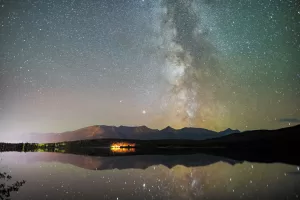
The Milky Way reflects on Pyramid Lake at Jasper National Park in Alberta.
Tips For A Successful Astronomy Experience
Plan your trip around a new moon or when the moon will not rise overnight, as moonlight greater than a thin crescent will drown out many objects in the night sky. The brightness of a full moon will fade out anything but the brightest stars and planets.
The summer night sky and winter night sky appear quite different. If you’re hoping to see a specific night-sky object — such as the Milky Way galaxy — research to find out the best seasons to view it.
Be respectful of others by limiting your use of light. To help your eyes adjust to the darkness for the best viewing experience, make sure all white lights are turned off. Full adjustment can take up to 30 minutes. Lights in the red spectrum help to preserve night vision.