
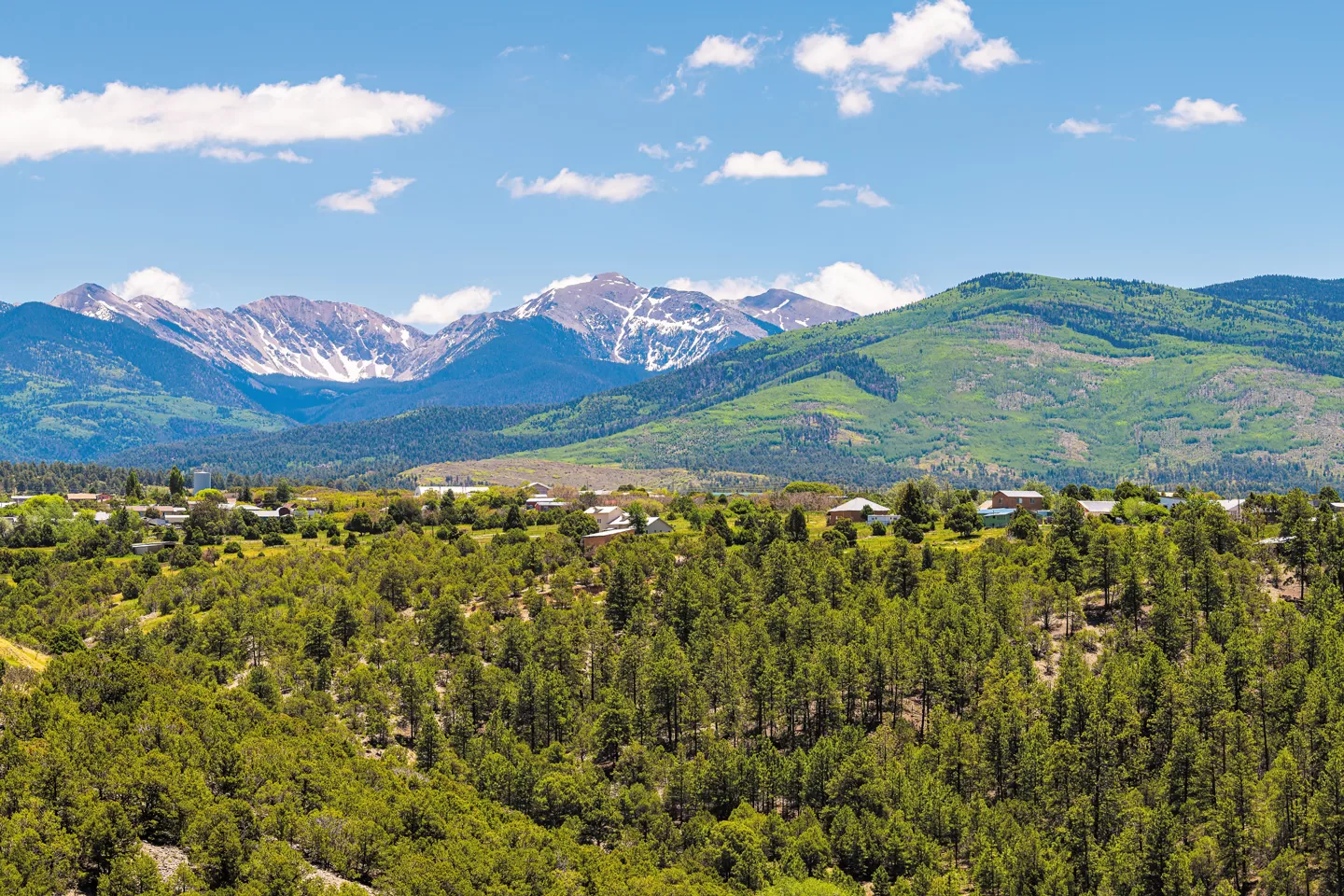
In northern New Mexico, Carson National Forest protects a bevy of natural treasures and invites visitors to enjoy the area year-round.
By Ann Bush, F516383
February 2023
Some of the finest mountain scenery in North America is found in New Mexico’s Carson National Forest. Spanning the northernmost part of the state, the forest contains 1.5 million acres of valleys, creeks, and meadows shadowed by mountains of mixed forest. The alpine tundra is home to abundant numbers of sheep, elk, mule deer, golden eagles, marmots, martens, picas, mountain lions, and black bears. It is one of five national forests in the state and helps give credence to the state’s nickname: the Land of Enchantment.
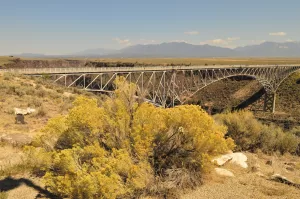
The Rio Grande Gorge Bridge towers over cliffs and the river coursing below it.
Today, less than 2 percent of New Mexico is protected as federally designated wilderness. In August 2021, Gov. Michelle Lujan Grisham signed an executive order that calls for at least 30 percent of New Mexico’s public lands to be protected by 2030.
Carson National Forest is a wonderful example of how strict land management policies improve the wild side of a state. Restrictions include limiting roads, promoting leave-no-trace rules, and fostering an economic philosophy of art over industry to create a unique ethnicity.
As part of the Sangre de Cristo Mountains, the forest attracts wildlife enthusiasts of all kinds. Yet, it never seems crowded. I found a silent wildness, a peaceful place that carefully allows outdoor activities without damaging natural beauty and is tastefully peppered with historic towns known for art galleries and delicious cuisine.
Before we explore some of its wilderness wonders, just what is a national forest?
National Forest Versus National Park
Many people are unsure of the differences between national parks and national forests. Over 85 million acres are specified as U.S. national park sites; more than 190 million acres are managed as national forests. As of today, the United States contains 423 units within the national park system and 154 national forests, occasionally crossing borders, confusing the public further.
National parks are managed by the National Park Service, which reports to the Department of the Interior. National forests are overseen by the U.S. Forest Service, which reports to the Department of Agriculture. This not only affects funding but also impacts how the lands are used.
Although both preserve land for public use, significant differences as to how and why result in varied goals. It is important to know where your RV is parked, because the rules change as to what you can do, and when.
A national park aims to maintain a pristine, undisturbed landscape for public use and enjoyment. To control damage or harm to the facility, activities are restricted, among them hunting, campfires, and backcountry camping. Preserving the beauty is of extreme importance, which might limit the number of visitors, especially during certain seasons. A national park will outline distinct boundaries where people and pets are allowed, especially dogs, which are not permitted on national park trails. Hunting, fishing, and boondocking are allowed in a national forest but not usually in a national park.
A national forest is managed mainly to protect wildlife and natural resources, ensuring their existence for future generations. Forest resources include timber, minerals, and water. The vast amount of land held and managed by the U.S. Forest Service is difficult and expensive to fence, and boundaries are unclear. Most roads are primitive, except in special areas carved out for camping and approved recreation. Dogs on a leash are allowed on trails; however, special restrictions exist in spring during mating season or when newborn animals are in the region.
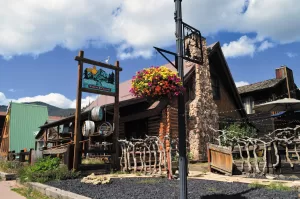
Red River offers eclectic shops and four seasons of outdoor recreation.
Fees and costs at these federal facilities depend on your time frame and travel plans. Many national parks charge an entrance fee, but national forests do not. Both charge campsite fees, but they vary in amount. A national forest requires permits for activities such as river rafting, overnight backpacking, or rock climbing.
Day passes are sometimes the best option for short trips. If you travel more frequently, an annual pass might be your best buy. The America The Beautiful National Parks and Federal Recreational Lands Pass is an interagency pass; it is honored nationwide at all U.S. Forest Service, National Park Service, Bureau of Land Management, Bureau of Reclamation, U.S. Fish & Wildlife Service, and U.S. Army Corps of Engineers parks. The annual fee is $80, and the pass also covers the cardholder’s accompanying passengers in a private noncommercial vehicle. A $20 Annual Senior Pass is available for U.S. citizens or permanent residents who are age 62 or older; a Lifetime Senior Pass costs $80. To purchase these passes online, go to www.store.usgs-gov.
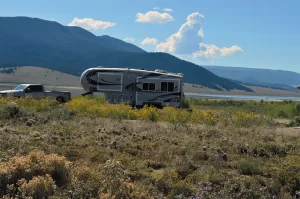
Eagle Nest Lake State Park has developed campsites in a serene setting.
Straight Versus Serpentine
Road conditions in national parks usually are visitor friendly, and RVs up to 35 feet or so generally have no difficulty negotiating the campgrounds or scenic byways. National forest roads range from straight four-lane highways to steep, narrow serpentine passes up mountains. In the latter category, including Wheeler Peak at 13,161 feet, Carson National Forest has a few scenic drives that may be challenging for large RVs. Before you go, review the scenic drives recommended by the USDA Forest Service at www.fs.usda.gov/recmain/carson/recreation (select Scenic Driving in the activity box).
One of the most pleasant routes I discovered while exploring Carson National Forest was the Enchanted Circle Scenic Byway. This approximately 90-mile route circles Taos and takes the visitor to some of the best places in this pristine forest.
*Rio Grande Gorge Bridge: As one of the highest bridges in the United States, this span stretches 1,280 feet across the steep Rio Grande Gorge, which was used by NASA for training Apollo astronauts in 1971. Go a few miles farther to the Wild Rivers Recreation Area, within the Rio Grande del Norte National Monument near Questa, for river rafting tours.
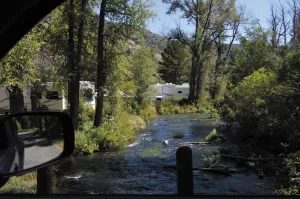
Cimarron Canyon State Park offers camping and fly fishing.
*Red River: This restored 1890s gold-mining town attracts fishermen, snowmobilers, and horseback riders. Shops stock cowboy boots, Western-style clothing, chainsaw carvings, fine art, jewelry, and many other items made in New Mexico.
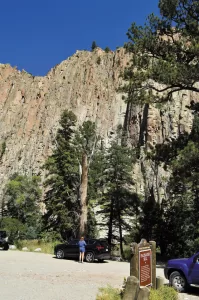
Cimarron Canyon State Park boasts the Palisades Sill formation.
*Eagle Nest Lake State Park: Nineteen miles from Red River near Bobcat Pass is Eagle Nest Lake, which is regularly stocked with trout and salmon, and also abounds with northern pike and yellow perch. Ice-fishing enthusiasts come here in winter.
*Cimarron Canyon State Park: Near Eagle Nest Lake, take a short detour off the Enchanted Circle Scenic Byway for more stunning campgrounds in a canyon with flowing clear creeks brimming with trout. Between the three Cimarron campgrounds one finds the Palisades Sill, a canyon of rugged beauty millions of years old.
*Vietnam Veterans Memorial State Park: On the eastern side of the Enchanted Circle, a lovely memorial pays tribute to those who served during the Vietnam War. Its museum has one of the finest collections of Vietnam War artifacts, including a helicopter. Be sure to take time to visit the chapel with its stunning stained glass.

The Vietnam Veterans Memorial in Angel Fire.
*Taos Ski Valley: In the center of Taos is one of the finest ski resorts south of the Rocky Mountains. This authentic Bavarian village was founded in 1955 by a Swiss-German immigrant and is still family-owned. Featuring the most of both worlds, the resort is open year-round. After winter snow season concludes, it transforms into a favorite summer place for hikers and bicyclists. The ice-skating rink becomes a ball toss game, snowboarding runs become foot trails, and most stores and restaurants are open on weekends. The lifts take people for scenic trips, which serious hikers walk down. Devouring German brats at the bottom of one ski run, I watched three guys load bicycles onto a lift chair and ride behind on the next chair for a crazy, wild trek back down. A large parking lot is designated for RVs. The road to the village from Taos is beautiful, with campgrounds along the way; they include the serene Fawn Lakes Campground (accommodates RVs under 32 feet), next to a babbling creek.
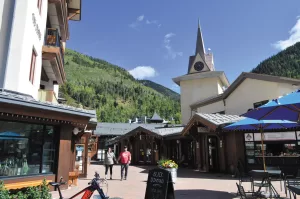
Taos Ski Valley exudes Bavarian charm year-round.
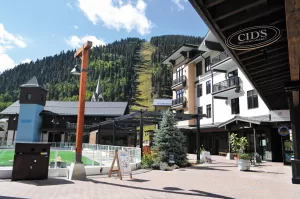
In warm weather, Taos Ski Valley visitors can hike, bike, and ride the lifts.
Chili Versus Chile
No matter where in New Mexico you go, food will be a highlight of the trip. However, don’t expect the Mexican cuisine served in most American restaurants. New Mexico’s distinctive flavors are a product of inhabitants’ history, beginning with the Native Americans teaching the Spanish conquerors about corn that could be found only in the Americas, as well as the very important chile.
New Mexicans are serious about their “chile,” the Spanish spelling of the word. Virtually everything on the menu will include chiles — either crammed inside a huge burrito, stuffed with cheese, simmered inside a stew, or sprinkled on enchiladas. Beware: Chiles come in different hotness levels, and no amount of water or beer will alleviate the sting. But don’t let this scare you away from trying them. Milk or a yummy sopaipilla drenched with honey usually works.
At the signing of the executive order pledging to conserve New Mexico land, Gov. Grisham noted, “We have set the wheels in motion to conserve our state’s incredible natural resources and ensure that New Mexico remains, forever, the Land of Enchantment.” Exploring Carson National Forest and its abundant natural treasures will make that commitment easier to understand.
More Info
Carson National Forest
208 Cruz Alta Road
Taos, NM 87571
(575) 758-6200
www.fs.usda.gov/carson